Staff Reports
Augusta, GA – After months of promises about accountability and structural change, the Charter Review Committee is discovering what Augusta residents already know: real reform is harder than writing strong words on paper.
For months, Augusta’s Charter Review Committee has spoken the language of reset. Members have talked about modernization, accountability, rebuilding trust, and fixing what hasn’t worked for decades. The rewrite of the city’s governing charter was framed as more than housekeeping. It was supposed to be structural. Transformational. Different.
But this week, the effort ran headfirst into a familiar reality: the boldest reform promises rarely survive contact with law, politics, or institutional inertia.
At the center of the unraveling is the ethics section — the very provision that was meant to signal that this time would be different.
The Tough Talk That Didn’t Hold
In December, the committee adopted ethics language that sounded decisive and, frankly, long overdue. The language suggested that elected officials who engaged in malfeasance would forfeit office. It contemplated barring violators from running again for years. It outlined employee consequences tied directly to ethics violations.
It read like accountability with teeth.
After years of public frustration, that tone mattered. It gave the impression that the charter rewrite was finally confronting the problem at its root — not just rearranging administrative procedures, but putting real guardrails around power.
This week, that language began to fall apart.
Retained counsel Andrew Plunkett advised the committee that key portions of the ethics section conflict with Georgia law. Removal of elected officials is governed by state statute. Eligibility to run for office is controlled by state election law. A local charter cannot independently create new removal mechanisms or impose new candidacy disqualifications.
In short: Augusta cannot remove its own elected officials simply because the charter says so.
The powerful language adopted in December — the “shall forfeit office” language — must now be rewritten into something far more restrained, likely “subject to removal under state law.”
That shift may sound procedural. It isn’t.
There is a world of difference between automatic consequences and referral into an already existing system that many voters distrust.
Reform That Reinforces the Status Quo
Once the legal boundaries are acknowledged, the ethics section begins to look less revolutionary and more declarative. The charter can define misconduct. It can create investigative pathways. It can require public reporting.
But it cannot create independent enforcement authority beyond what state law already provides.
The proposed three-year ineligibility period for violators? Likely gone. Georgia controls candidacy qualifications.
Automatic forfeiture language? Gone. State law controls removal.
Employee termination triggers? Must be harmonized with existing personnel policies, which means softened to avoid conflict.
What remains are provisions that clarify and formalize processes that already exist.
That may be good governance hygiene. But it is not structural change.
How Did We Get Here?
Georgia’s preemption over election law is not new. These limitations did not materialize overnight. They were always there.
So how did the committee adopt ethics language in December that now requires rescission and redrafting?
Was the legal review incomplete? Did the drafting process outrun careful vetting? Or was the rhetoric allowed to exceed what the law would ultimately permit?
Dr. Shawna Robinson has now placed the body on notice that she intends to move to rescind and re-adopt the ethics section at the next meeting. The supposed centerpiece of reform is officially back under construction.
For a project billed as overdue and deliberate, that is not a small moment.
The Familiar Pattern
This is where the skepticism sets in.
Augusta has heard versions of this story before. There is dysfunction. There is public frustration. There is a call for reform. There is a commission. There are meetings. There is strong language.
Then the language is narrowed. The enforcement is deferred. The authority is constrained. The structure remains largely intact.
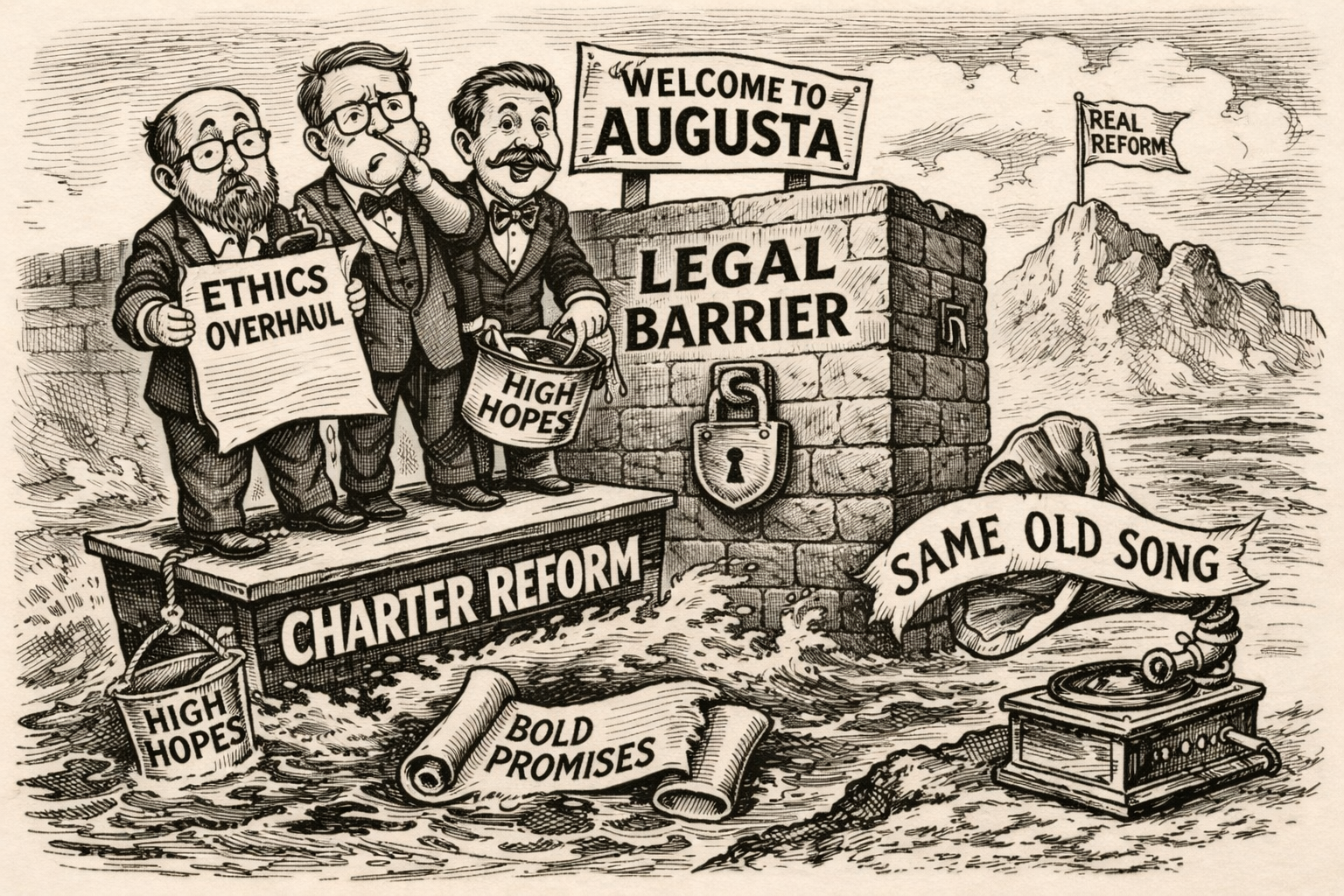
The tune changes slightly. The lyrics stay the same.
Meanwhile, the more technical parts of the charter rewrite — internal auditor funding language, procurement terminology, procedural clarifications — are moving forward smoothly. Those provisions passed with little controversy this week.
They matter. But they are managerial. They refine how things operate. They do not fundamentally alter who holds power or how that power can be taken away.
The ethics section was the only part that felt like a break from the past.
Now it must be rewritten to align with the very framework that already exists.
Town Halls in the Shadow of Revision
Three town halls are scheduled before final adoption. Some members describe them as informational briefings. Others argue they were intended to gather meaningful public feedback before final votes.
If the ethics language must now be softened to comply with state law, those meetings may become less about unveiling bold reform and more about explaining why bold reform wasn’t legally possible.
That is not the story voters were primed to hear.
Compounding the uncertainty, an attempt this week to formally commit to positioning the charter for a 2026 ballot failed for lack of support. Even the timeline appears less solid than previously suggested.
Reform or Rebranding?
None of this means the charter rewrite will accomplish nothing. It may produce a cleaner document. It may improve transparency around audits. It may streamline governance language.
But the fundamental enforcement mechanisms remain anchored in state law. The power structures remain largely intact. The removal processes remain what they have always been.
When the strongest ethics language must retreat from “shall forfeit” to “subject to removal,” the promise of transformation begins to sound more like recalibration.
For residents who have watched cycles of reform come and go, this feels familiar. Big expectations. Careful revisions. Limited change.
A new document may emerge from this process.
Whether a new reality does is another question entirely.
If this rewrite ultimately clarifies what was already true rather than changing what has long frustrated voters, Augusta may once again find itself listening to the same old song — just arranged in a slightly different key.
Other GCG Coverage of the Charter Reform Committee:
Augusta’s Charter Rewrite Rearranges the Furniture — But Does It Change the House?
The Quiet Rewrite of Power: Inside Augusta’s Charter Review as a Mayoral Election Approaches