AUGUSTA, Ga. —
Defense casts Tanya Tripp as a manipulated spouse while prosecutors lay out a timeline of deception, setting up a trial that may hinge on forensic certainty and proof of knowledge nearly nine years after Janelle Carwell’s disappearance.
After nearly nine years of delay, speculation, and public debate, the Tripp murder trial formally began Wednesday with opening statements that laid out two fundamentally different explanations for what happened to 16-year-old Janelle Carwell in April 2017.
From the outset, it was clear this case will not simply be about what happened — it will be about who knew what, when.
And perhaps more importantly: what can the State actually prove?
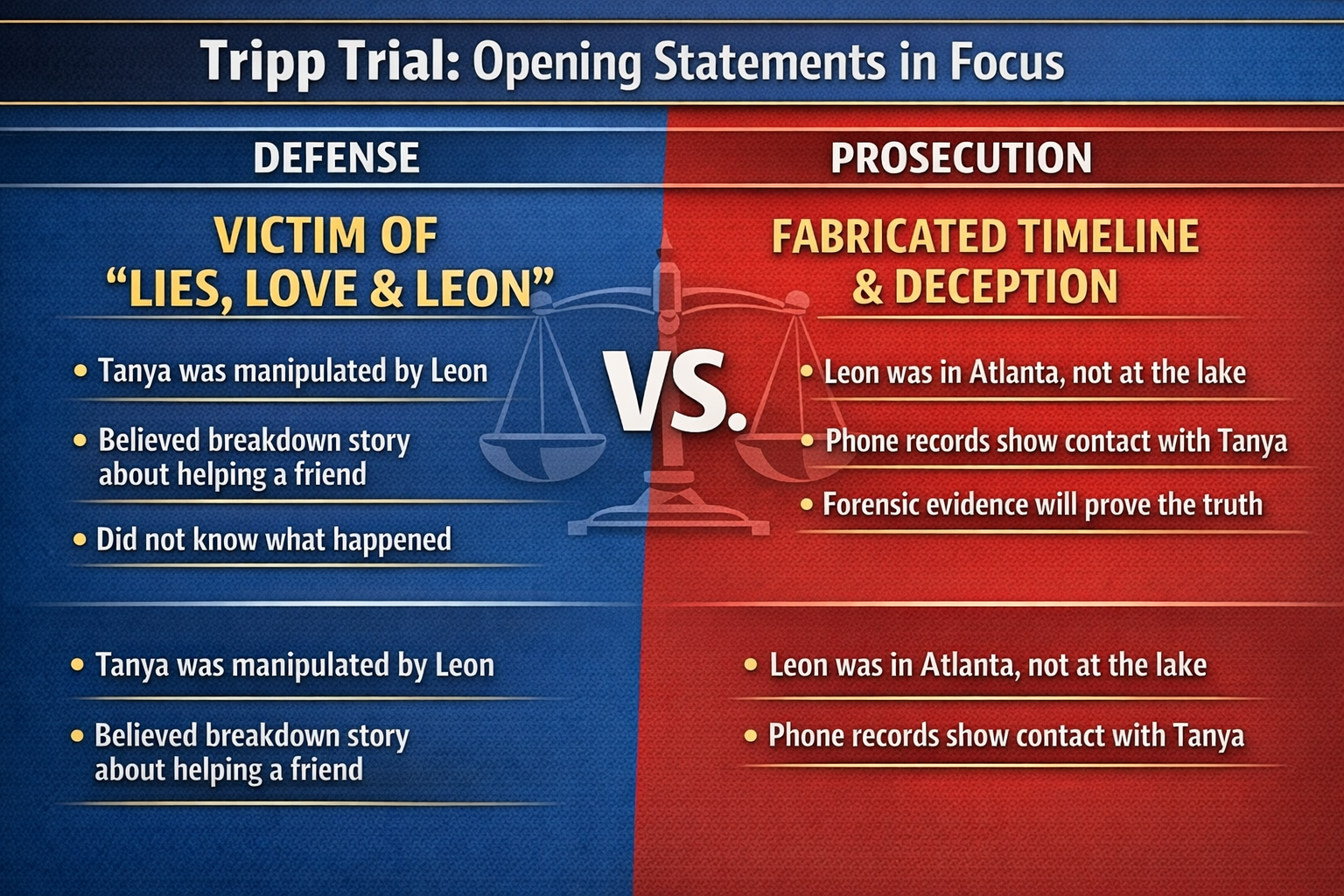
The Prosecution’s Counter: Timeline, Contact, and Deception
Where the defense leaned emotional and relational, prosecutors leaned chronological and forensic.
Their opening statement focused on what they describe as a fabricated timeline.
1. The Initial Report
The jury heard that Tanya reported Leon and Janelle missing on April 17. The initial explanation involved Leon allegedly going to Clarke’s Hill Lake.
The State signaled that the story changed — and that phone records would contradict aspects of it.
2. Atlanta and Phone Tracking
Prosecutors previewed evidence placing Leon in the Atlanta area — specifically DeKalb County — during the relevant period.
They also referenced documented contact between Leon and Tanya during that timeframe.
That contact is central. If the prosecution can show Tanya knew Leon’s true whereabouts — or knew the original explanation was false — it could significantly undermine the defense’s “manipulated spouse” narrative.
3. Physical and Forensic Evidence
The State previewed forensic testimony regarding recovered remains and expert analysis, including testimony from a forensic specialist.
The prosecution’s tone suggested confidence that scientific evidence will anchor their case. Unlike the defense, the State did not dwell heavily on emotional framing. Instead, prosecutors appeared to focus on consistency, corroboration, and contradiction.
Their case appears likely to rise or fall on whether jurors believe the timeline proves knowledge and participation.
Tanya Tripp’s Defense Strategy: Reframing Tanya Tripp
Defense attorneys for Tanya Tripp wasted no time establishing a theme designed to resonate emotionally and legally: Tanya is not a co-conspirator — she is a victim.
Tanya Tripp’s defense team came out swinging, setting up their theme, and described her as “the victim of lies, love, and Leon.”
Her defense strategy appears to rest on three pillars:
1. Leon as the Architect
According to the defense, the sequence began Easter weekend 2017 when Leon allegedly left the house claiming he needed to help a friend with a broken-down vehicle — and asked for Tanya’s phone and Janelle’s phone to navigate.
The defense told jurors that the friend never actually had a car problem.
They further highlighted the later discovery of Leon’s abandoned white truck — windows down, keys inside, and three shovels in the back, a detail clearly intended to suggest preparation and concealment by Leon alone.
The implicit message: if someone planned something, it was not Tanya.
2. Love as a Legal Blindfold
The defense did not run from Tanya’s past public statements defending Leon. Instead, they embraced them.
Jurors were reminded that she maintained contact with Leon and even publicly defended him during the investigation. The defense framed that not as guilt, but as emotional loyalty — arguing that she believed him even when logic might have suggested otherwise.
In effect, the defense is asking jurors to separate poor judgment from criminal intent.
That distinction is legally critical.
Under Georgia law, mere association or continued communication is not enough. The State must prove knowledge and participation beyond a reasonable doubt.
Which brings us to the defense’s third pillar.
3. “They Don’t Know”
Perhaps the most legally pointed argument from the defense was this: the State does not know exactly what happened.
Defense counsel emphasized the absence of clear answers about the “who, what, when, where, why, [and] how” death. The argument is strategic.
In cases built heavily on circumstantial evidence, creating doubt about timeline certainty can be enough to fracture juror confidence. The defense appears prepared to argue that even if Leon is responsible, that does not automatically make Tanya complicit.
They even referenced a recorded statement in which Leon allegedly said, “My wife ain’t got nothing to do with this.”
If admitted and credited, that statement could become a central flashpoint.
Opening statements are not evidence. They are roadmaps.
But the maps drawn Wednesday reveal a trial that may hinge less on what happened to Janelle — and more on whether Tanya knew.
Jurors will likely be asked to answer questions such as:
-
Did Tanya know Leon’s story about helping a friend was false?
-
Did she knowingly assist, conceal, or mislead?
-
Or was she emotionally dependent and manipulated?
-
Does post-disappearance contact prove complicity — or marital loyalty?
The defense is drawing a bright line between Leon and Tanya.
The prosecution appears intent on erasing it.
A Case Shaped by Time
Nearly nine years have passed since Janelle Carwell was reported missing.
Time cuts both ways in a case like this.
Memories fade. Witnesses move. Public narratives harden.
But physical evidence — if jurors find it credible — does not forget.
As testimony begins, this trial is likely to become a study in how jurors weigh emotional narrative against forensic detail, and whether loyalty can coexist with innocence.
The courtroom battle has begun.
The question now is whether the State can close the gap between suspicion and proof — or whether the defense can persuade twelve jurors that love, however misguided, is not a crime.
Prior GCG Coverage:
Jury Selection Continues in Janell Carwell Murder Trial; Opening Statements Likely Thursday