Aiman Tariq – Regional News Editor
Atlanta, GA –
Health care fraud is one of those crimes that can sound abstract until the numbers get attached to real programs.
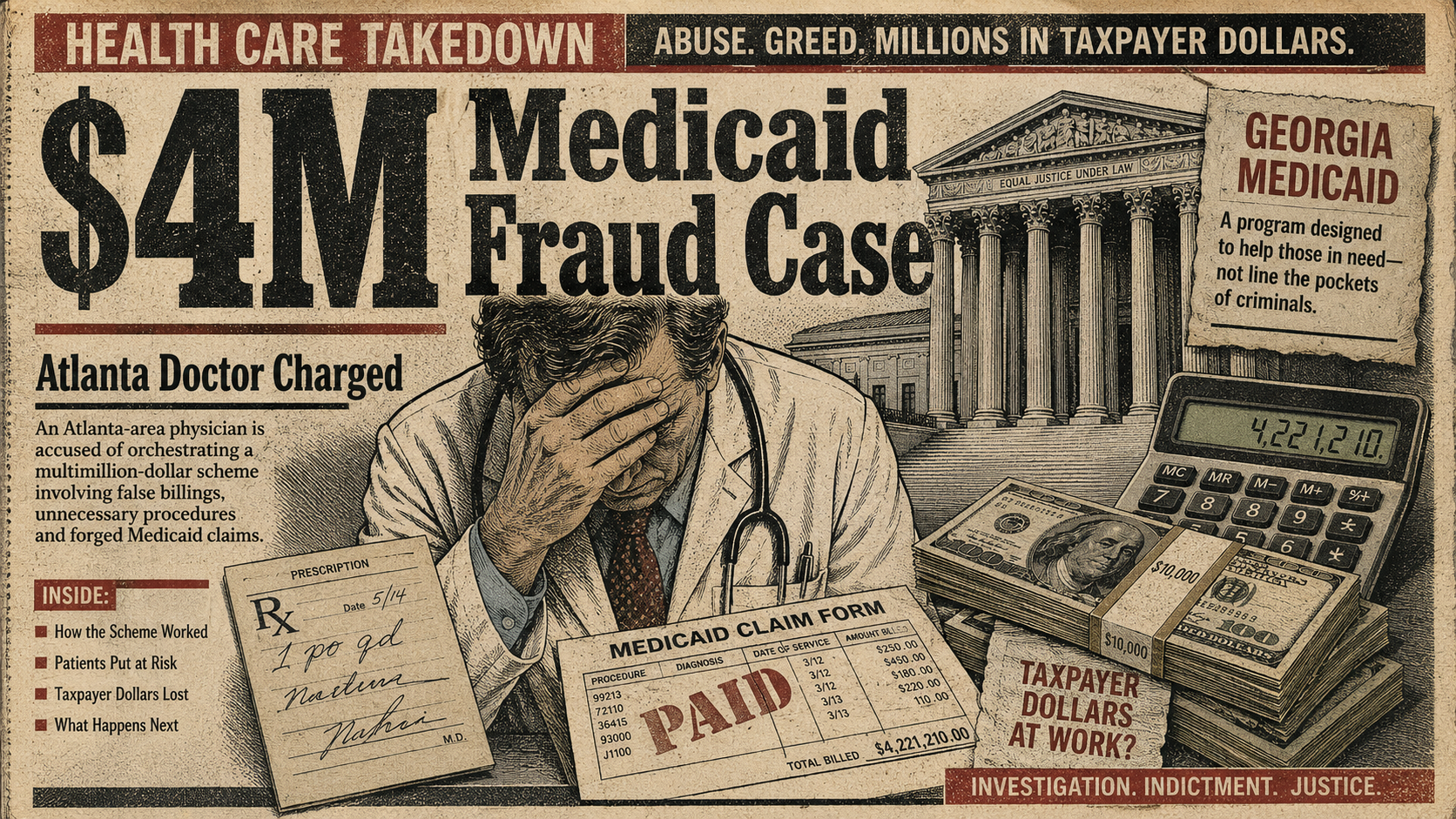
In Georgia, the latest case involves an Atlanta-area doctor accused of submitting more than $4 million in false claims to Georgia Medicaid over several years, according to the Georgia Attorney General’s Office. The indictment is part of a broader national health care fraud takedown that federal officials say involved hundreds of defendants and billions of dollars in alleged false claims.
That does not mean the Georgia case is proven. It means prosecutors have filed charges, and the government will now have to prove its allegations in court.
But the case does raise a familiar question for publicly funded health care: when a program is built to serve vulnerable patients, how much money can be lost before anyone outside the system notices?
Atlanta Physician Charged With Health Care Fraud
According to Attorney General Chris Carr’s office, Murrell Rutledge Jr., 52, of Atlanta, has been charged with 40 counts of health care fraud in a federal indictment.
Prosecutors allege Rutledge operated Rutledge Medical Associates in East Point and submitted thousands of false claims to Georgia Medicaid between January 2017 and February 2023.
The claims allegedly involved wound care services, allergy testing, and psychotherapy services that were never provided.
According to the attorney general’s office, the alleged false billings totaled more than $4 million. The state says Rutledge and his practice received millions of dollars in Medicaid payments to which they were not entitled.
Those remain allegations. Rutledge is presumed innocent unless and until proven guilty.
That distinction matters, especially in cases announced through law enforcement press releases. Charges are not convictions. A large dollar figure is not proof by itself. And the public version of an indictment is only the government’s side of the case.
What Prosecutors Say Happened?
The basic allegation is straightforward: Georgia Medicaid was billed for services prosecutors say patients did not receive.
According to the indictment summary released by the attorney general’s office, the alleged billing pattern continued over a six-year period. The services at issue included wound care, allergy testing, and psychotherapy — three categories where documentation, patient records, provider notes, and billing codes are likely to matter heavily if the case moves forward.
That is usually where health care fraud cases get more technical.
The question is not only whether a claim was submitted. It is whether the service was medically necessary, whether it was actually performed, whether the proper provider performed it, whether the claim was coded accurately, and whether the records support the payment.
Prosecutors say the claims were false.
The defense will have the opportunity to challenge that.
A Separate Settlement Involving Psychiatric Billing

Carr’s office also announced a separate civil settlement with Avant Interventional Psychiatry and Dr. Okah Anyokwu.
According to the attorney general’s office, the $375,000 settlement resolves allegations that Georgia Medicaid was billed for psychiatric services as if they had been performed by Anyokwu when some services had instead been provided by other Avant employees.
State officials said some of those employees were not licensed or enrolled as Medicaid providers.
The settlement does not include an admission of liability.
That is a key difference between the two Georgia matters announced this week. One is a criminal indictment, where prosecutors must prove the charges beyond a reasonable doubt. The other is a civil settlement, where the allegations were resolved without an admission that the parties did what the government alleged.
It is easy to collapse those categories into one headline. The legal difference matters.
Why Medicaid Fraud Cases Are Hard to Read?
Medicaid fraud cases can look simple from the outside: the government says someone billed for something they should not have billed for.
But the machinery underneath is complicated.
Medicaid involves patients, providers, state agencies, federal funding, care management organizations, billing contractors, medical records, and reimbursement rules that can vary by service type. A single claim may pass through multiple hands before payment is made.
That complexity can create room for mistakes. It can also create room for abuse.
That is why careful language matters. When officials say a provider submitted false claims, the correct phrasing is “according to prosecutors” or “according to the indictment.” That is not hesitation for its own sake. It is the difference between relaying an allegation and treating it as a proven fact.
As we have noted in broader coverage of how official numbers can be useful but incomplete, the first question is not only what a public agency says, but how the claim is documented and what process comes next. [ADD INTERNAL LINK HERE]
Part of a National Health Care Fraud Takedown
The Georgia cases were announced as part of the U.S. Department of Justice’s 2026 National Health Care Fraud Takedown.
According to the Justice Department, the nationwide effort resulted in charges against 455 defendants, including 90 doctors and other licensed medical professionals. Federal officials said the alleged schemes involved more than $6.5 billion in false claims.
The Justice Department also said the takedown involved cases in 56 federal districts and 45 states and territories, with 50 state Medicaid Fraud Control Units participating.
Those are large numbers. But here again, they should be read carefully.
A national takedown is a collection of cases, not one single scheme. Some cases involve Medicare. Some involve Medicaid. While some involve private insurers. Some involve alleged kickbacks, medically unnecessary services, false diagnoses, or billing for care that was never provided.
The common theme is alleged misuse of health care systems that rely heavily on documentation and trust.
The Georgia Medicaid Fraud Unit’s Role
Carr’s Medicaid Fraud and Patient Protection Division participated in the Rutledge indictment in coordination with the U.S. Attorney’s Office for the Northern District of Georgia.
According to Carr’s office, the case was investigated by the Georgia Attorney General’s Medicaid Fraud and Patient Protection Division, the U.S. Department of Health and Human Services Office of Inspector General, and the Georgia Department of Community Health.
The division also handled the Avant settlement after receiving information from a private citizen and one of Georgia’s care management organizations, according to the attorney general’s office.
That detail is worth noting. Fraud investigations do not always begin with a sweeping federal review. Sometimes they begin with a referral, an internal inconsistency, a patient complaint, a whistleblower-style tip, or a billing pattern that starts to look different from the rest of the system.
Carr’s office says that since he took office, the Medicaid Fraud and Patient Protection Division has secured more than 100 convictions involving Medicaid fraud and abuse, neglect, and exploitation of older adults. The office also says it has obtained more than $138 million in civil settlements and judgments tied to Medicaid fraud enforcement.
Those figures provide context, but they do not tell us whether any particular new case will succeed.
What the Public Should Watch Next?

The Rutledge case will now move through federal court.
The next steps may include an arraignment, motions, discovery, plea negotiations, or a trial schedule, depending on how the case proceeds. Prosecutors will have to show that the claims were false and that the defendant acted with the required intent under federal law.
That intent issue often matters in health care fraud cases.
Bad paperwork is not always criminal fraud. A billing error is not always an indictment-level offense. But prosecutors in cases like this typically argue that the volume, pattern, and nature of the claims show something more deliberate than mistake.
Whether that argument holds up will depend on the evidence.
The civil settlement involving Avant is different. That matter has already been resolved financially, according to the attorney general’s office, and the settlement contains no admission of liability.
Why It Matters for Patients and Taxpayers?
Medicaid is not just a line item in a state budget. It is a health care program for low-income residents, children, pregnant women, people with disabilities, and others who qualify for coverage.
That is why fraud allegations can carry a public cost beyond the dollar figure.
If money is paid for services that were not provided, the program loses resources. If services are billed under the wrong provider or without proper qualifications, patients may be left wondering who actually delivered their care. And if enforcement is too slow, bad billing patterns can continue for years.
At the same time, enforcement has to be careful. Health care providers are entitled to due process. Settlements are not admissions of wrongdoing. Indictments are allegations. And public trust depends not only on catching fraud, but on proving cases fairly.
That balance is the whole point.
The Bottom Line
An Atlanta-area doctor has been charged with 40 counts of health care fraud in a case involving more than $4 million in alleged false billings to Georgia Medicaid, according to the Georgia Attorney General’s Office.
The indictment alleges that Rutledge Medical Associates billed Medicaid for services that were never provided between 2017 and 2023. Prosecutors will have to prove those allegations in court.
Georgia also announced a $375,000 civil settlement with Avant Interventional Psychiatry and Dr. Okah Anyokwu over alleged Medicaid billing issues. That settlement does not include an admission of liability.
Both Georgia matters were announced as part of a national health care fraud takedown that federal officials say involved 455 defendants and more than $6.5 billion in alleged false claims.
The simplest version is that Georgia is part of a national push against health care fraud.
The more careful version is that one criminal case now has to be proven, one civil case has been settled without admitted liability, and the larger question remains how well publicly funded health care programs can detect billing problems before the numbers reach the millions.