Aiman Tariq – Regional News Editor
Atlanta, GA –
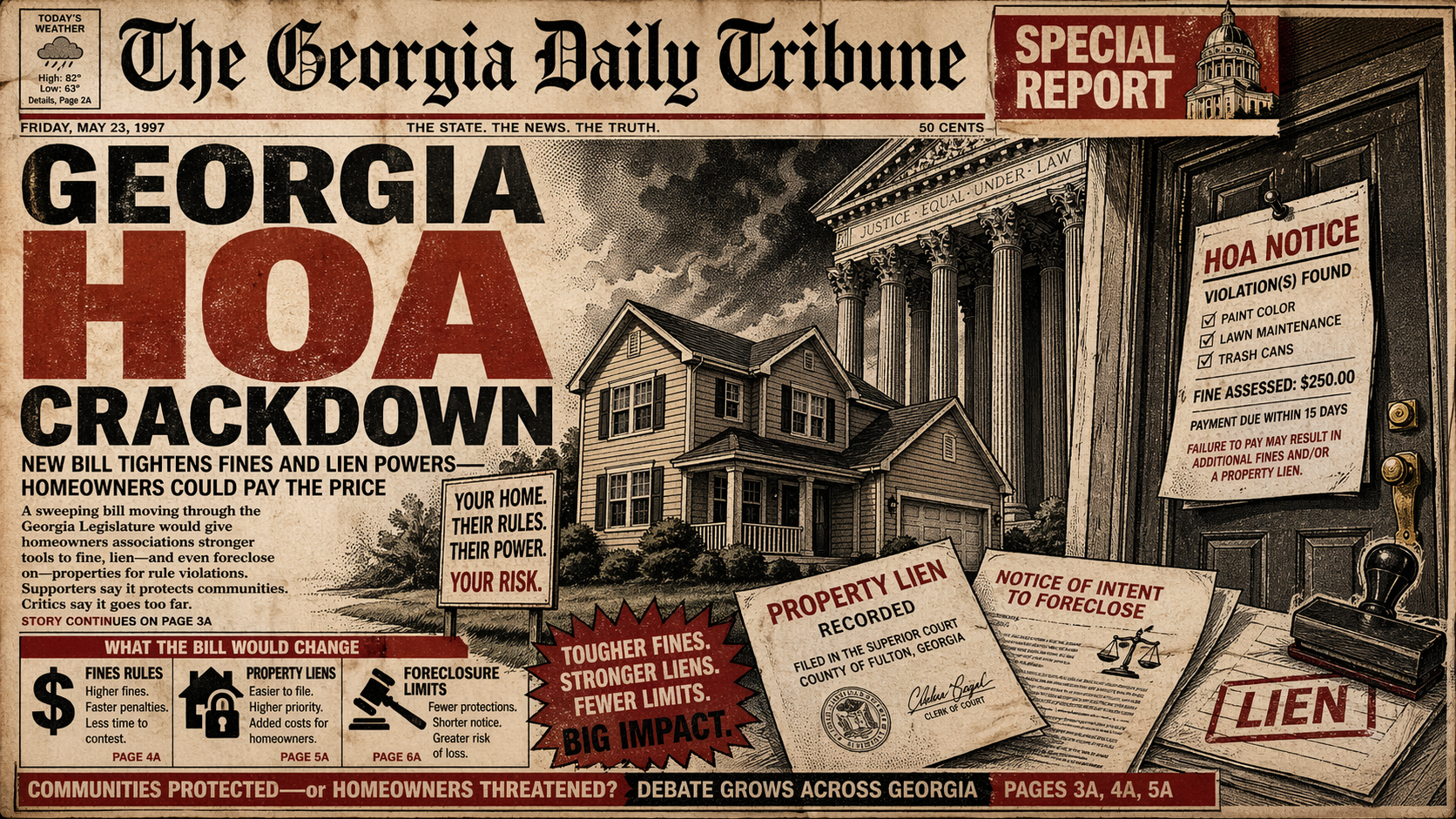
A Georgia bill aimed at homeowners’ associations would make it harder for HOA boards to use fines and liens as a path toward foreclosure, while also requiring more disclosure about how associations handle money and records.
According to reporting from The Current and the bill text itself, Senate Bill 406 passed the General Assembly with broad bipartisan support and would impose new procedural limits on how associations collect fines, place liens, and handle disputes with property owners.
That does not mean the bill eliminates HOA enforcement. It means lawmakers appear to have concluded that some guardrails were needed — particularly in cases where homeowners said disputes over relatively small issues had escalated into major legal and financial pressure.
What the Bill Would Change?
Under SB 406, associations that want to collect fines and fees would have to register annually with the Georgia Secretary of State. The bill would also limit what kinds of debt can support a lien, raise the current debt threshold for filing a lien, require certain records to be uploaded to the state, and create a hearing process for disputes overseen by the Secretary of State.
In practical terms, the measure appears designed to reduce the risk that a homeowner could slide from a dispute over fees into a lien and, eventually, hoa foreclosure without clearer process and more outside oversight. That is one reason the bill drew overwhelming support in both chambers.
The legislation also gives homeowners another venue for complaints short of court. For residents already in long-running disputes with their associations, that may be one of the more consequential pieces of the proposal.
Why Lawmakers Said It Was Needed?

Sen. Matt Brass, the bill’s sponsor, said during legislative hearings that he had heard repeated stories of boards or management companies piling on fines and fees in ways that could eventually lead to liens and loss of property. According to The Current, Brass described some of the complaints as examples of association power being used aggressively or unevenly.
That does not automatically prove widespread abuse across the state. And the bill’s supporters did not frame it that way. The narrower claim was that existing protections were not always working for homeowners who believed they had little leverage once an association dispute escalated.
That appears to be the basic Georgia rule question behind the measure: how much power should private neighborhood associations have to impose financial penalties before the state requires more transparency and review?
Homeowner Complaints Helped Shape the Debate
At hearings on the bill, several homeowners described disputes that had grown expensive or highly adversarial. One man described being fined over pavers placed in a muddy yard. Another said a conflict over runoff from a neighboring property spiraled into costly legal trouble. A real estate agent said one homeowner faced the risk of losing his house over failure to repaint a front door while caring for a dying spouse.
Those accounts are anecdotal, not a statewide audit. But they clearly carried weight with lawmakers.
That matters because debates over hoa rules often turn on a tension that is easy to state and harder to resolve. Associations exist to maintain standards and shared property arrangements. But once fines, legal fees, and liens accumulate, the consequences can become much larger than the original violation.
Opponents Said Law Should Not Be Built Around a Few Bad Cases
A lawyer representing the Community Associations Institute argued during earlier hearings that the state did not need SB 406. According to The Current, she said Georgia has more than 11,300 associations representing over 2.5 million people, and that lawmakers were hearing from a relatively small number of dissatisfied owners rather than seeing evidence of a systemwide problem.
That argument is not trivial. With so many associations operating across Georgia, lawmakers had to decide whether the complaints reflected isolated misconduct or a structural problem serious enough to justify new regulation.
Brass’ answer appeared to be that the proposed changes were modest. He said associations would mainly need to pay a $100 annual registration fee and provide records if they intended to keep collecting fines and fees. In his view, that was a manageable burden if it prevented more serious abuses.
Transparency Is a Big Part of the Bill
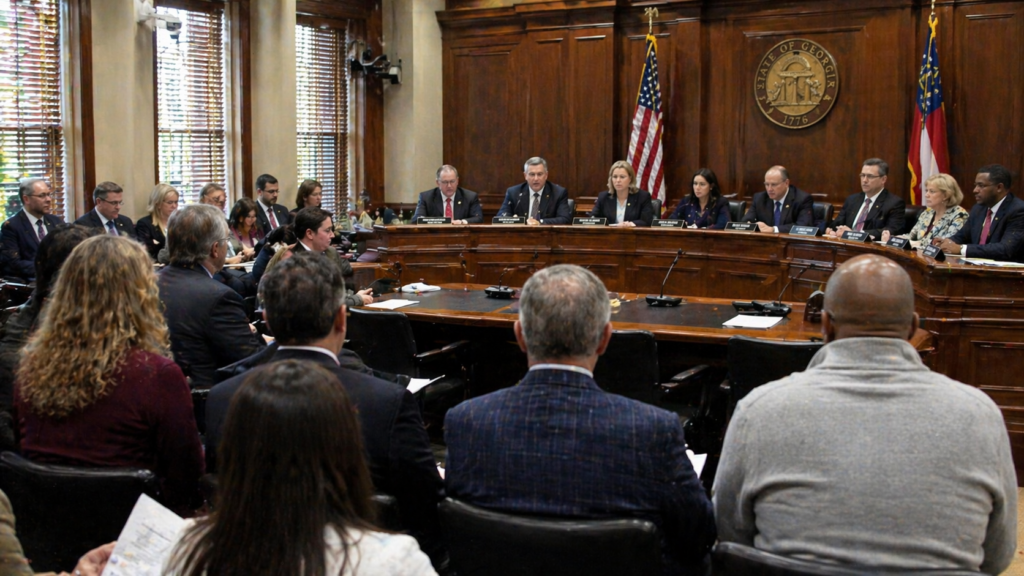
One of the more notable provisions would require associations to open their financial books to members and provide records to the state.
That may prove just as important as the lien provisions.
Disputes inside HOAs often become more heated when homeowners feel they cannot see how decisions were made, how money is being handled, or whether boards followed their own rules. Requiring more disclosure will not eliminate those disputes, but it could make it harder for boards to operate with minimal scrutiny.
That is part of why the bill’s path through the Georgia capitol drew attention beyond the usual property-law audience. The measure was not just about fines. It was also about access to records, hearing rights, and the idea that quasi-governmental neighborhood bodies should not function entirely behind closed doors.
What the Bill Does Not Do?
The bill does not abolish homeowners’ associations. It does not stop them from levying fines altogether. And it does not mean every complaint against an HOA board will now go in the homeowner’s favor.
What it appears to do is slow down the most serious enforcement steps and require more process before disputes become financially ruinous.
That makes the bill more incremental than sweeping. Even Brass, according to The Current, said the legislation only “scratches the surface” of the broader problems some homeowners say they face.
In that sense, SB 406 looks less like a full restructuring of association law and more like an attempt to establish a framework for tighter oversight later if lawmakers decide more is needed.
Why This Has Broader Appeal?
Part of the bill’s political strength may be that it does not fit neatly into one ideological box. Property-rights concerns, consumer-protection concerns, and basic transparency concerns can all point in the same direction here.
It is also the kind of issue that tends to attract strong reactions from ordinary homeowners rather than only lobbyists or policy specialists. HOA disputes are often intensely local and personal. They are not abstract fights.
And unlike culture-war issues that can quickly become media spectacle involving celebrities or actors from Georgia, this debate stayed focused on procedures, debt, and whether neighborhood associations had too much unchecked leverage over residents.
The Bottom Line
Georgia lawmakers have passed a bill that would place new limits on how homeowners’ associations fine residents, place liens on property, and move toward foreclosure.
Supporters say the measure responds to stories of aggressive enforcement and gives homeowners more transparency and a hearing process outside the courts. Opponents argue the law is based on a relatively small number of bad cases and may impose new burdens on thousands of associations.
The measure does not erase HOA authority. But it does signal that lawmakers think some oversight is warranted when fines and liens become powerful enough to threaten someone’s home.
If Gov. Brian Kemp allows SB 406 to become law, Georgia homeowners and associations alike will be working under a more regulated system — one that asks not just whether fees can be collected, but how far that power should go before the state steps in.