Aiman Tariq – Regional News Editor
Atlanta, GA –
Tax relief is easy to explain at the gas pump. It is harder to measure once the money is missing from the state ledger.
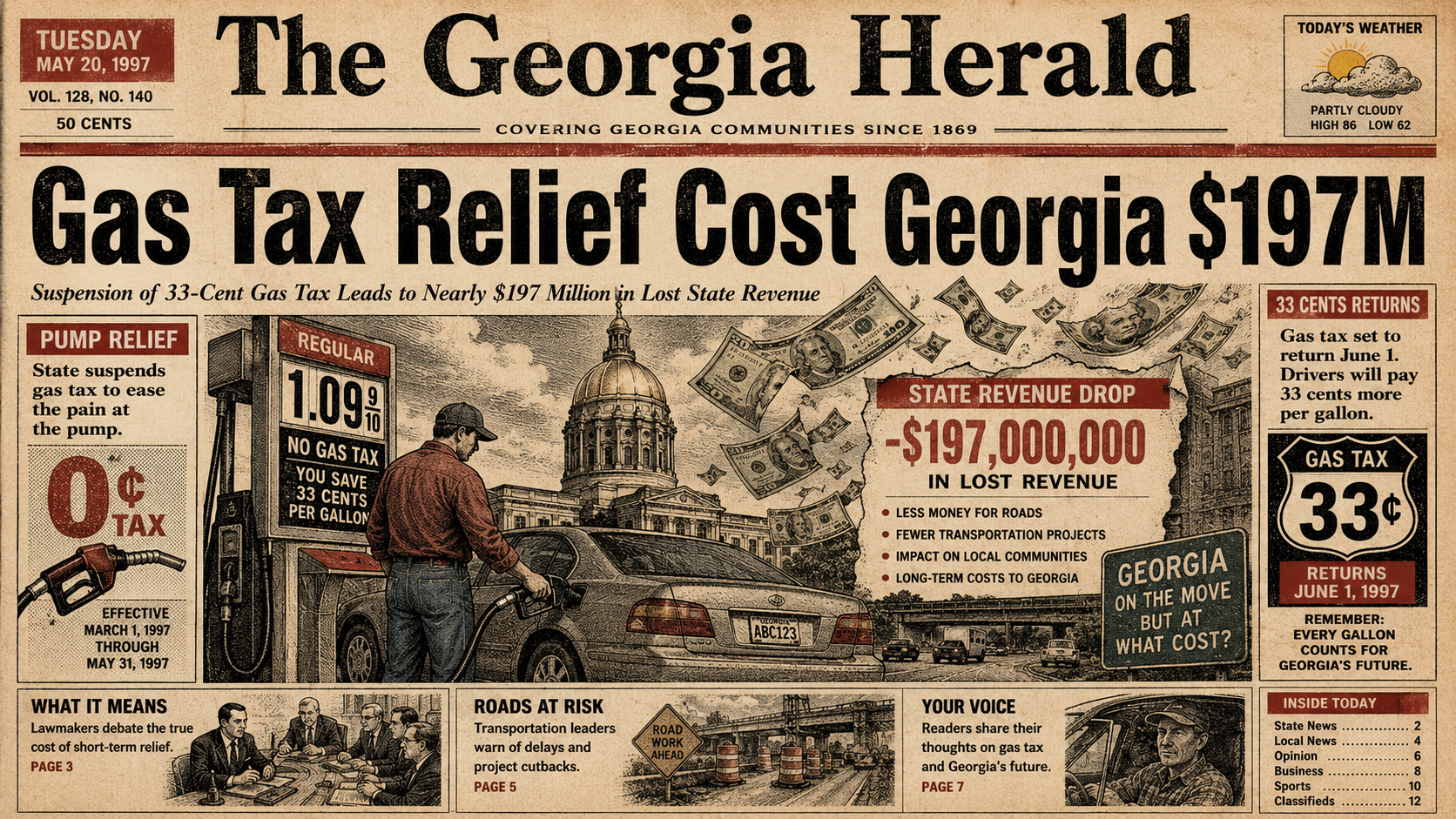
Georgia drivers received temporary relief this spring when the state suspended its motor fuel tax, holding down prices during a period of higher fuel costs. But according to state revenue figures reported by Channel 2 Action News and Yahoo, the suspension came with a clear tradeoff: nearly $196.6 million in lost state revenue for May.
That does not mean the policy was automatically wrong. It does mean the savings drivers saw at the pump were not free. They were shifted from household fuel bills to the state’s revenue collections.
That is the basic tension in gas tax holidays. They can provide fast, visible relief to drivers, especially commuters and small businesses that rely heavily on fuel. But they also reduce money that would otherwise flow into transportation and state operations.
What the State Says It Lost?
According to reporting on the governor’s May revenue release, Georgia’s net tax revenue was down 12.6% for the month, with the gas tax suspension identified as the major reason for the decline.
The dollar figure was nearly $196.6 million.
That is the part of the story that is easiest to repeat. It is also the part that needs context.
A gas tax suspension does not erase the cost of fuel. It temporarily removes a tax from the price structure. Drivers may see lower prices, but the state collects less money. Whether that is worth it depends on the broader economic moment, the state’s reserves, and what the lost revenue would otherwise have supported.
In Georgia’s case, the suspension removed the state motor fuel excise tax during a period when fuel prices had climbed sharply earlier in the year.
Why the Tax Was Suspended?
Gov. Brian Kemp first moved to suspend the state gas tax in March as fuel prices rose following global oil disruptions. Reuters reported at the time that Georgia’s suspension removed a tax of 33.3 cents per gallon on gasoline and 37.3 cents per gallon on diesel.
The governor’s office later extended the suspension for an additional two weeks, saying the move was meant to provide relief through the Memorial Day travel period.
That extension ran through June 2.
The Georgia Department of Revenue says the suspension covered the motor fuel excise tax during the suspension period, but did not suspend prepaid local sales tax or other local taxes. That matters because drivers may not have seen the exact same reduction at every station, depending on local pricing decisions and market conditions.
What Drivers Saw at the Pump?

For drivers, the policy was more direct than the revenue math.
If a motorist filled a 15-gallon tank, a 33.3-cent-per-gallon suspension could amount to roughly $5 in tax relief per fill-up. For commuters filling up weekly, that could be noticeable.
But once the suspension ended, prices were expected to rise by roughly the amount of the restored tax. Local and state reporting described the return as about 33 cents per gallon for gasoline and about 37 cents for diesel.
That does not mean every station changed prices at the same time or by the same amount. Retail gas prices move with wholesale supply, station competition, location, and timing. Still, the end of the suspension restored a tax that had been absent from the price structure.
That is why drivers may have experienced the policy less as a budget debate and more as a sudden jump at the pump.
Why Revenue Losses Matter?
Gas taxes are not just another line item. They are tied closely to transportation funding.
In general, motor fuel taxes help support road construction, maintenance, bridges, and transportation infrastructure. When those collections stop, even temporarily, the state has to absorb the gap or rely on other funding strength.
Georgia has been in a relatively strong fiscal position in recent years, and governors sometimes use that flexibility to offer temporary tax relief. But the May figure shows the scale of the decision.
Nearly $197 million is not a rounding error.
It is enough money to matter in transportation planning, budget forecasting, and future debates over whether temporary relief is worth repeating.
The Relief Argument
The case for the suspension is straightforward.
Fuel prices can hit households quickly because driving is not optional for many Georgia families. In much of the state, people need cars to get to work, school, medical appointments, and grocery stores. Higher gas prices can also strain delivery businesses, contractors, food trucks, and workers who drive long distances.
That is why gas tax suspensions are politically attractive. They are simple to announce, easy for the public to understand, and tied to a daily cost people already complain about.
Kemp’s office framed the extension as relief for “hardworking Georgians,” especially around Memorial Day travel, when millions of Americans were expected to drive.
That argument is not complicated. When prices rise, a temporary tax cut can soften the blow.
The Budget Argument
The harder question is whether a gas tax suspension is the best way to provide relief.
Not every driver benefits equally. People who drive more, use larger vehicles, or consume more fuel receive more savings. People who drive less receive less. And because gas tax relief applies broadly, it can also benefit people who may not need help as much as lower-income households do.
There is also the question of whether the full savings always reach consumers. Gas prices are affected by wholesale prices, competition, station margins, and timing. A tax suspension creates room for lower prices, but it does not guarantee a perfectly clean pass-through in every location.
That does not mean drivers saw no benefit. It means the real-world effect is harder to measure than the official tax rate.
This is the difference between a visible price break and a precise economic outcome.
May Revenue Numbers Show a Wider Dip

The gas tax was not the only pressure point in the May revenue report.
According to the same revenue summary reported by Channel 2 and Yahoo, reductions in individual income tax collections accounted for another $97.7 million decline, while corporate income tax collections fell by about $60.5 million compared with the previous year.
That broader context matters.
A single month of tax data can be noisy. Revenue collections can shift because of timing, filing patterns, policy changes, refunds, and year-to-year economic differences. One bad or unusual month does not necessarily define the state’s fiscal health.
But when a large, intentional tax suspension is layered on top of other revenue declines, the monthly number becomes more noticeable.
It tells readers less about panic and more about tradeoffs.
Why This Is Not Just a Gas Price Story?
The simplest version of the story is that Georgia gave drivers a break and lost nearly $197 million in revenue.
The more accurate version is that the state chose short-term fuel relief at a measurable fiscal cost, while relying on broader budget strength to absorb the hit.
That is not unusual. States make those choices during periods of economic pressure. The question is whether the public understands both sides of the exchange.
The relief was real for drivers who bought fuel during the suspension.
The revenue loss was also real.
Both can be true at once.
What Happens Next?
The gas tax suspension ended at 11:59 p.m. on June 2, and tax collections on motor fuel have resumed.
Kemp had said before the expiration that he did not plan to extend the suspension again, according to local reporting. That means the debate now shifts from immediate relief to whether the policy was worth the cost.
For drivers, the most visible change is the return of the tax at the pump.
For the state, the question is how the lost revenue fits into the larger budget picture and whether similar suspensions are likely if fuel prices spike again.
The Bottom Line
Georgia’s gas tax suspension gave drivers temporary relief during a period of higher fuel prices.
According to reported state revenue figures, it also cost nearly $196.6 million in May revenue.
That is the tradeoff.
For many drivers, the policy meant a cheaper fill-up at a time when household budgets were already stretched. For the state, it meant a sizable decline in collections tied to transportation funding and broader revenue planning.
The next time fuel prices climb, the same debate is likely to return.
The question will not simply be whether drivers need relief. Many do.
The question will be how much relief the state can afford, how long it should last, and whether a broad gas tax suspension is the most effective way to deliver it.