Aiman Tariq – Regional News Editor
Atlanta, GA –
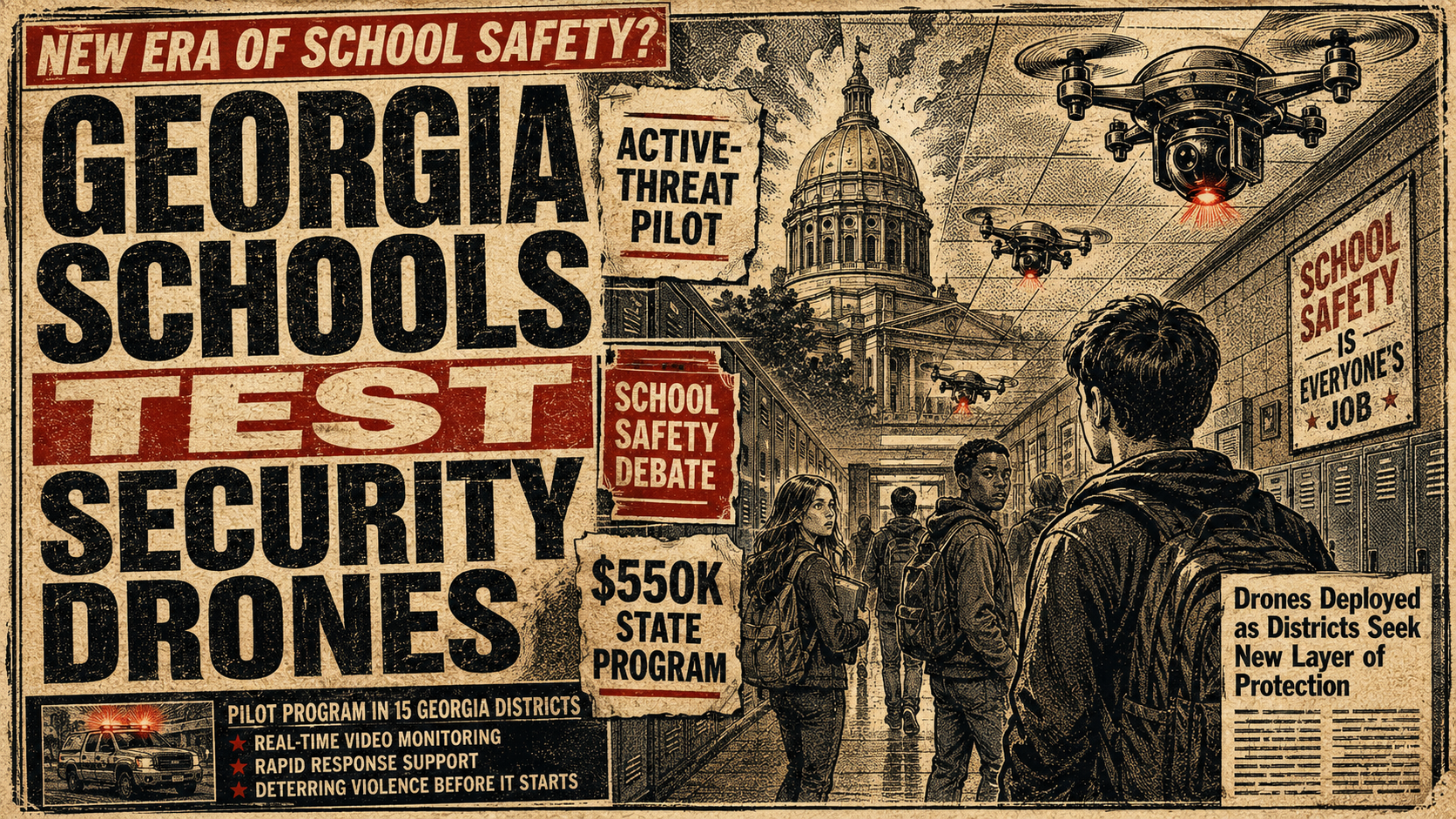
Five Georgia high schools are expected to begin testing a drone-based emergency response system this fall, according to reporting from WABE and information confirmed by the Georgia Department of Education.
The pilot program will place remotely operated drones inside selected schools with the goal of responding during an active-shooter threat before local law enforcement arrives.
That is the simple version of the story.
The more complicated version is this: Georgia is about to test a technology that supporters say could buy critical time during the worst moments a school can face, while critics and safety experts are likely to ask whether another expensive security tool can do what prevention, staffing, threat assessment, and basic response planning still struggle to do.
Five Georgia Schools Selected
According to WABE, the five schools selected for the pilot are Coffee County High School in Douglas, Forsyth Central High School in Cumming, Gainesville High School in Gainesville, River Ridge High School in Woodstock, and Statesboro High School in Statesboro.
The Georgia Legislature included $550,000 in the 2026 state budget for the program, which will be run by Campus Guardian Angel, a Texas-based company that markets drone systems for active-threat response.
Georgia will become the second state to launch a Campus Guardian Angel pilot program, according to WABE. Florida approved funding for the program in 2025, and the company has said drones are being installed at three schools there.
That makes the Georgia rollout part of a broader experiment, not a proven statewide model.
The pilot will run through the 2026-2027 school year unless lawmakers add more funding during the 2027 legislative session.
How the Drone System Is Supposed to Work?
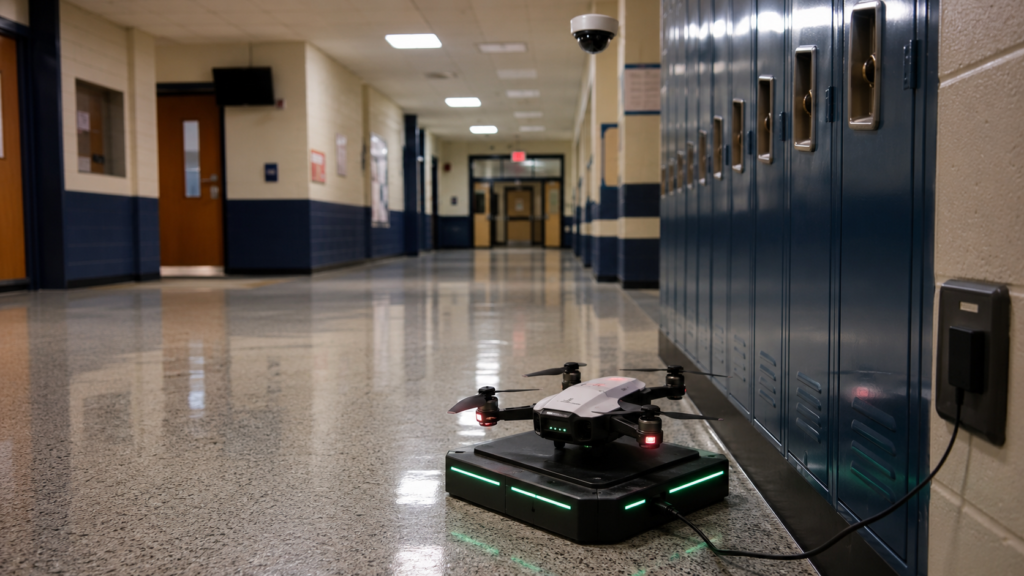
According to the company and reporting from WABE, the drones would be placed on charging pads throughout each school before an emergency occurs.
If an active-shooter event is reported, the drones would be flown remotely from the company’s operations center in Austin, Texas. The company says the drones can move through hallways, clear rooms and corners, provide live information, and use less-lethal measures intended to disrupt or slow down an attacker.
Campus Guardian Angel has described the system as a way to give law enforcement more time and better situational awareness during the early moments of an active threat.
That timing argument is central to the company’s pitch.
The company says its drones can fly 30 to 50 mph inside a school and up to 100 mph outside. It also says the drones can use sirens, strobe lights, pepper spray, and physical impact to disorient or incapacitate a shooter.
Those are company claims. They will now be tested in Georgia schools under real-world conditions, though hopefully never in the kind of emergency the system is designed for.
The First-Minutes Problem
The reason this type of technology is getting attention is not hard to understand.
In school shootings, the first minutes matter. Law enforcement may not yet be inside the building. Teachers may be trying to secure classrooms. Students may be hiding, running, or following emergency instructions with limited information.
Supporters argue that drones already positioned inside a school could respond faster than officers arriving from outside.
But that claim raises practical questions: How reliably can drones identify a threat? How do operators avoid confusion during chaos? How do teachers, students, school resource officers, and local police know where drones are and what they are doing?
Those details matter because a school emergency is not a controlled demonstration.
Lawmakers Frame It as an Added Layer
Republican state Rep. Matt Dubnik, who chairs the House Appropriations Subcommittee on Education, pushed for the program’s funding.
He told WABE the drones are not meant to replace school resource officers or police response, but to provide a more coordinated response during the first moments of an active threat.
That distinction is important.
If the system is treated as an additional tool, it may be easier to evaluate honestly. If it is sold as a technological answer to school shootings, the public should be more skeptical.
School safety rarely comes down to one device, one product, or one budget line.
It usually depends on layers: prevention, mental-health reporting, threat assessment, secure storage of firearms, trained staff, communication systems, school resource officers, emergency planning, and community trust.
Drones may become one more layer. They are not the whole wall.
A Growing School Security Industry
The Georgia pilot also fits into a much larger trend.
WABE noted that the business of school shooting security has become a multibillion-dollar industry. NPR has reported that the school security industry is worth as much as $4 billion and continues to grow.
That does not automatically mean every product is unnecessary or ineffective.
It does mean districts and lawmakers should be careful.
After high-profile acts of violence, school systems often face enormous pressure to “do something.” Companies offering visible security solutions can become attractive because they give officials something concrete to fund, install, and point to.
The harder question is whether the tool addresses the most likely risks or simply offers the most visible response.
That is why pilot programs matter. They should not just test whether the equipment can fly. They should test whether the system improves decision-making, coordination, training, and response without creating new risks or false confidence.
Georgia’s Recent Context
The drone pilot comes after a period of intense attention on school violence in Georgia.
A student at Apalachee High School in Winder is accused in a 2024 shooting that killed two students and two teachers. He has pleaded not guilty to multiple charges, including murder.
His father was convicted in March of second-degree murder and involuntary manslaughter for giving his son the gun used in the attack and is expected to be sentenced this summer, according to WABE.
That case has shaped the policy conversation around school safety in Georgia.
It also shows why the debate is broader than response technology. In that case, prosecutors focused not only on what happened at school, but on firearm access, warning signs, and parental responsibility.
A drone system would not answer all of those questions.
It is aimed at the moment after a threat becomes active. Much of the larger policy debate is about what happens before that point.
Other Proposals Did Not Advance
Another school safety proposal did not make it through the Georgia Legislature this year.
House Bill 1023 would have required public schools to use weapon detection systems at main entry points. The House passed the measure, but it did not advance out of the Senate before the session ended.
That matters because Georgia lawmakers are clearly looking at multiple hardware-based approaches to school security.
Weapon detection systems focus on entry points. Drones focus on response after an emergency begins. Both raise cost, training, privacy, and reliability questions.
And both should be evaluated against the same standard: whether they reduce risk in a measurable way, not whether they sound impressive in a hearing.
What Schools Will Need to Work Through?
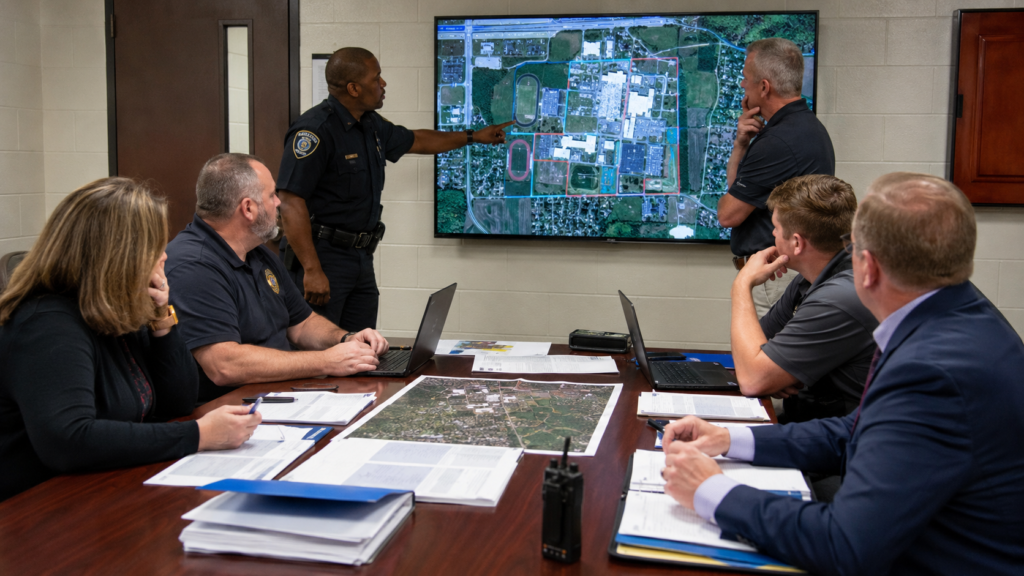
The five selected schools will need more than equipment.
According to WABE, Campus Guardian Angel says the systems will be installed this summer and ready before the school year begins. Local law enforcement and school district law enforcement will also be trained to work alongside the system.
That training piece may be the most important part of the pilot.
A drone response system creates operational questions that schools will have to answer clearly:
- Who triggers the system?
- Who confirms there is an active threat?
- How do local officers know where drones are operating?
- How are teachers told what to expect?
- What happens if a drone misidentifies a person?
- What happens if communication systems fail?
- How is student privacy protected when cameras and remote operators are involved?
None of those questions means the pilot should not happen.
They mean the pilot should be treated seriously, with public reporting on what was tested, what worked, what failed, and what still needs review.
The Technology Question Is Not the Only Question
There is a reason this program will attract attention.
Drones inside schools sound futuristic. The idea of a device reaching a threat before officers arrive is easy to understand. For parents, even the possibility of buying time in a violent emergency can feel worth exploring.
But school safety policy should be judged by more than urgency.
The public should know how the state will measure success. Will officials look at response time? Coordination with police? False alarms? Training outcomes? Cost per student? Reliability during drills? Feedback from teachers and school resource officers?
A pilot program without transparent benchmarks risks becoming a demonstration rather than an evaluation.
That would be a mistake.
If Georgia is going to spend public money on a new school security model, the state should be able to say what it learned.
The Bottom Line
Five Georgia high schools will test a drone-based active-threat response system during the 2026-2027 school year.
The state has allocated $550,000 for the pilot, and the selected schools are Coffee County High School, Forsyth Central High School, Gainesville High School, River Ridge High School, and Statesboro High School.
Supporters say the drones could buy critical time in the first moments of an active threat and help law enforcement respond with better information.
That may be true.
But the pilot should be treated as an experiment, not a guarantee.
The central question is not whether drones sound like a bold idea. It is whether they actually improve safety, coordination, and response in a way that can be measured.
Georgia schools, parents, and lawmakers deserve that answer before the program becomes anything larger.