Aiman Tariq – Regional News Editor
Atlanta, GA –
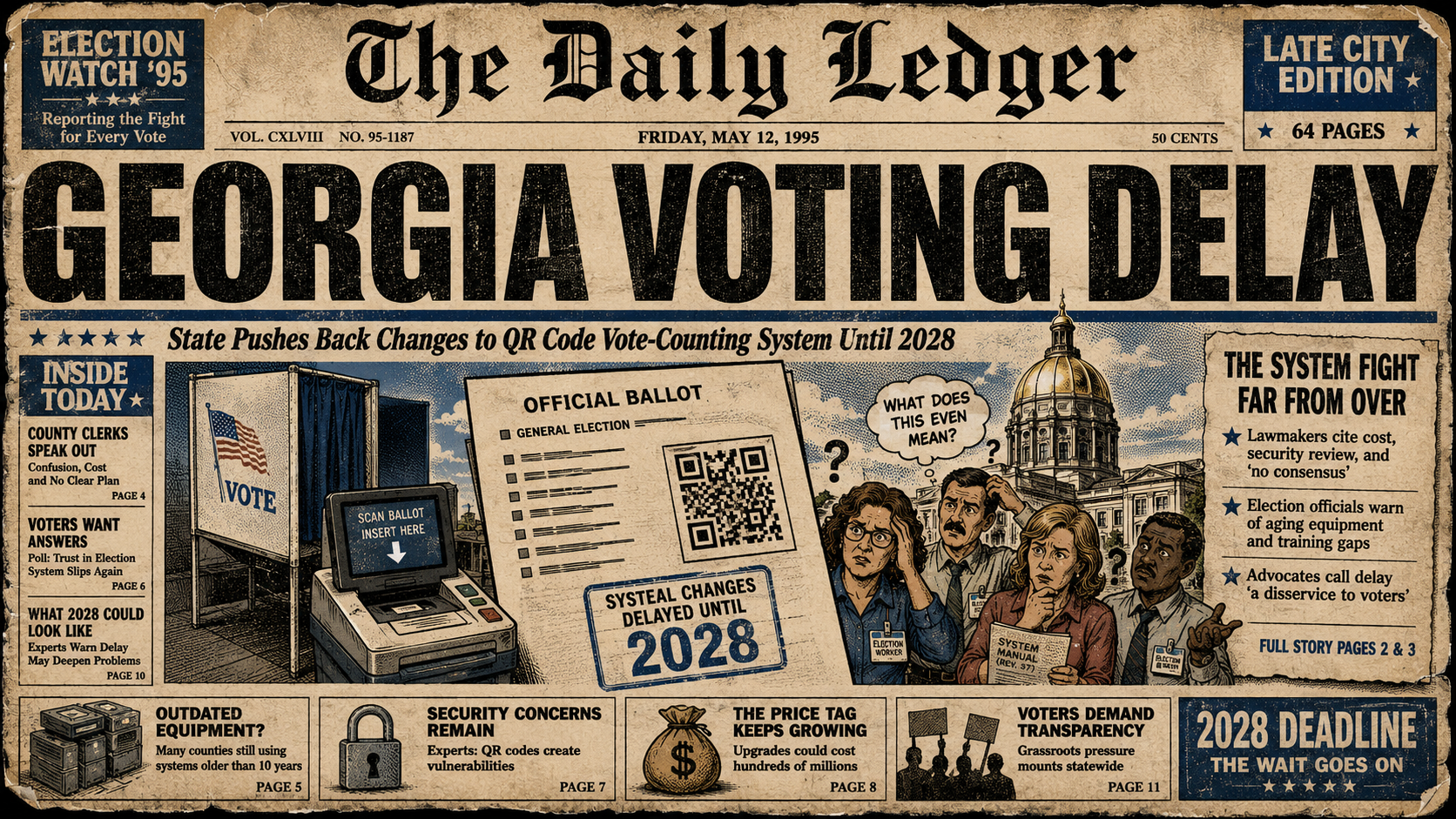
Georgia voters will continue using the state’s current ballot-marking and QR code tabulation system through this year’s midterm elections after lawmakers voted to delay a self-imposed deadline for replacing it.
The decision does not settle the larger fight over Georgia’s voting equipment. It only postpones it.
According to reporting from NBC News and the Associated Press, the Republican-controlled Legislature approved legislation Tuesday that moves the deadline for ending QR code-based vote counting to the 2028 election cycle. The bill now heads to Gov. Brian Kemp, who called lawmakers into a special session partly because the state was days away from falling out of compliance with its own election law.
That is why the story is less about whether Georgia’s system is trusted by everyone — it clearly is not — and more about whether lawmakers had a workable replacement ready before the July 1 deadline.
They did not.
Why The Deadline Had To Move?
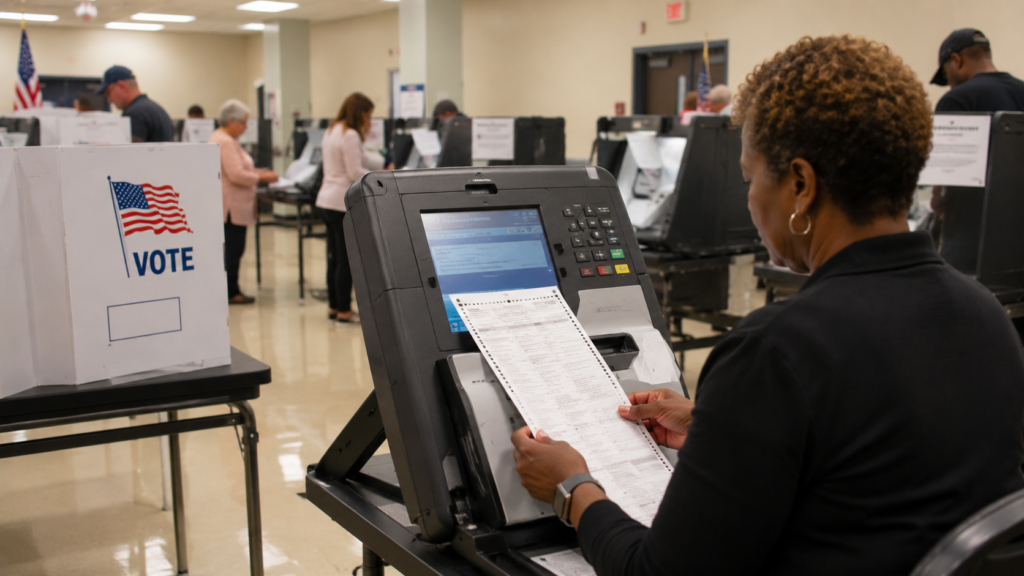
Georgia’s current in-person voting system uses ballot-marking devices. Voters make selections on a screen, and the machine prints a paper ballot that includes both a written summary of the voter’s choices and a QR code.
The QR code is what scanners use to tabulate votes.
That system has been criticized for years by some election-integrity advocates because voters cannot read or personally verify what is contained in the QR code. The human-readable summary can be reviewed by voters and used in audits, but the tabulation itself relies on the machine-readable code.
Lawmakers voted in 2024 to phase out QR code counting by July 1, 2026. But the law did not put a replacement system fully in place, and state officials later warned that modifying or replacing election equipment could be expensive and complicated.
State officials said in 2024 that making changes to the existing system could cost tens of millions of dollars, while a full replacement could run as high as $300 million, according to NBC News.
That left lawmakers with a choice: force a major election-system change just before a high-stakes midterm cycle, or delay the deadline and keep the current system in place.
They chose delay.
A Fix That Is Really A Pause
The legislation extends the deadline for replacing the current system until 2028 and creates a study committee to recommend future changes.
That matters because it gives lawmakers more time, but it does not answer the underlying questions.
Georgia still has to decide what kind of voting system it wants next. It still has to determine how much that system will cost, how counties will be trained, how voters will be educated, and whether any new process can avoid creating more doubt than it solves.
That is the tension at the center of this bill.
Supporters of the delay argue that changing equipment too close to an election could create confusion for voters and election workers. That is not a small concern. Georgia is expected to host major statewide races this year, including contests for governor and U.S. Senate.
A rushed change could invite mistakes, litigation, and more suspicion.
But critics of the current system argue that delaying the fix leaves voters with the same QR code process that lawmakers already agreed should be replaced.
That is why this is not a clean win for either side. It solves the immediate legal deadline. It does not solve the trust problem.
How The Current System Became So Controversial?
Georgia’s voting system has been under intense scrutiny since the 2020 presidential election, when Donald Trump narrowly lost the state to Joe Biden.
Some criticism of QR code tabulation has come from election-security advocates who object to any system that counts unreadable machine codes rather than voter-verifiable text. Other criticism has been fueled by unfounded allegations of widespread fraud.
Those are not the same argument.
The first is a design and transparency concern: voters can see their printed choices, but they cannot read the QR code used for tabulation.
The second is a fraud claim, and repeated allegations of widespread fraud in Georgia’s 2020 election have not been proven.
That distinction is important because it is possible for two things to be true at once: a voting system can deserve scrutiny, and conspiracy theories about that system can still be unsupported.
This is why election-system debates require careful language. Concerns about transparency should not automatically be dismissed as conspiracy theories. But unproven claims should not be treated as evidence.
The Hand Recount Provision
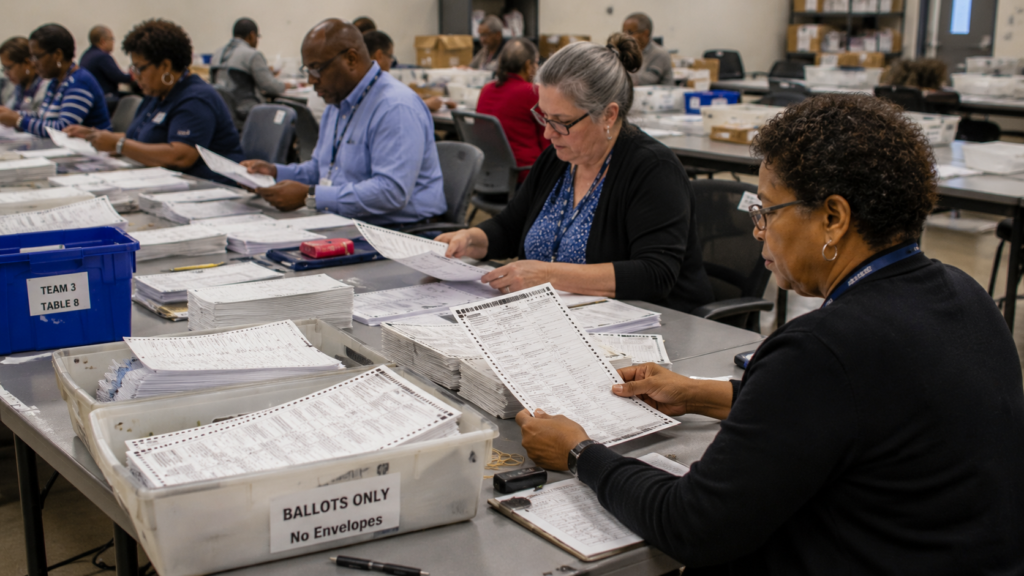
The bill also includes a limited hand recount provision.
According to AP and local Georgia reporting, the final version allows hand recounts in up to eight statewide races, including contests such as governor, lieutenant governor, attorney general and secretary of state.
But those recounts would only apply when the margin is within one-half of one percentage point. They also would be limited to the top two races appearing on a ballot.
Federal races, including U.S. Senate and U.S. House contests, would not qualify.
That is narrower than earlier proposals, which drew sharper criticism from Democrats and election officials concerned about delays, cost and accuracy.
Hand counting can sound more transparent in theory. In practice, it can introduce its own problems. Large-scale hand counts require staffing, training, time and consistent procedures. The more ballots involved, the more opportunities there are for human error.
That does not mean hand recounts are never useful. It means they are not a magic fix.
Democrats Warn About Doubt After Election Day
Democrats opposed the recount provisions and warned that the bill could create another opening for distrust after close elections.
State Rep. Debra Bazemore, a Democrat, argued that the question was not whether lawmakers supported election integrity but whether the legislation actually improved it or created another way to cast doubt on legitimate results.
That argument reflects a broader concern in Georgia politics.
Since 2020, election rules have often been debated not only as administrative systems, but as political signals. A change can be framed as increasing confidence by one side and undermining confidence by the other.
That makes actual election administration harder.
County officials have to run elections based on laws, equipment, budgets and timelines. Voters experience those debates much more simply: they want to know whether their ballot will count and whether the rules will still be the same when they show up.
Republicans Say The Bill Buys Time
Republican supporters framed the legislation as a practical solution to an immediate conflict.
State Rep. Victor Anderson said the bill is not the ultimate answer but gives the state a path toward a future voting system while avoiding disruption before this year’s elections.
That is probably the strongest argument for the delay.
The state had a deadline. It did not have a ready replacement. Counties were facing uncertainty. The special session forced lawmakers to choose between an imperfect status quo and a rushed overhaul.
For now, the status quo remains.
The harder question is whether lawmakers use the additional time to build a clearer, more trusted system — or simply push the same fight into the next election cycle.
Why Does Timing Matters?
Election equipment changes are not like changing office software.
Counties have to acquire equipment, test it, train poll workers, update procedures, educate voters and prepare for legal challenges. Even small changes can create confusion if they arrive too close to Election Day.
That is why election experts often warn against major rule changes immediately before a major election.
But timing cuts both ways.
If lawmakers believed in 2024 that QR code tabulation needed to end by 2026, critics can reasonably ask why the state did not move faster to design, fund and implement the replacement.
Delaying the deadline may be practical. It also reveals a planning failure.
The Redistricting Issue That Did Not Move
Gov. Kemp also asked lawmakers to consider new congressional and legislative maps for the 2028 election cycle after a major U.S. Supreme Court decision on redistricting.
Lawmakers declined to take up that issue during the special session, saying there was not enough time.
That left the voting-system deadline as the central election issue lawmakers actually resolved.
Even that resolution is temporary.
Georgia has now avoided an immediate compliance problem, but the broader election-law debate remains active.
What Happens Next?
The bill now goes to Gov. Kemp.
If signed, Georgia’s current QR code vote-counting system will remain in place through this year’s midterms, and lawmakers will have until 2028 to move toward a different system.
A committee will also study options and recommend changes by the end of January.
That recommendation process will matter. If it becomes another venue for partisan messaging, the state could end up back in the same position: a deadline approaching, counties asking for clarity, and voters left trying to sort out what changed.
If it produces a serious plan with funding, training and enough lead time, Georgia may finally move beyond the QR code fight without creating a new election mess.
The Bottom Line
Georgia lawmakers have delayed the state’s deadline to stop using QR Code Voting System to count votes until 2028.
The move keeps the current system in place for this year’s midterm elections and avoids a last-minute equipment change that county officials and lawmakers said could create confusion.
But it does not settle the debate over voter-verifiable ballots, machine-readable QR codes, hand recounts or public trust.
The simple version is that lawmakers bought more time.
The more accurate version is that Georgia had to buy more time because it set a deadline before it had a replacement ready.
The state now has another chance to design a voting system that is clear, affordable, secure and understandable to voters.
Whether lawmakers use that time well remains the real test.