Aiman Tariq – Regional News Editor
Atlanta, GA –
A state budget is one of the clearest statements lawmakers make about priorities. It is also one of the easiest places to hide tradeoffs in plain sight.
That is why Georgia’s latest senate budget proposal is worth reading as more than a collection of line items. The broad picture is easy enough to summarize: the Senate largely stayed within Gov.
Brian Kemp’s $38.5 billion spending cap for the next fiscal year, added a major pension boost for state employees, and reshuffled money in higher education and literacy spending to make the math work. The harder part is deciding what those choices signal about what the Senate thinks matters most — and what it thinks can absorb a cut.
What the Senate Changed?
According to WABE and Capitol Beat, the Senate Appropriations Committee added $100 million to the Employee Retirement System of Georgia, a move supporters described as one of the most important items in the plan because it could support more consistent cost-of-living increases for state employees and retirees.
Democrats backed that pension move during committee consideration, and the Senate later passed its version of House Bill 974 on March 27 before sending it into negotiations with the House.
That pension funding did not come out of nowhere. Under Kemp’s revenue cap, new money in one place generally means less money somewhere else. In this case, one of the most significant Senate changes was a reduction tied to online instruction in the university system.
The Senate pulled $125 million from the higher-education funding formula by treating online classes as less expensive to deliver than in-person courses. Sen. Blake Tillery said the chamber used a reduced ratio so that 1.1 hours of online instruction would be treated like one in-person hour for funding purposes.
Why Does Pension Money Draw So Much Attention?
Budget fights often get framed around big headline items like schools, roads, or public safety. But pension funding tends to matter in quieter ways that accumulate over time.
That appears to be part of what made the retirement-system addition stand out. Senate leaders argued the extra money would help create more predictable cost-of-living adjustments for state workers. Even Democrats who disagree with the chamber on other spending choices publicly praised that move.
That does not make it risk-free or universally sufficient. It does, however, suggest there was unusual bipartisan agreement around the idea that shoring up the employee retirement system of georgia was worth protecting, even if other areas had to absorb the offset.
The broader budget context also matters. The conference-committee highlights released after the end-of-session deal said HB 974 was built on a $38.5 billion revenue estimate, about $738 million, or 1.95 percent, above the original FY 2026 budget. That is a real increase, but not the kind of jump that lets lawmakers fund every priority without forcing choices elsewhere.
Education Was Not Cut Equally

One of the clearer lessons from this year’s debate is that “education funding” is too broad a phrase to tell readers much by itself.
The Senate and House were aligned on the broad goal of putting literacy coaches in schools serving students in kindergarten through third grade. Where they diverged was the method.
The Senate chose to fund the literacy initiative through a $70 million grant, while the House had tried to route the money through the K-12 funding formula. Tillery said the House approach effectively undercounted what would be needed because it assumed hiring all the coaches would take longer than a year.
At the same time, the Senate’s higher-education change sent a different message: online programs may still be important, but lawmakers do not appear eager to fund them at the same rate as face-to-face instruction. That is not necessarily an ideological statement. It may simply reflect the Senate’s view of comparative cost.
Still, it is a reminder that the budget is not only about how much goes to education overall. It is also about which delivery models lawmakers decide deserve full-value treatment.
Some Savings Came From Assumptions, Not Just Cuts
Another Senate move drew less attention but says something about how lawmakers are balancing risk and cost.
WABE reported that senators removed $11 million the House had included to hire more staff to verify that food-stamp recipients are eligible. Georgia has struggled with one of the nation’s highest error rates in this area, which can threaten federal funding. Senate leaders said they could avoid the staffing expense because Equifax had offered to do the verification work for free.
That may ultimately save money. It may also turn out to be the kind of assumption that deserves closer watching once implementation begins. Budget documents can make choices sound settled long before the operational details are. That is one reason a floor speech or committee summary should be treated as a starting point, not the whole story.
The Senate Budget Vote Wasn’t the End of the Story
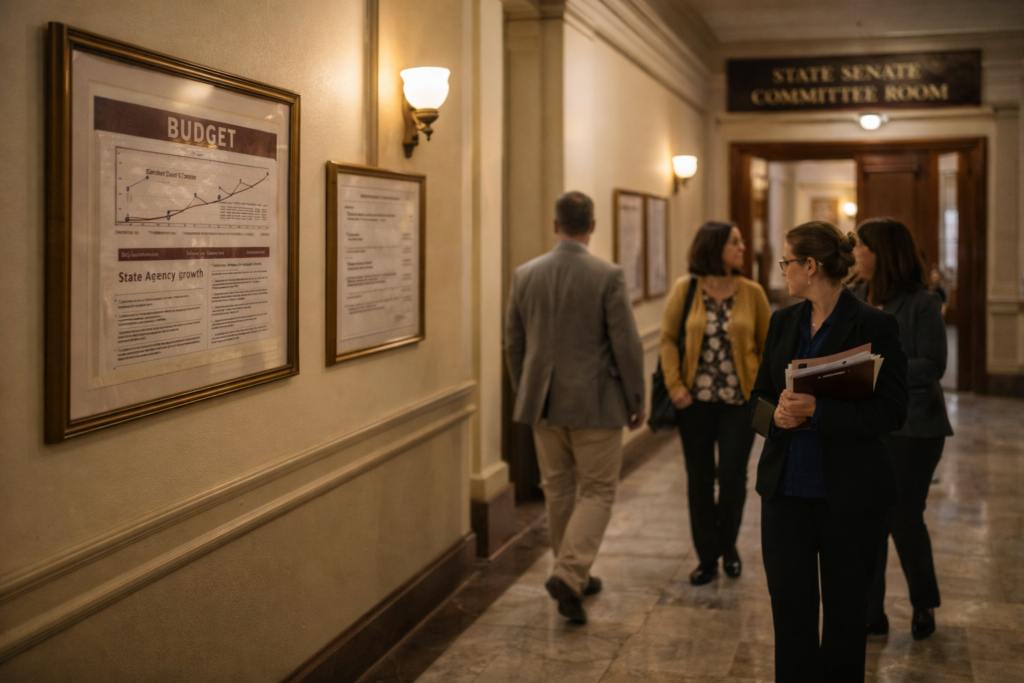
Georgia’s budgeting process does not end when one chamber passes its version. It just moves into a less visible phase.
After the committee action WABE described, the full Senate approved its version of the spending plan on March 27, according to Capitol Beat and WABE. From there, the bill moved into conference negotiations with the House, where lawmakers worked out differences before the General Assembly gave final passage to House Bill 974 on April 2, sending it to Gov. Brian Kemp.
That matters because people often hear about a dramatic senate budget vote and assume the issue is effectively settled. In Georgia, it usually is not. The committee version, the floor version, and the conference-committee version can all tell slightly different stories about what lawmakers were willing to trade away to protect their top priorities.
Why Budget Language Can Be More Revealing Than Budget Slogans?
Budgets are full of shorthand. “Efficiency.” “Reform.” “Modernization.” “Right-sizing.” Sometimes those terms describe real management choices. Sometimes they are just cleaner ways to describe reductions.
That is why debates over terms like icon budgeting or “smart budgeting” can be misleading if they are not tied to actual line items. The more useful question is not whether lawmakers say they are spending smarter. It is whether the numbers show a pattern: who gets protected, who gets squeezed, and which promises survive when the cap gets tight.
In this case, the pattern seems fairly clear. The Senate protected pension funding, backed early-literacy spending, and looked to higher education and administrative alternatives for savings. Whether that is prudent stewardship or short-term balancing depends in part on how those choices play out once the new fiscal year starts in July.
What Happens Next?
The General Assembly has now completed its work on HB 974, and the final conference-committee version has been sent to Kemp, who has line-item veto authority. That means the political fight inside the Legislature is effectively over, but the executive branch still has the last move on specific appropriations.
That is often where the cleanest talking points begin to blur. A budget can pass with broad agreement on a few priorities while still leaving unresolved questions about whether the assumptions behind it — especially on college funding ratios, outsourced eligibility work, or recurring obligations — will hold up over a full year.
The Bottom Line
The Georgia Senate used its version of the budget to make a fairly clear statement about priorities for the next fiscal year: protect pensions, back literacy, and make room for both by trimming elsewhere.
The strongest marker in the plan was the extra $100 million for the Employee Retirement System of Georgia, a choice that won praise across party lines. But like most budget wins, it came with offsets, including a sizable reduction tied to online higher education funding.
That does not make the final package reckless, and it does not make it settled wisdom either.
What it does suggest is that Georgia’s FY 2027 budget was built less around sweeping expansion than around selective protection. The final document may be easier to summarize than to interpret. As always with state spending, the broad signal is clear before the full consequences are.