Aiman Tariq – Regional News Editor
Atlanta, GA –
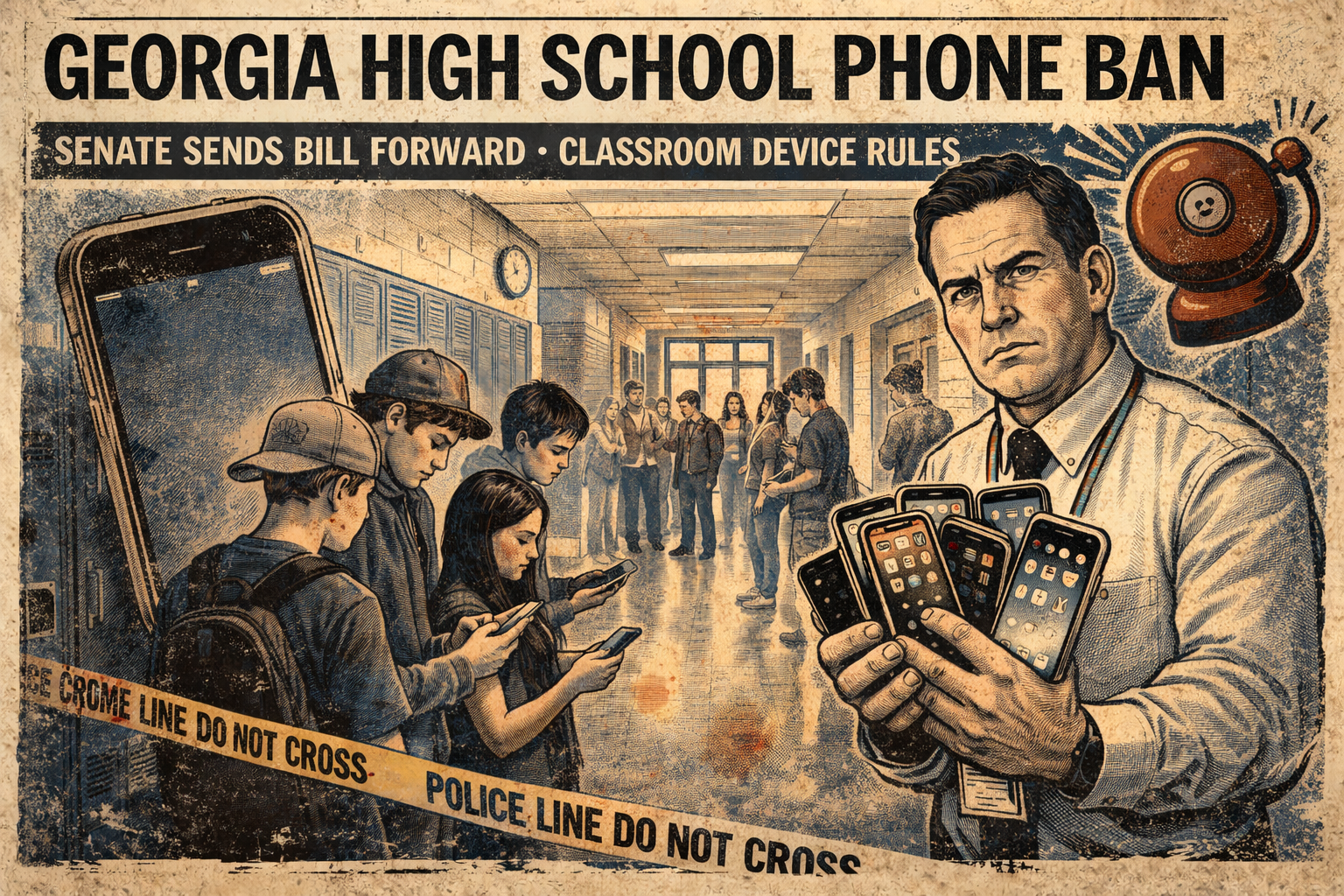
Georgia lawmakers have moved a statewide high school phone ban to the governor’s desk, extending a broader school-device policy that the state began rolling out last year for younger students.
According to WABE, the Georgia Senate voted unanimously Monday to approve House Bill 1009, a measure that would bar public high school students from using phones and other personal electronic devices during the school day. If Gov. Brian Kemp signs the bill, it would expand an existing state restriction already in place for students through eighth grade.
The vote suggests there is now broad agreement in the Capitol that personal devices have become a classroom issue worth regulating. But as with most education bills, the bigger question is not only what the measure says on paper. It is how local districts will enforce it, what exceptions will matter in practice, and whether a statewide rule solves the same problem in every school.
What the Bill Would Do?
House Bill 1009 would require Georgia public high schools to restrict student access to personal electronic devices during the school day. According to the bill text and WABE’s reporting, that includes not only cellphones, but also tablets, smartwatches, headphones, laptops, and similar devices capable of communicating with other devices.
In other words, this is not a narrow phone bill aimed only at texting in class. It is a broader school-device measure that treats a range of connected devices as potential distractions during instructional time.
The legislation also preserves exceptions for students whose devices are required under an Individualized Education Program, a Section 504 plan, or another medical plan. That part matters because statewide school rules often become more workable when they make room for disability-related and medical needs up front.
What Counts as a Device
The bill goes beyond the familiar image of a student glancing at a screen under a desk. The categories lawmakers discussed include watches, tablets, headphones, and other devices that can send or receive information.
That means this is not really about a single cell phone icon in a school handbook. It is about how much digital access students should have during the school day, and whether local administrators can manage that without constant case-by-case disputes. That broader framing is part of why lawmakers described the bill as a classroom and school-culture measure, not just a discipline rule.
Why Lawmakers Say the Ban Is Needed?

Supporters of the bill have framed it largely around distraction, mental health, classroom focus, and school safety.
Rep. Scott Hilton, the bill’s author, said the measure would help student mental health, grades, test scores, and school safety, according to WABE. Sen. Shawn Still, who carried the measure in the Senate, said a legislative committee studying children and social media use identified device use during the school day as one of its main concerns.
That is a familiar argument in education policy right now. Across the country, schools have been reassessing the role of cell phones in schools, especially after years of complaints from teachers who say digital interruptions have become harder to contain than ordinary classroom disruption. The political appeal of these bans is that they offer a visible response to a problem many parents and educators already believe exists.
Still, unanimous votes do not necessarily mean unanimous agreement on how a policy will work at ground level. Sometimes they simply mean opposition to the premise has become politically harder to sustain.
The Disagreement Was Not About Whether Phones Distract
The main debate in the Senate was narrower.
According to WABE, Sen. RaShaun Kemp proposed an amendment that would have let school systems create policies allowing high school students to access personal devices between classes. Kemp argued that high school students are not elementary or middle school students and that many have jobs, responsibilities, and, in some cases, children. The amendment failed.
That exchange gets at the actual tension inside bills like this one. It is not simply whether devices distract students. Most lawmakers appear to agree that they do. The harder question is whether all students should be treated the same from first bell to last bell, or whether high schools need more flexibility because older students live more adult-like lives.
Why the Between-Class Amendment Failed
Supporters of the stricter version argued that letting students use phones between classes would create an enforcement problem for teachers and staff.
Still told lawmakers that allowing phones during breaks would effectively turn teachers into device enforcers who would have to collect and return them repeatedly. That concern appears to have carried more weight than arguments for limited flexibility.
That may end up being the most important practical point in the bill. School policy often rises or falls on enforceability. A rule that sounds moderate in theory can become unmanageable if teachers are expected to police it minute by minute.
Why This Looks Like an Extension, Not a New Direction?

Georgia already moved in this direction last year when Kemp signed a law restricting personal device use for students through eighth grade. HB 1009 extends that framework into high school rather than creating an entirely new school-device regime.
That continuity matters politically. It allows supporters to present the latest measure less as an experiment and more as the next step in a policy direction the state has already chosen.
It also helps explain why the bill advanced so smoothly. When lawmakers are expanding an existing model instead of inventing one from scratch, resistance is often lower, especially if districts have already begun adjusting to similar rules in lower grades.
What Happens Next
As of the latest reporting, HB 1009 is headed to Gov. Brian Kemp for consideration. Capitol Beat reported that, if signed, the high school cellphone restriction would take effect in the 2027–28 school year.
That timeline means the bill is close to becoming law, but implementation questions would still remain for local systems. Districts would need to translate state language into building-level procedures, and those details often determine whether a rule feels clear or chaotic once students return to class.
One thing the debate has already made clear is that Georgia lawmakers are no longer treating student phone use as a side issue. They are treating it as a statewide education policy question.
The Bottom Line
Georgia senators have given final legislative approval to a bill that would ban student access to phones and other personal electronic devices during the public high school day. The measure now awaits the governor’s decision.
Supporters say the bill will reduce distractions, improve learning, and make schools safer. Critics of the stricter approach did not appear to dispute the distraction problem so much as the idea that every high school should be locked into the same all-day rule.
If Kemp signs the measure, Georgia will be betting that a statewide restriction on cell phones in schools is easier to manage than a patchwork of local compromises.
Whether that makes classrooms calmer, or simply moves the enforcement burden elsewhere, is something districts will have to answer once the policy moves from debate to practice.