Aiman Tariq – Regional News Editor
Atlanta, GA –
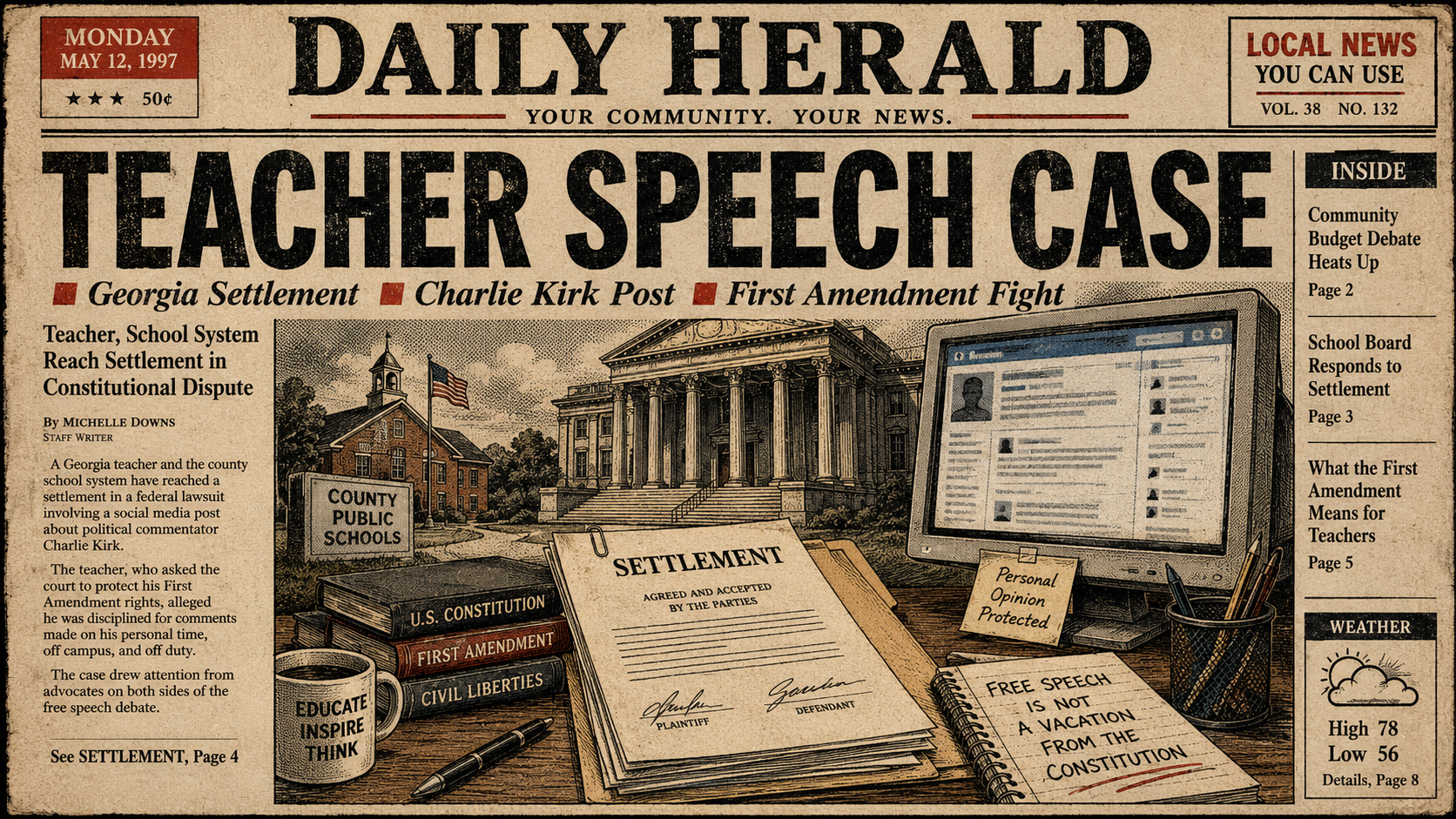
A Georgia school district has agreed to pay nearly $300,000 to settle a lawsuit with a former English teacher who said she was removed from the classroom after posting about conservative activist Charlie Kirk on her private social media account.
According to the Atlanta Journal-Constitution, the Oglethorpe County School District agreed to pay Michelle Mickens $270,420 for alleged emotional distress and $17,080 in attorney fees. The district denied Mickens’ allegations as part of the settlement, and the lawsuit was dismissed Wednesday, according to court filings cited by the AJC.
That makes the headline simple enough: Ga. teacher gets nearly $300K in settlement over Charlie Kirk social media post.
The harder question is what the settlement says about public employees, political speech, and how quickly school districts may move when outside pressure turns a private social media post into a public controversy.
What the Settlement Says?
According to the AJC, Mickens and the school system signed the settlement agreement in June. The agreement included the payments to Mickens and her attorney, while also requiring Mickens to resign from her position and not seek employment with the district again. The district also agreed to provide a positive employment reference.
The settlement does not mean the school district admitted wrongdoing.
That distinction matters. Settlements often end litigation without deciding whether a constitutional violation occurred. They can reflect legal risk, cost, uncertainty, or a desire to move on.
But the size of the payment still gives the case weight. A nearly $300,000 agreement is not a routine personnel matter, especially for a small school system outside Athens.
It also places Mickens’ case within a broader pattern of lawsuits filed by educators and public employees who said they were punished for speech about Kirk’s death.
How the Case Started?
According to the original complaint and reporting from multiple outlets, Mickens was a high school English teacher in Oglethorpe County and a former Georgia Teacher of the Year finalist. She posted a quote from Kirk on her private Facebook account after work hours, from her personal computer.
The AJC reported that the post initially included a quote from Kirk about gun deaths and the Second Amendment, without commentary from Mickens. Later, in responses to comments, Mickens criticized Kirk’s views while also saying she did not condone violence.
According to CBS Atlanta, Mickens said the post was on a private account visible to close friends. The lawsuit alleged that after the post was shared more widely, district leaders placed her on leave and asked her to resign or face termination.
The school district disputed her version of events. In a statement reported by Atlanta News First after the lawsuit was filed, Superintendent Beverley Levine said many of the facts presented by Mickens’ side were “inaccurate or incomplete” and that the district expected to defend itself in court.
That is the basic tension in the case: Mickens described off-duty political speech. The district framed the lawsuit as disputed and incomplete. The settlement ended the case before a court decided who was right.
Why the First Amendment Question Matters?
This is not just a story about one teacher’s Facebook post.
Public school teachers are government employees, but they do not lose all constitutional rights when they take the job. At the same time, school districts have some authority to regulate employee conduct when it affects school operations.
That balance is rarely clean.
The SPLC, which represented Mickens, said the lawsuit accused the school system and superintendent of violating her First Amendment rights by attempting to dismiss her for speech made outside the classroom. The organization said Mickens was discussing a matter of public concern and that her comments did not disrupt the school.
The district did not accept that framing.
That is why cases like this tend to turn on details: where the speech occurred, whether it was made as a private citizen, whether it related to a matter of public concern, whether it disrupted the workplace, and whether the employer’s response was proportionate.
Those questions are fact-heavy. They are also exactly the kinds of questions that often get lost once a social media post becomes a political fight.
Outside Pressure Became Part of the Story
According to the complaint and reporting from CBS Atlanta and the SPLC, Mickens later learned that screenshots of her private post had been shared publicly. CBS reported that a former classmate shared the post on X and called on people to contact school officials.
That detail matters because it shifts the story from a private post to a public pressure campaign.
School districts can face real pressure when a teacher’s post spreads online. Parents may call. Activists may organize. Board members may demand answers. Administrators may feel they have to act quickly.
But speed is not the same as judgment.
This is where the free-speech concern becomes practical. If a public employee can be pushed out after outside accounts amplify a private political comment, then the real power may not sit only with the school district. It may also sit with whoever can generate the loudest backlash.
That does not mean teachers can say anything without consequences. It does mean districts should be careful before turning online outrage into employment action.
Several Educators Faced Similar Consequences
Mickens was not the only educator or public-facing employee affected after posts about Kirk’s death.
The AJC reported that at least two Cobb County teachers lost their jobs, an unidentified number were placed on leave, and an Emory University professor and Delta Air Lines flight attendant faced similar consequences after posts tied to Kirk.
The SPLC also described Mickens as part of a broader wave of public-sector employees who were threatened, disciplined, or fired over speech about Kirk’s death.
That broader context cuts both ways.
On one hand, it shows school systems and employers were responding to a highly charged national moment. On the other hand, it raises the question of whether employers reacted to genuine workplace disruption or to political pressure around unpopular speech.
Those are not the same thing.
Why the Settlement Does Not End the Debate?
The settlement ends Mickens’ lawsuit, but it does not settle the underlying issue.
It does not answer how far school districts can go when an employee’s private speech becomes controversial. It does not clarify how much disruption must exist before discipline becomes legally defensible. It does not tell other teachers exactly where the line is.
What it does show is that litigation over speech can become expensive.
According to the AJC, plaintiffs in similar cases have received large settlements or awards in recent months, including cases involving a University of Tennessee professor, an Indiana University employee, and an Iowa teacher.
That may affect how school districts handle future controversies. Administrators may still discipline employees in some cases, but settlements like this create a reminder that retaliation claims can carry real financial risk.
What Teachers May Take From This?
For teachers, the practical message is not simple.
Private social media is not always truly private. A post shared with friends can be screenshotted, reposted, and stripped of context. A comment made after work can still reach parents, students, administrators, and advocacy accounts.
But the other side is just as important: public employees are not required to surrender their ability to speak on public issues altogether.
That is why careful context matters. A teacher speaking in the classroom is one situation. A teacher speaking as a private citizen from home is another. A teacher directly threatening or harassing someone is different from a teacher expressing a political view, even a harsh one.
The Mickens case sits in that difficult middle ground where the speech was controversial, the public reaction was intense, and the legal question was whether the district went too far.
What Happens Next?
The lawsuit has been dismissed, according to court filings cited by the AJC. Mickens agreed not to return to the Oglethorpe County School District, and the district agreed to provide a positive employment reference.
That likely closes the legal case between Mickens and the district.
But it does not close the broader issue for Georgia schools.
As political speech continues to move through private posts, screenshots, viral accounts, and public pressure campaigns, school districts will keep facing the same question: when does employee speech become a legitimate workplace concern, and when does discipline become retaliation?
The Bottom Line
Michelle Mickens’ lawsuit is over, but the free-speech question behind it remains.
According to the AJC, the Oglethorpe County School District paid nearly $300,000 to settle the case while denying her allegations. Mickens agreed to resign and not seek employment with the district again.
The district did not admit wrongdoing. A court did not decide whether Mickens’ rights were violated.
Still, the settlement is a signal.
When a public school employee is removed from the classroom after off-duty political speech, the facts matter. The context matters. The level of disruption matters. And the difference between responding to a workplace problem and reacting to political pressure matters.
For Georgia educators, this case is likely to remain part of that larger conversation.
It is a reminder that the First Amendment does not disappear at the schoolhouse door — but in practice, it may still have to be defended there.