Aiman Tariq – Regional News Editor
Atlanta, GA –
Georgia is preparing to build something most states have discussed more than they have delivered: a dedicated road for commercial trucks on one of the Southeast’s busiest freight corridors.
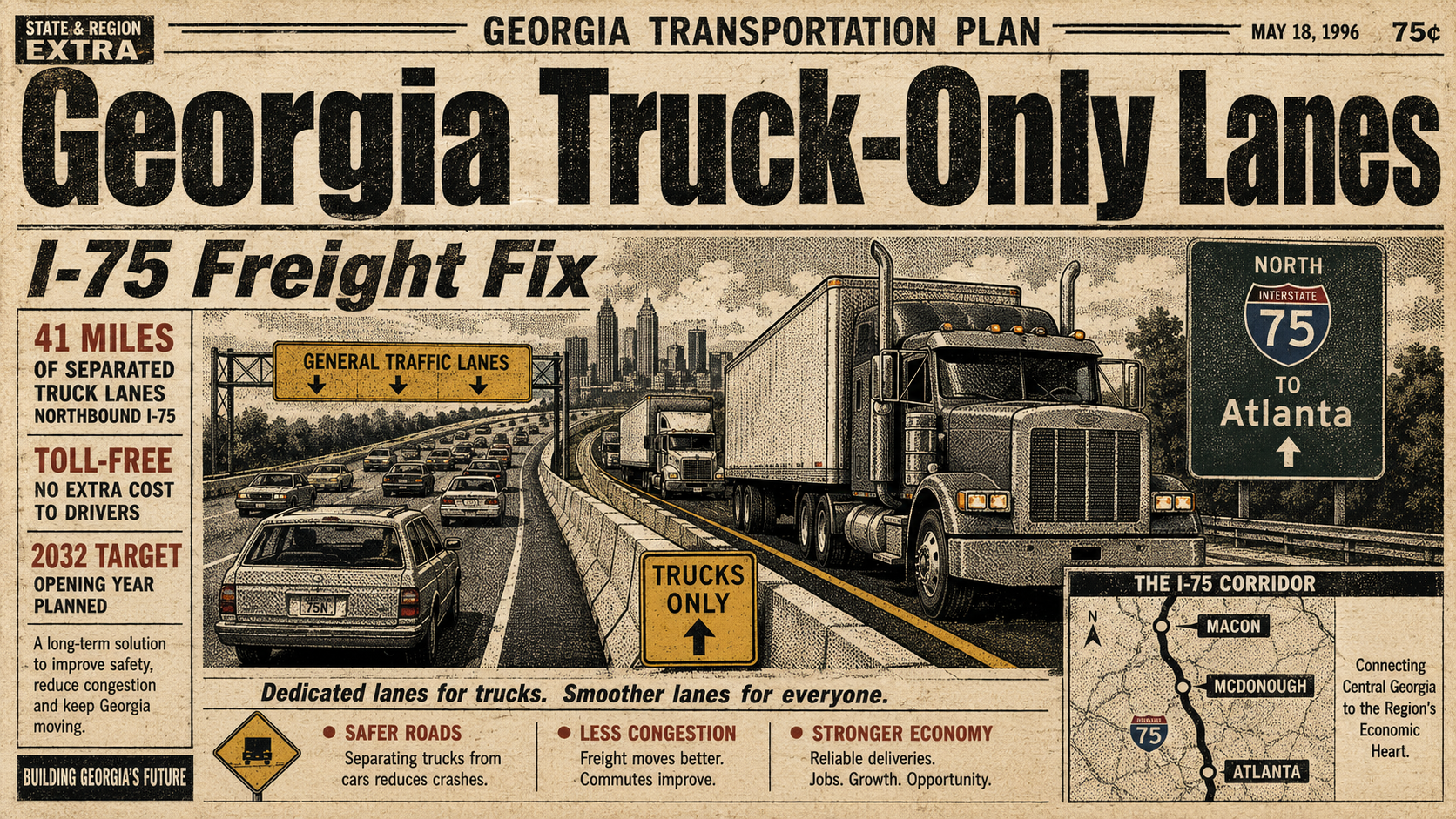
According to the Georgia Department of Transportation, the I-75 Commercial Vehicle Lanes project would add two barrier-separated lanes for commercial vehicles along 41 miles of northbound I-75, running from the I-75/I-475 interchange in Monroe County to near the State Route 20 interchange in Henry County. The lanes would pass through Monroe, Lamar, Butts, Spalding, and Henry counties.
Construction is now expected to begin in 2027, with completion projected by the end of 2032. GDOT says the lanes would be toll-free for trucks.
That makes the project easy to describe and difficult to judge too early. If it works, it could separate heavy freight from passenger traffic on a corridor that regularly slows near McDonough. If it does not, Georgia will have spent years of construction and billions of dollars testing a model that still depends on design, merge points, enforcement, and actual driver behavior.
What Georgia Plans to Build?
The core plan is straightforward.
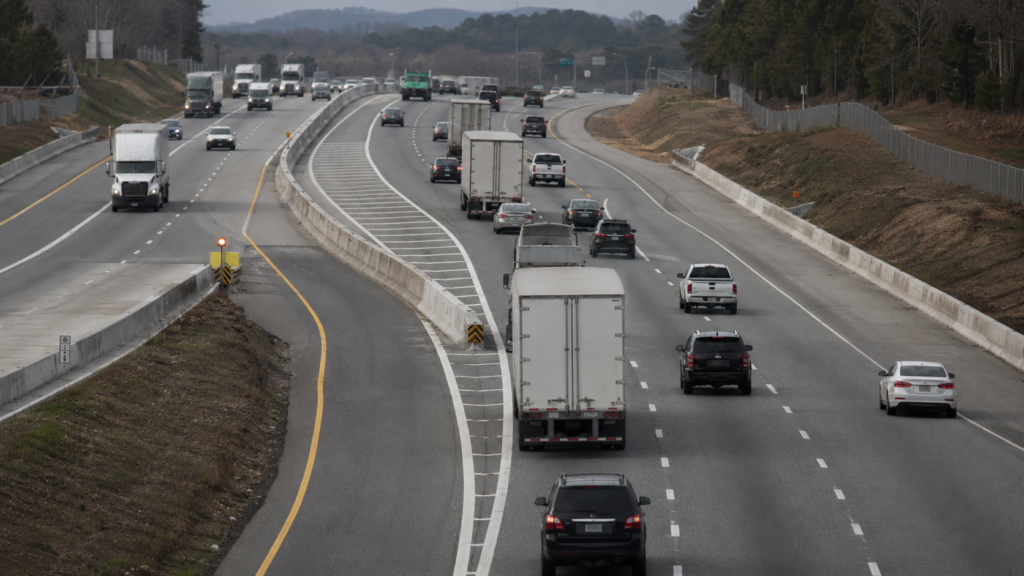
GDOT would build two new lanes on the northbound side of I-75. Those lanes would be separated from the general-purpose lanes by a barrier and reserved for commercial vehicles. Earlier project coverage says the total stretch would cover about 41 miles, beginning near Macon and ending near the McDonough area south of Atlanta.
This is not just another widening project.
A standard widening adds lanes and leaves all traffic mixed together. This project attempts to manage the mix itself by separating trucks from cars over a long stretch of interstate.
That matters because heavy trucks and passenger vehicles behave differently. Trucks accelerate more slowly, need more room to stop, and can create different traffic patterns when grades, ramps, merges, and congestion come together.
GDOT’s argument is that separating those movements could improve reliability for trucks while also reducing friction in the regular lanes.
Why Does This Stretch of I-75 Matters?
The location is not random.
The I-75 corridor between Macon and Atlanta is one of Georgia’s most important freight routes, carrying traffic between the Port of Savannah, the Port of Brunswick, metro Atlanta distribution centers, and points beyond. Land Line Media, citing GDOT, described the Atlanta-to-Macon stretch as one of the busiest freight corridors in the United States.
The congestion case is also supported by national trucking data.
The American Transportation Research Institute’s 2026 bottleneck list ranked McDonough, Georgia, on I-75 as the 10th-worst truck bottleneck in the country. Georgia also had several other locations high on the list, including Atlanta interchanges on I-285, I-75, and I-20.
That does not mean one project solves Georgia’s freight problem. It means this project is aimed at a real choke point.
And that distinction matters. Infrastructure claims can get oversold quickly. A new lane is not magic. But when a state targets a known bottleneck and builds around a specific traffic problem, the argument is at least more concrete than a general promise to “fix traffic.”
The Timeline Is Clearer Now
The current timeline gives the project a more defined shape.
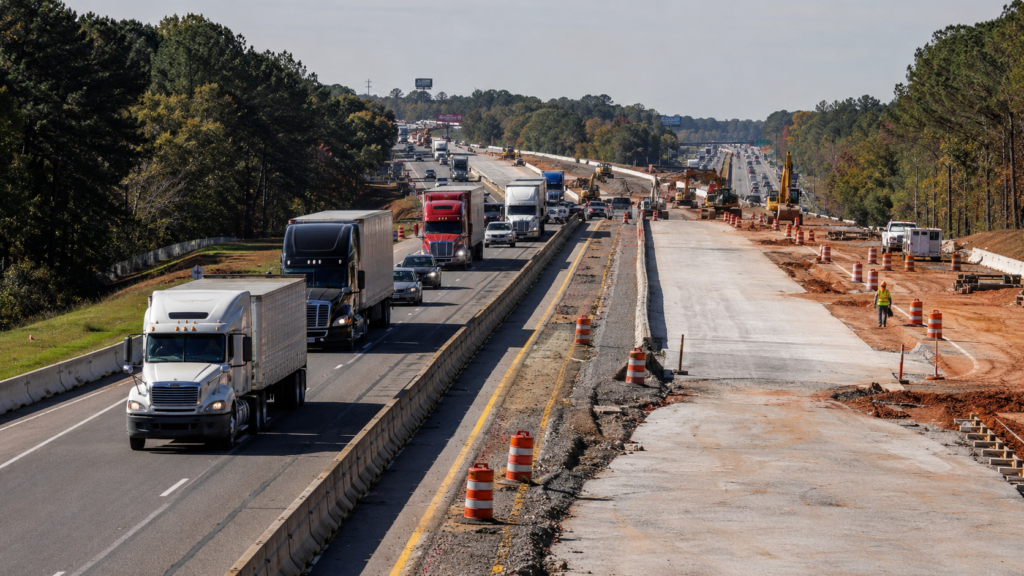
CDLLife reported that GDOT expects project design to be finalized and construction to begin in 2027. Completion is expected by the end of 2032.
That is a long horizon, and it should be read as a projection, not a guarantee.
Large highway projects move through design, right-of-way, environmental review, procurement, construction phasing, and field conditions. Any one of those can affect timing.
There is also the construction problem itself. The same corridor that needs relief will have to absorb years of work zones before the promised relief arrives. For drivers who already dislike that stretch of I-75, the middle years may feel worse before they feel better.
That does not make the project a bad idea. It just means the benefit cannot be judged from a rendering or a press release.
GDOT Expects Most Trucks to Use the Lanes
One of the more striking numbers is GDOT’s expected truck usage.
In response to public comments, GDOT said it anticipates that 73% to 100% of trucks traveling to destinations within the project limits will move from the general-purpose lanes into the commercial vehicle lanes, depending on where they are going. The department also said about 27% of trucks entering the lanes near Macon are expected to exit before reaching McDonough.
Those numbers are important, but they should be treated carefully.
A projection is not the same as observed traffic. The lanes have not opened. Drivers have not used them. Enforcement has not been tested. The merge design has not been tested in real conditions.
Still, the numbers show how GDOT is thinking about the project: not as a small optional lane, but as a major reorganization of truck movement through the corridor.
If the department’s projection holds, the general-purpose lanes could see a meaningful shift in traffic composition. If it does not, the public will have fair questions about whether the design delivered what was promised.
Public Comments Were Mostly Supportive, With Conditions
GDOT received 132 public comments during the process, according to coverage of the department’s response. Of those, 57 supported the project, 35 expressed conditional support, 19 opposed it, and 21 were uncommitted.
That is not overwhelming public consensus, but it is not broad rejection either.
The conditional support may be the most useful category. It suggests people understand the freight problem but still want answers about design, safety, construction impacts, and who gets heard before final decisions are made.
Commenters asked GDOT to include professional truck drivers in the planning process. That is not a small point. Truck-only lanes are being designed for people who understand grades, merges, blind spots, stopping distance, and driver fatigue in a way most commuters do not.
GDOT responded that coordination with transportation organizations will be important throughout the project. That is a reasonable answer, but it is also the kind of answer that should be tracked. The real question is whether working drivers have a meaningful role in evaluating what gets built.
The Merge Point Will Matter
Separated lanes create their own test at the places where they begin and end.
That is why concerns about the northern merge near the Henry County end of the project are worth taking seriously. A truck-only facility may improve conditions in the middle of the corridor, but the benefit can weaken if trucks and cars are pushed back together in a confusing or overloaded merge.
GDOT said its safety analysis shows the proposed northern merge area up to SR 155 would have fewer estimated crashes than the no-build alternative. The department pointed to more channelized traffic flow, less weaving, and an auxiliary lane between SR 155 and SR 20 as reasons the design should operate safely.
That is the official analysis. It is also still a model.
Merge points are where paper design and daily traffic meet. If the project works, the merge should feel routine. If it does not, drivers will know quickly.
Truck Parking Is Part of the Same Problem
The truck-only lanes are the headline, but parking is part of the same freight system.
Land Line Media reported that Georgia is also investing roughly $7 million to add truck parking at two I-75 locations in Monroe County. That includes 23 spaces at the northbound weigh station and 36 spaces at Rest Area 22 southbound.
That matters because freight mobility is not only about keeping trucks moving.
Drivers also need legal places to stop. A corridor can move freight faster during the day and still fail drivers at night if parking is unavailable. For owner-operators and small fleets, time lost in congestion and time spent hunting for parking both carry real costs.
The parking projects are smaller than the commercial vehicle lanes, but they are not unrelated. They address a quieter problem that often sits behind the louder congestion debate.
What It Could Mean for Drivers?
For truck drivers, the promise is simple: a more predictable run through one of the most frustrating stretches of I-75.
That could mean less weaving, fewer slowdowns, more consistent travel times, and less mixing with passenger vehicles. For small fleets and owner-operators, reliability matters because delay can affect delivery windows, fuel costs, hours-of-service planning, and the next load.
But there are reasons to keep expectations measured.
The project will take years. Construction zones can create new slowdowns before any long-term benefit arrives. The lanes are northbound only. The design depends on drivers entering and exiting correctly. And the actual benefit will depend on what happens at the edges of the facility.
That is why this project should be described as promising, not proven.
Why Other States Will Be Watching?
Dedicated truck lanes at this scale are still unusual in the United States.
If Georgia’s 41-mile project performs well, it could become a model for other freight-heavy states. If it struggles, it may become a warning about the difficulty of separating freight from general traffic at a large scale.
That is the larger significance.
Georgia is not just adding capacity. It is testing a design approach that treats freight as its own traffic system, not just another category of vehicles fighting for space in the same lanes.
For a state with ports, logistics hubs, interstate freight movement, and fast-growing metro congestion, that approach makes sense on paper. The question is whether it works on pavement.
The Bottom Line
Georgia is moving ahead with a major truck-only lane project on northbound I-75 between Monroe County and Henry County.
GDOT says the project will add two barrier-separated, toll-free commercial vehicle lanes across about 41 miles, with construction expected to begin in 2027 and finish by the end of 2032.
The reason is clear enough: this corridor carries heavy freight traffic and includes one of the nation’s worst truck bottlenecks near McDonough.
The harder question is whether the project will perform as expected once it is built.
If GDOT’s projections hold, the lanes could give trucks a more reliable path northbound and reduce some pressure on the general-purpose lanes. If they do not, the state will still have to answer why the assumptions looked better than the traffic.
For now, the timeline is set, the corridor is chosen, and the work is coming.
The trucks may eventually get a road of their own. Whether that road changes the daily experience on I-75 is the part Georgia still has to prove.