Aiman Tariq – Regional News Editor
Atlanta, GA –
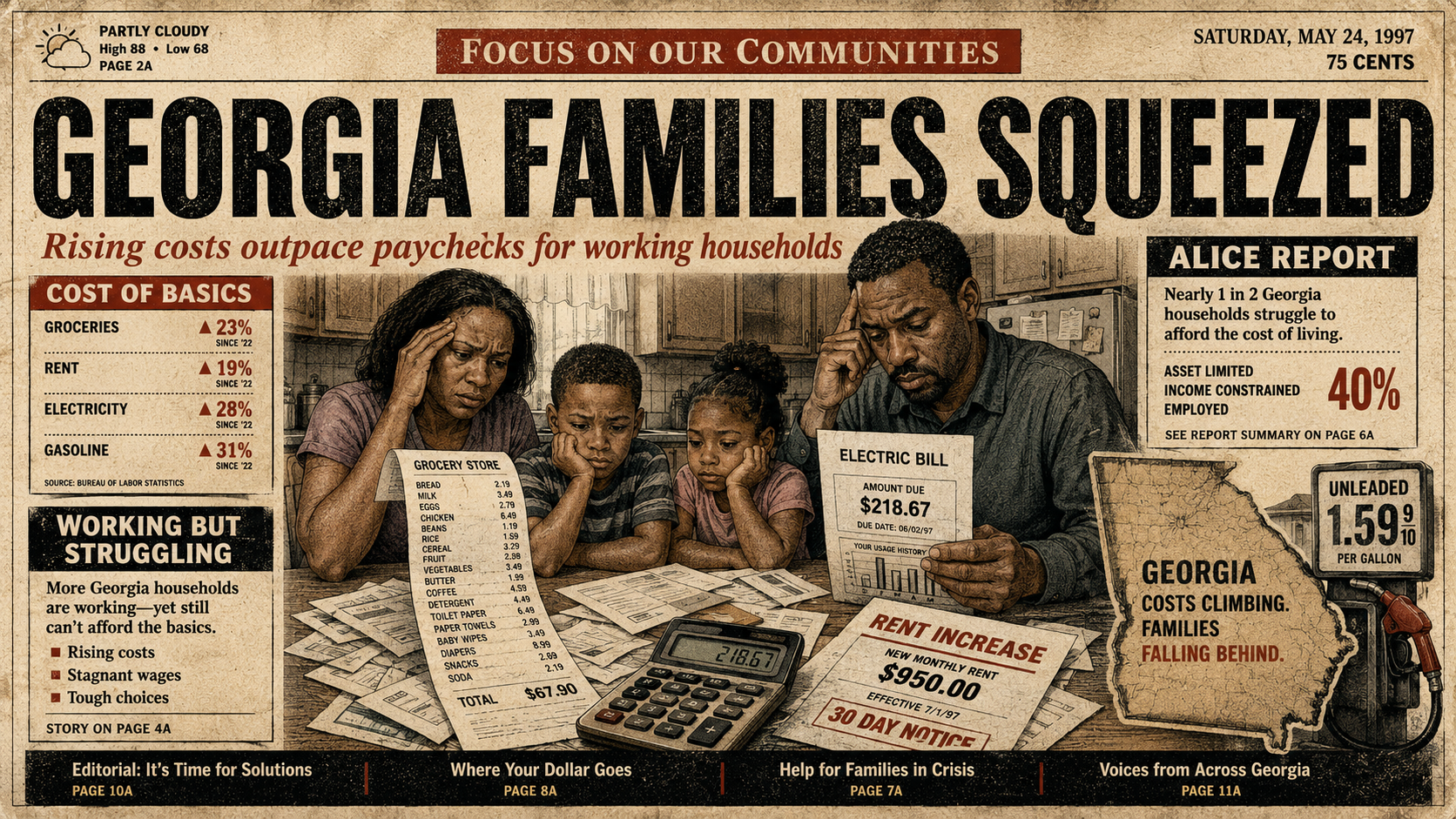
The simplest version of the story is that many Georgia families are still having trouble paying for the basics.
The more accurate version is slightly harder: a large share of households are working, earning above the federal poverty line, and still falling short of what it actually costs to live in the state.
A new United Way ALICE report, cited in recent coverage from WABE and The Current, found that roughly 44% of Georgia households are below the ALICE Threshold — meaning they are either in poverty or earning above the federal poverty level but still unable to reliably cover essentials such as housing, food, child care, transportation, health care and utilities.
That is not the same as saying nearly half of Georgia households are unemployed or officially poor. It is saying the old poverty line does not fully capture the pressure many families are under.
And that distinction matters.
What are the ALICE Report Measures?
ALICE stands for Asset Limited, Income Constrained, Employed.
It is a category used by United Way to describe households that earn more than the federal poverty level but less than the basic cost of living in their county. In Georgia, United for ALICE reports that 13% of households were below the federal poverty level in 2024, while another 30% were ALICE households — more than twice the share officially counted as poor.
That gap is the core of the report.
A family may not qualify as poor under federal standards and still be one car repair, medical bill or rent increase away from serious trouble. That is especially true in a state where transportation costs, housing costs and utility bills can vary sharply depending on where a household lives.
According to WABE’s report, a family of four in Georgia needed more than $77,000 in 2024 just to cover the essentials.
That number is not a comfort budget. It is a survival budget.
Why “Above Poverty” Can Still Mean Behind?
The federal poverty level is useful as a national baseline. But it is not always a precise measure of what families experience locally.
That is the difference between a broad standard and a household budget.
A broad standard can tell policymakers who falls below a national income line. A household budget shows whether a family can actually pay rent, keep the lights on, buy groceries, get to work, cover child care and handle a doctor’s visit without taking on debt.
For many Georgia families, the report suggests the answer is no.
This is why the phrase “working poor” often misses part of the picture. Many ALICE households are not technically in poverty. They may have jobs. They may pay taxes. They may be doing what public officials often say families are supposed to do.
But the math still does not work.
Costs Are Rising in the Categories Families Cannot Skip

The pressure is not only coming from one place.
WABE reported that many Georgia households are struggling with basic expenses such as gas, electricity and food, with rising prices leaving little room for unexpected costs.
Federal inflation data gives that complaint some context. The Bureau of Labor Statistics reported that the Consumer Price Index rose 0.5% in May and was up 4.2% over the previous 12 months. Shelter and gasoline were among the categories that pushed costs higher.
In the South region, BLS reported that medical care services and used cars and trucks also increased in May, while rent rose over the year.
That matters because households do not experience inflation as one clean number. They experience it as a rent renewal, a higher electric bill, a more expensive grocery cart, a used car that costs more than expected, or a tank of gas that eats into the week’s food budget.
For a family already near the edge, even small increases can become large decisions.
Transportation Is a Bigger Issue in Georgia
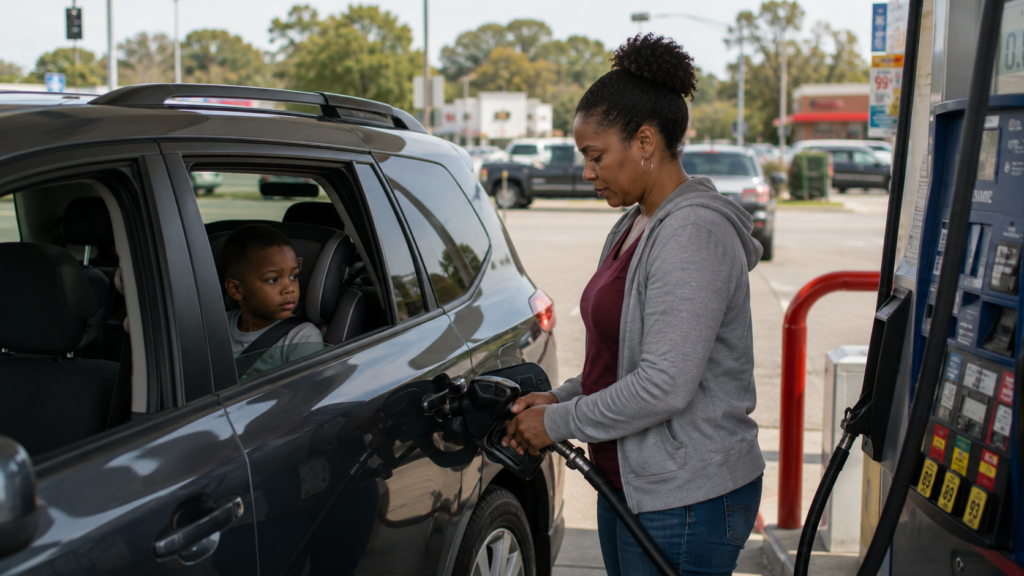
One reason the numbers can hit Georgia families hard is transportation.
Much of the state is car-dependent. Outside a few urban corridors, families often need a vehicle to get to work, school, child care, medical appointments and grocery stores.
That makes fuel, insurance, maintenance and car repairs harder to treat as optional expenses.
WABE cited Saloni Firasta-Vastani of Emory University’s Goizueta Business School, who noted that limited public transit makes fuel costs more difficult for Georgia households to absorb.
That is an important point.
In some places, a family can respond to rising gas costs by taking a train, bus or subway more often. In much of Georgia, that option either does not exist or does not work well enough for daily life.
So when transportation costs rise, families often cut somewhere else.
Hardship Looks Different by County
Statewide numbers can be useful, but they can also smooth over local differences.
United for ALICE county data shows wide variation across Georgia. Some counties have lower shares of households below the ALICE Threshold, while others have a majority of households struggling to afford basics. For example, the county data lists Bryan County at 31%, Bulloch County at 51%, Burke County at 54%, and Bibb County at 58% below the threshold.
That does not mean one county is simply “doing well” and another is “doing badly.” Local wages, rent, housing supply, transportation access, family size and job mix all shape the numbers.
But it does mean statewide averages should be read carefully.
A family in coastal Georgia, metro Atlanta, rural south Georgia or the Augusta area may face very different costs and job opportunities, even if all are counted in the same state-level figure.
That is why local context matters.
The Demographic Picture Is Broader Than One Group
According to the coverage from WABE and The Current, Black and Hispanic households showed the highest percentages of financial hardship, but the United Way of Greater Atlanta emphasized that all demographic groups in Georgia are affected.
That is an important framing.
The report does not describe hardship as limited to one neighborhood, one race, one age group or one kind of worker. It points to a wider affordability problem, even if some groups are more heavily affected than others.
That is often how cost-of-living pressure works. It does not land evenly, but it spreads widely.
A higher-income household may complain about prices and still have savings. A lower-income household may face the same price increase and have to skip something essential.
The percentage increase may be the same. The consequence is not.
What Families Can and Cannot Control?
Personal budgeting advice can help at the margins.
WABE reported that Firasta-Vastani recommended steps such as shopping at discount grocery stores and preparing meals at home as ways families can reduce costs.
Those are reasonable suggestions.
But they also have limits.
A family can meal prep and still face unaffordable rent. A worker can compare grocery prices and still need a car repair. A parent can cut back on nonessentials and still be unable to afford child care.
This is why the ALICE data should not be read only as a personal finance story.
It is also a wage story, a housing story, a transportation story, a health care story and a child care story.
Why Policymakers Watch These Numbers?
The ALICE report is useful because it captures households that often disappear in political debates.
They may not qualify for some forms of assistance. They may not show up in poverty statistics in the same way as lower-income households. But they are still financially fragile.
That matters for state and local government because these households are often one shock away from needing emergency help.
A missed paycheck, hospital bill, rent hike or vehicle problem can push a family from barely stable into crisis.
For policymakers, that raises harder questions than whether the poverty rate is up or down.
It asks whether working households can actually survive on the wages and costs available to them.
The Bottom Line
Nearly half of Georgia households are struggling to cover basic costs, according to United Way’s latest ALICE data and recent reporting from WABE and The Current.
The headline number is striking, but the details matter.
Many of these families are not counted as officially poor. They are above the federal poverty line, working, and still unable to reliably meet the real cost of living.
That makes this less a story about one bad month and more a warning about the gap between income measures and daily life.
For Georgia families, the test is not whether a spreadsheet says they are above poverty. It is whether they can pay for housing, food, utilities, child care, transportation and health care — and still have enough left to handle the next surprise.
For too many households, the answer appears to be no.