Aiman Tariq – Regional News Editor
Columbus, GA –
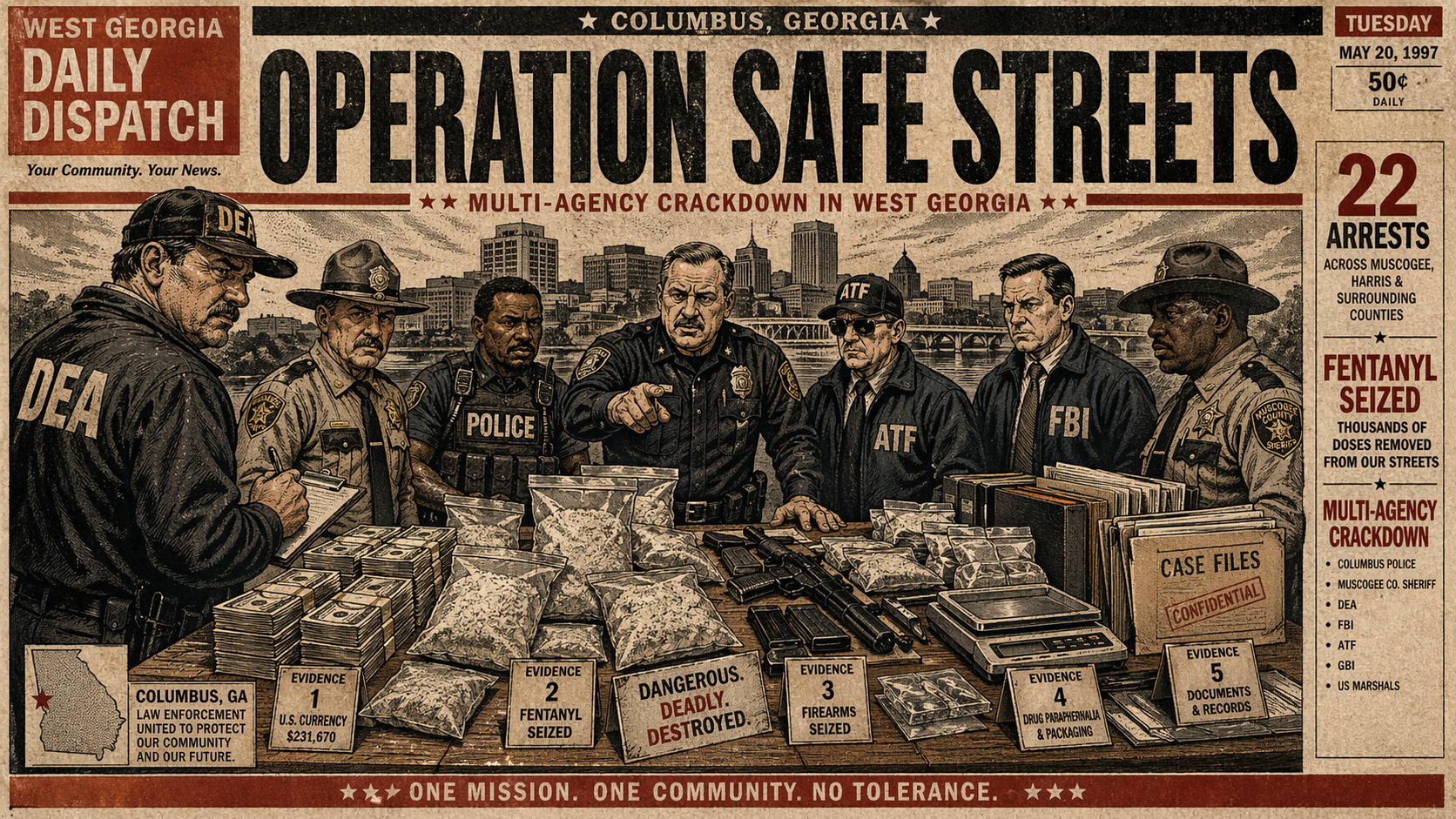
According to the Muscogee County Sheriff’s Office, a multi-agency operation targeting fugitives and narcotics activity in Muscogee County and neighboring Russell County led to 22 arrests, 55 cleared warrants, and the seizure of fentanyl, methamphetamine, cocaine, marijuana, firearms, and cash. Authorities say the effort, called Operation Safe Streets, was designed to support an ongoing crime-reduction push in the Columbus area.
The numbers are significant, but they should still be read the way law-enforcement seizure claims usually are: as official accounts of what officers say they found during a coordinated operation, not as a complete picture of the local drug trade. In cases like this, the arrests, the charges, and the claimed value of the drugs are all important. So is the reminder that those figures come from law enforcement and will be tested through the court process where applicable.
What Authorities Say Was Seized?
According to the sheriff’s office, the operation yielded 88 grams of fentanyl, 4.5 kilograms of methamphetamine, 1.45 pounds of cocaine, 1.9 pounds of marijuana, one bottle of promethazine, eight firearms, a stolen vehicle, two seized vehicles, and more than $11,800 in cash. WTVM also reported the sheriff’s office estimate that the total drug value was $522,270.
Authorities also said the amount of fentanyl seized had the potential to kill 45,000 people. That type of statement is common in drug-enforcement announcements and is meant to convey the danger of the substance, but it is still best understood as law enforcement’s public-safety framing rather than a literal count of likely outcomes. The more grounded takeaway is simpler: fentanyl remains one of the most dangerous drugs in circulation, especially because very small quantities can be lethal. DHS says as little as two milligrams can be deadly depending on purity and a person’s body size.
Multi-Agency Operation Crossed the State Line
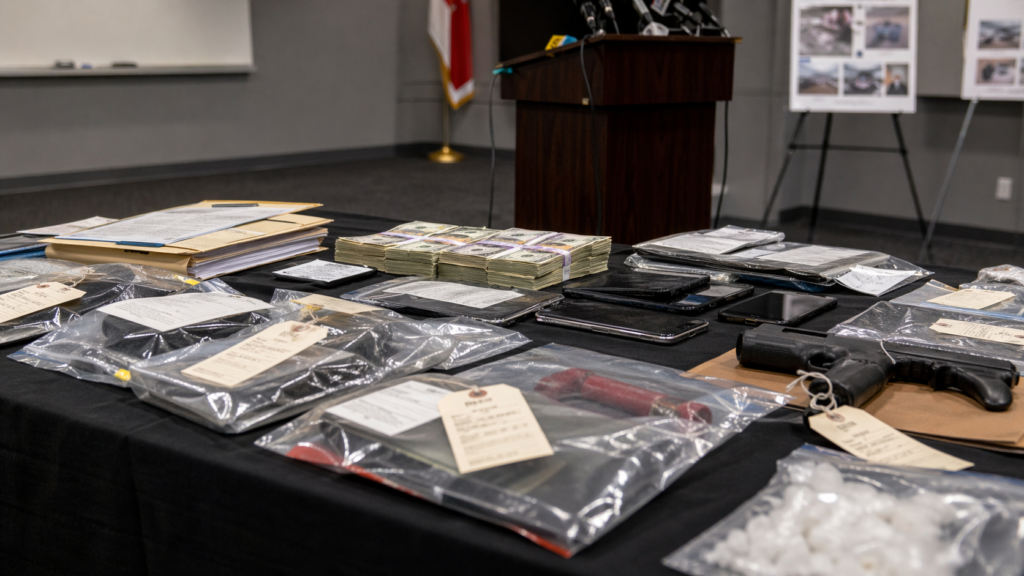
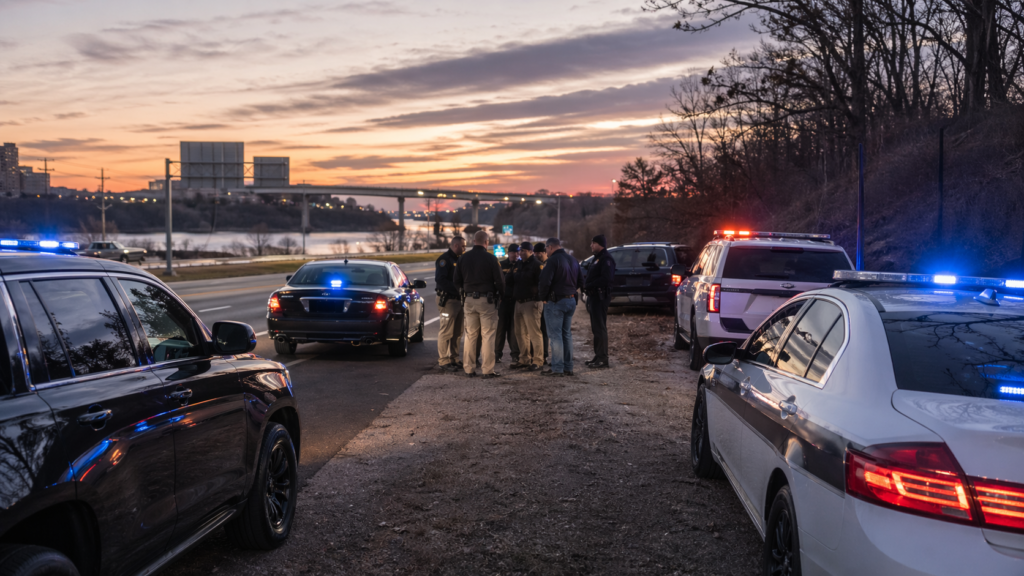
According to the sheriff’s office, the operation involved the Muscogee County Sheriff’s Office Collaborative Intelligence Group and Special Operations Unit, along with the Coweta County Sheriff’s Office, Georgia State Patrol, Russell County Sheriff’s Office, and the Phenix City Police Department.
That regional piece matters. Drug investigations often do not stop at a county line, and Columbus law enforcement has increasingly described its public-safety work as a cross-border effort involving east Alabama as well as west Georgia. The inclusion of Phenix City officers fits that pattern. It also explains why local readers searching for terms like phenix city library may have come across this operation even though the case itself centers on narcotics enforcement, fugitives, and joint police work rather than any library-related incident.
What the Operation Was Meant to Target?
Sheriff Greg Countryman said the goal was to make “impactful arrests” and continue what his office describes as a downward crime trend in Muscogee County. That framing is worth noting carefully. Operations like this can produce immediate results in the form of arrests, seizures, and recovered property. They do not, by themselves, prove a lasting reduction in violent crime or narcotics trafficking.
That is especially true with fentanyl and methamphetamine cases, where supply chains, street distribution, and overdose risk can shift quickly even after a significant seizure. Public statements often emphasize the immediate disruption. The longer-term question is whether those disruptions hold.
Why Street-Value Numbers Need Context?
One of the most quoted figures in cases like this is the claimed fentanyl street value or overall value of the narcotics seized. Those numbers can be useful as a rough shorthand, but they are not a market index in the usual sense. Street-value estimates vary by region, purity, packaging, and how agencies calculate equivalent retail distribution.
In this case, the sheriff’s office put the fentanyl alone at $26,400, methamphetamine at $421,100, cocaine at $66,070, and marijuana at $8,700. Those numbers help show scale, but they should still be read as law-enforcement estimates attached to a seizure announcement, not as audited market prices.
Firearms and Public-Safety Concerns
Authorities also reported eight seized guns. The sheriff’s office did not immediately provide a public breakdown tying each weapon to a specific charge in the public summaries cited by local outlets, so the safer reading is simply that firearms were recovered during the operation. That does not automatically mean every gun was illegally possessed, nor does it answer whether all of them were connected to trafficking counts.
Even so, guns remain a recurring part of major drug investigations, especially when investigators are targeting fugitives and narcotics networks at the same time. Online search spillover often pulls in unrelated phrases such as bulldogs firearms, but in this case the issue is narrower: the sheriff’s office says multiple weapons were taken during a regional enforcement effort aimed at drug trafficking and wanted suspects.
A Familiar Regional Pattern
Readers around Georgia may notice that crime and enforcement stories often travel well beyond the community where they begin. That is partly because regional audiences search for law-enforcement updates in clusters — sometimes alongside unrelated local queries such as clarkesville library or toccoa police dept — and partly because narcotics enforcement has become a shared concern across rural and metro jurisdictions alike.
That does not mean every operation has statewide significance. But it does explain why a Muscogee County seizure can draw attention from readers who are not in Columbus and may be following the broader issue of fentanyl, firearms, and cross-county policing rather than one specific case.
What Happens Next?
The immediate next step will be the court process for those arrested. The sheriff’s office has not framed the case as a single conspiracy indictment in the material cited by local reporting; instead, it presented the operation as a coordinated crackdown that cleared warrants and led to multiple arrests tied to narcotics investigations. That means the legal outcomes may unfold across different defendants, charges, and timelines.
The broader question for Columbus-area residents is whether this kind of operation becomes a periodic disruption or part of a sustained enforcement pattern. Law-enforcement agencies often point to large seizures as evidence that pressure is working. The harder measure is whether overdose risk, trafficking activity, and gun-related crime actually decline over time.
The Bottom Line
According to the Muscogee County Sheriff’s Office, Operation Safe Streets resulted in 22 arrests, 55 cleared warrants, and the seizure of fentanyl, methamphetamine, cocaine, marijuana, cash, vehicles, and eight firearms.
The operation appears to have been substantial, especially given the amount of methamphetamine recovered and the cross-agency coordination involving Georgia and Alabama departments. But the sheriff’s claims about impact still need to be understood as law-enforcement claims at the front end of a criminal case, not the final word on what the operation will mean for public safety.
For now, the clearest takeaway is that authorities are still treating fentanyl and multi-agency narcotics enforcement as a central part of the region’s crime strategy — and that the courts, not the press release, will determine what comes next for the people arrested.