Aiman Tariq – Regional News Editor
Cartersville, GA –
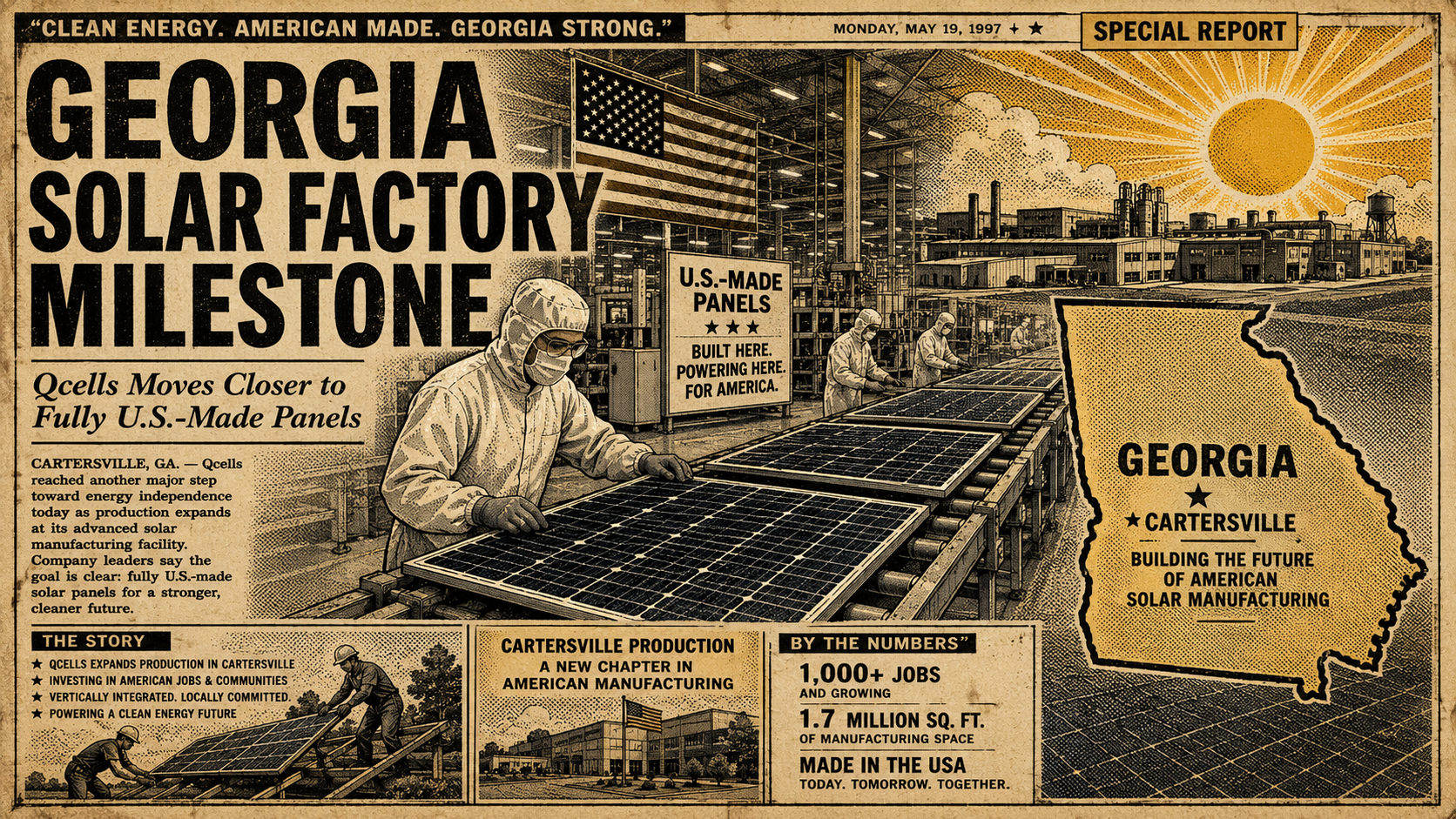
Solar manufacturing in Georgia has reached a new milestone, with Qcells beginning production of solar cells at its Cartersville factory as the company moves closer to building fully U.S.-made solar panels.
The development is being described as a major step for the domestic solar supply chain. But it is also a reminder of how complicated that supply chain still is. Solar panels may look simple once installed on rooftops or in large fields, but the manufacturing path behind them runs through several technical stages — and for years, many of those stages have depended heavily on overseas production.
That is what Qcells is trying to change in northwest Georgia.
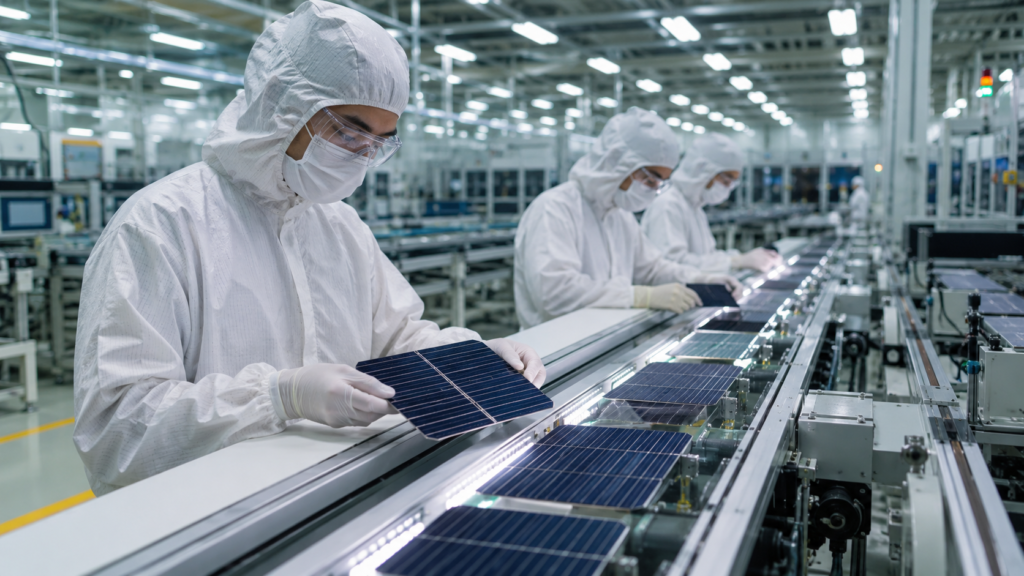
According to WABE, the company has started making the solar cells that go inside panels at its new Cartersville facility. Qcells has assembled solar modules in Dalton since 2019, but the ingots, wafers and cells used in those panels had previously been produced abroad.
The difference matters because cells are not just another part of the panel. They are the component that converts sunlight into electricity.
Why Do Solar Cells Matter?
Solar panel manufacturing is often discussed as if the panel itself is the whole story.
It is not.
A solar module is built from several major components. Ingots are processed into wafers. Wafers become cells. Cells are then assembled into modules, which are the finished panels most people recognize.
Until now, the United States has had far more capacity to assemble modules than to make the upstream components that go into them.
Reuters reported this week that the United States has about 3.2 gigawatts of solar cell capacity, compared with about 60 gigawatts of panel capacity. That gap means many U.S. panel factories still depend on imported cells.
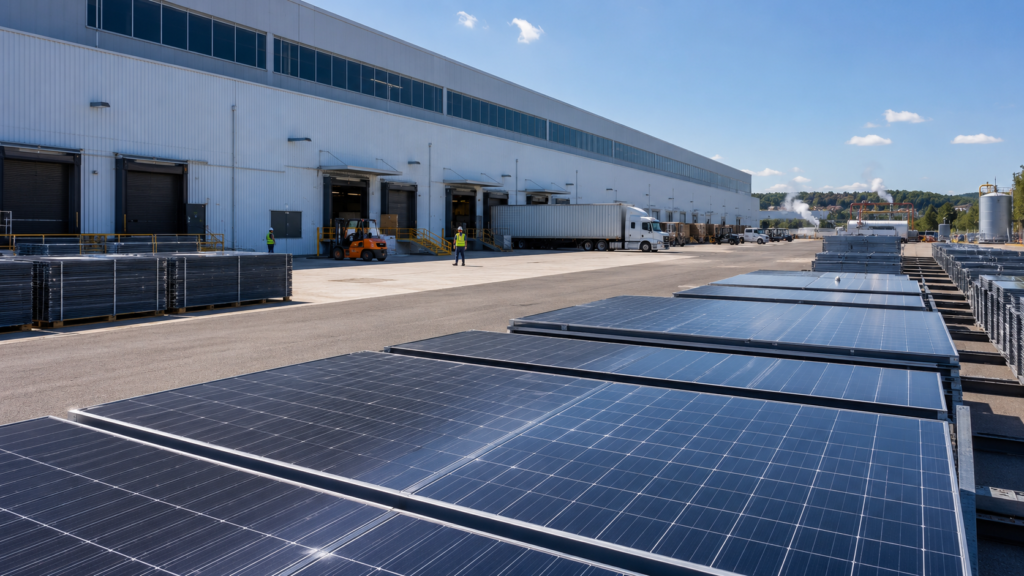
That is why Qcells’ Cartersville production is getting attention. If the factory reaches full production, the company says it will add 3.3 gigawatts of annual capacity for ingots, wafers and cells, along with 3.5 gigawatts of module capacity.
That would not solve every U.S. solar manufacturing challenge. But it would move one of the most important missing pieces onto American soil.
A Georgia Factory With National Significance
Qcells’ Cartersville plant is part of a larger Georgia footprint.
The company already operates a solar module factory in Dalton, which opened in 2019 and has expanded multiple times. The Cartersville project is meant to go further by bringing several major stages of production under one roof.
Qcells says the Cartersville site will be the first and only factory in the United States to make the major parts of a silicon solar module in one place, from ingot to finished panel.
That claim is significant, but it also needs to be read carefully.
“Fully U.S.-made” solar manufacturing is not only about where final panels are assembled. It depends on where the key materials and components come from, how much of the supply chain is domestic, and whether production can operate without routine disruption from customs, tariffs or overseas bottlenecks.
That is where this project is different from a normal factory expansion. It is not just adding output. It is trying to shorten the distance between raw manufacturing steps and finished panels.
Supply Chain Problems Pushed the Issue
The timing is not accidental.
Qcells and other solar manufacturers have faced recurring pressure from trade rules, customs reviews and concerns about forced-labor links in overseas supply chains. Those issues have slowed imports and complicated production for companies that rely on foreign-made components.
Last year, Qcells reduced production and furloughed workers after delays tied to imported components. The company said at the time that it expected operations to normalize, but the disruption showed why domestic cell production has become more than a political talking point.
If a factory in Georgia can make more of the critical parts itself, it reduces exposure to some of those overseas delays.
That does not mean the company becomes immune to global market pressure. Solar remains a global industry. Prices, trade policy and foreign competition still matter. But making cells in Cartersville gives Qcells more control over one of the most important stages of production.
Georgia’s Role in Clean-Energy Manufacturing
Georgia has become a major state for electric vehicles, batteries and solar manufacturing.
Qcells is one part of that larger shift. The company announced in 2023 that it would invest more than $2.5 billion to expand solar manufacturing in Georgia, including the Cartersville facility and additions to the Dalton operation.
State officials framed that announcement as one of the largest clean-energy manufacturing investments in Georgia history. The project was also expected to create thousands of jobs in northwest Georgia.
That matters for the state’s economic-development strategy. For years, Georgia has tried to position itself as a manufacturing hub for the energy transition, not just a consumer market for clean-energy products.
Solar manufacturing fits that strategy because it connects industrial jobs, domestic supply chain policy and growing electricity demand.
Still, the long-term results will depend on more than ribbon cuttings. Factories need stable demand, reliable supply chains, trained workers and policies that do not shift too abruptly from year to year.
What the Company Says Comes Next?
Qcells says it plans to fully ramp up production at the Cartersville factory later this year.
Once the Cartersville and Dalton facilities are operating at full capacity, the company says the two Georgia sites are expected to produce about 47,000 panels per day. Qcells says that would be enough annual output to power more than 1 million homes for a year.
Those are company figures, and they should be treated as projections rather than guaranteed outcomes. Production targets depend on ramp-up speed, market demand, labor availability, equipment performance and federal policy.
But even as projections, they give a sense of the scale Qcells is aiming for.
The company is not simply adding a line of panels. It is trying to build a domestic manufacturing chain that can compete in an industry long dominated by Asia-based production.
Tax Credits and Trade Policy Shape the Market
Federal policy is a major part of the story.
The solar, battery and electric-vehicle industries have all tried to bring more production to the United States partly because of tax credits and incentives that favor domestic manufacturing.
The U.S. Department of Energy finalized a $1.45 billion loan guarantee in 2024 to support Qcells’ Cartersville facility. The department said the facility would produce ingots, wafers, cells and finished solar panels, and would help reestablish critical parts of the domestic solar supply chain.
That support gives the project a public-policy dimension. Supporters argue that the United States needs domestic manufacturing capacity for energy security and economic competitiveness. Critics of industrial incentives often argue that government-backed manufacturing projects should be judged by whether they deliver lasting jobs, cost-effective output and real supply chain resilience.
Both questions will follow the Cartersville plant.
The factory may be a milestone, but the larger test is whether it can operate competitively over time.
Why Does This Matter Beyond Solar Panels?
The solar industry is growing because electricity demand is rising and because utilities, companies and households continue to add renewable power.
But domestic manufacturing has lagged behind installation growth. The U.S. has built a large market for solar deployment without building an equally complete domestic supply chain.
That mismatch is what policymakers and manufacturers are now trying to fix.
Qcells’ Georgia expansion shows how that correction might look: large factories, federal backing, state economic-development support, and companies trying to move more steps of production closer to the final customer.
The risk is that manufacturing plans can run ahead of market conditions. Global solar prices remain highly competitive, and manufacturers in China and Southeast Asia still dominate many parts of the supply chain.
That means U.S. factories may need more than patriotic branding. They will need scale, efficiency and consistent policy support.
The Local Economic Question
For Cartersville, Dalton and the surrounding northwest Georgia region, the immediate question is more practical.
How many stable jobs will the facilities support? How much of the supplier network will remain in Georgia or nearby states? And will the investment continue to grow if solar prices or federal policies change?
Those questions are not meant to undercut the significance of the announcement. They are the questions that determine whether a manufacturing milestone becomes a long-term regional industry.
Georgia has already seen major announcements tied to clean-energy manufacturing. The harder part is turning those announcements into durable economic infrastructure.
For Qcells, beginning solar cell production in Cartersville is a clear step forward.
Whether it becomes the model for U.S. solar manufacturing will depend on what happens after the ramp-up.
The Bottom Line
Qcells has started producing solar cells at its Cartersville factory, moving Georgia closer to the center of U.S. solar manufacturing.
The company already assembles solar modules in Dalton, but the Cartersville facility is designed to bring more of the upstream supply chain — including ingots, wafers and cells — into domestic production.
That is a meaningful shift for an industry that has relied heavily on overseas components.
It also comes after recent supply chain disruptions showed how vulnerable U.S. panel manufacturing can be when key parts are imported.
For Georgia, the project is another sign that the state is becoming a major clean-energy manufacturing hub. For the U.S. solar industry, it is a test of whether domestic production can move beyond assembly and into the harder, more technical parts of the supply chain.
The announcement is a milestone. The next question is whether the factory can scale reliably enough to make “made in America” solar panels more than a slogan.