Aiman Tariq – Regional News Editor
Atlanta, GA –
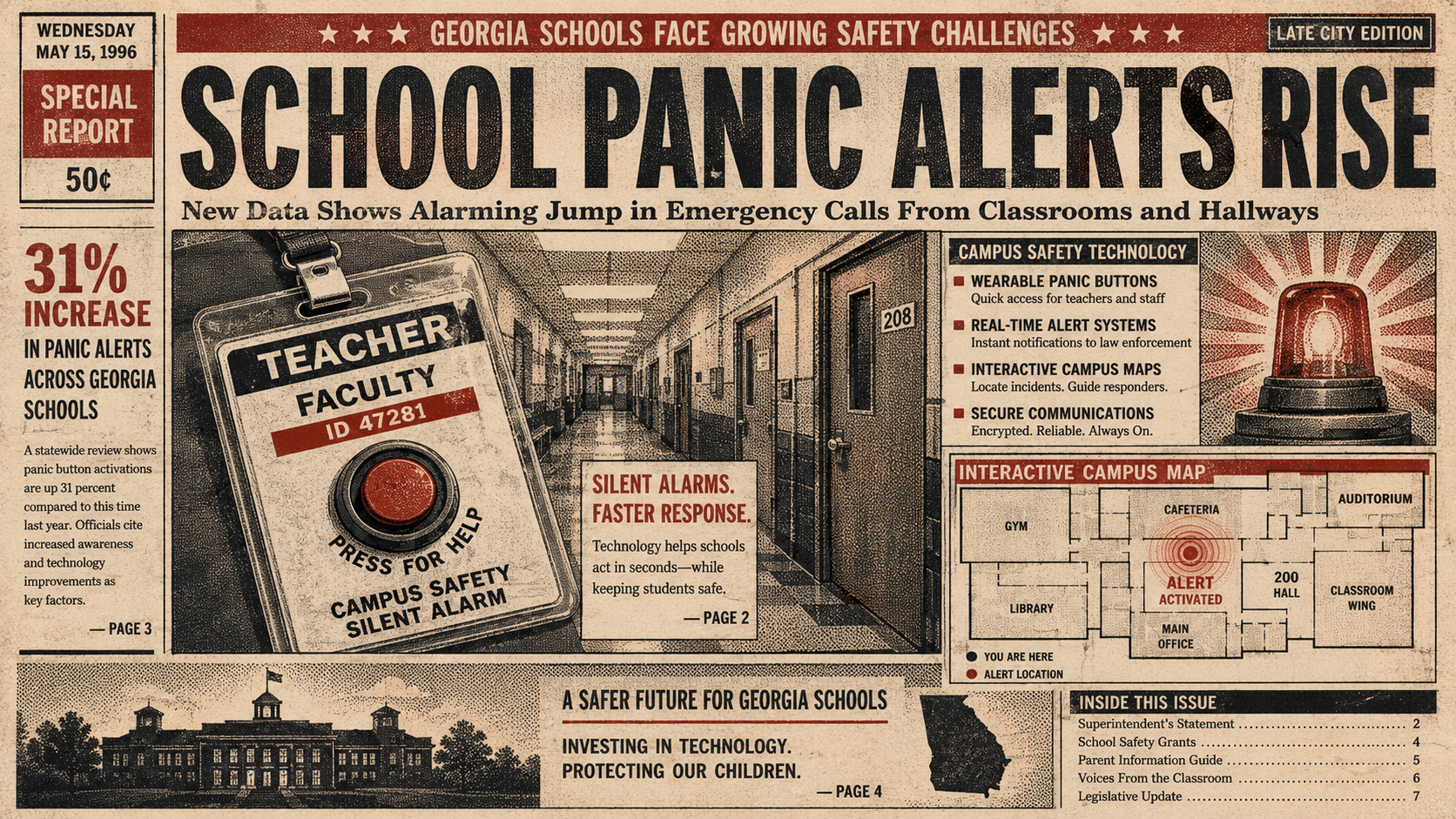
School safety technology is often discussed in the context of worst-case emergencies. But a new school safety trends report suggests that wearable panic buttons are being used far more often for the everyday problems that can unfold across a campus long before they become headlines.
According to a 2026 School Safety Trends Report from CENTEGIX, a metro Atlanta-based panic button and crisis alert company, school panic button alerts increased 31% compared with the previous school year.
That number does not mean schools are suddenly facing more extreme threats. It may mean something more complicated: educators are using alert systems more often, and for a wider range of situations, as districts try to shorten response times and improve visibility across campuses.
That distinction matters. A panic button is not a safety plan by itself. It is a tool. The question is what schools do after it is pressed.
What the Report Says?
According to CENTEGIX, the report is based on more than 346,000 alerts from K-12 schools using its crisis alert system.
The company says alerts were up 31% compared with the previous school year. Most of those alerts were not for active threats or campus-wide lockdowns.
According to the report, 88% of alerts were tied to student behavior or staff support situations, including physical altercations, students leaving campus without permission, or other incidents where an educator needed help.
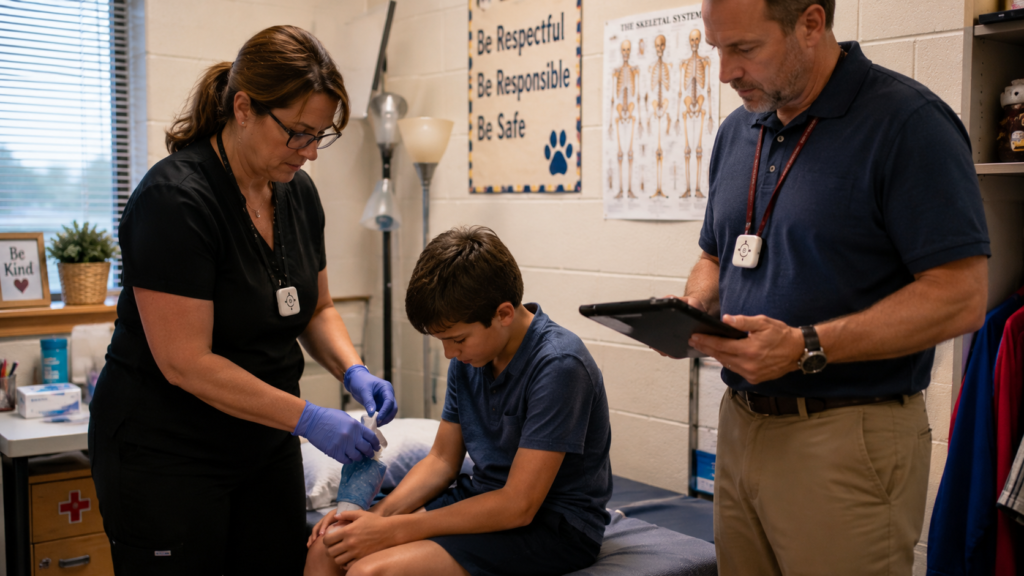
Another 10% of alerts were connected to medical emergencies, including seizures, cardiac arrest, allergic reactions, and similar situations where response time can matter.
Only about 1% of alerts were described as extreme, campus-wide emergencies requiring broader lockdown responses.
That breakdown is important because it pushes the discussion away from one narrow idea of school safety. The technology is often sold publicly around active threats. But according to the company’s own numbers, most alerts are being used for problems that are more routine, more frequent, and easier to miss from a district office.
Why Location Data Matters?
One of the central claims in the report is that location matters almost as much as the alert itself.
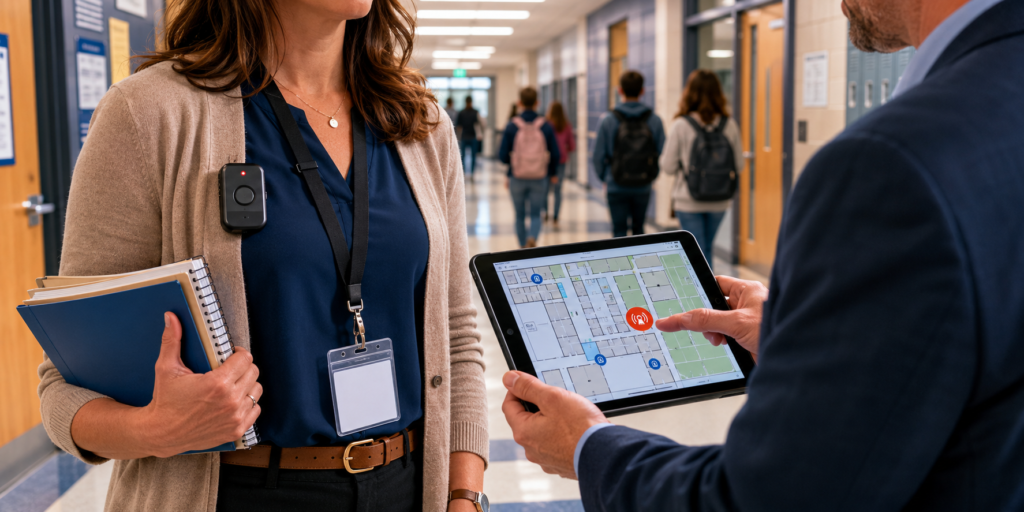
A traditional emergency call can tell responders that something is happening at a school. A wearable panic button system is meant to show where on campus the alert was triggered.
That can make a difference on large campuses where a gym, cafeteria, bus lane, playground, front office, and classroom wing may all require different response routes.
According to the report, 58% of incidents occurred outside the classroom, including hallways, exterior areas, and cafeterias. That is a practical detail, not just a technology talking point.
Many school safety plans still treat the classroom as the center of the emergency. But students and staff move constantly. A fight may begin in a hallway. A medical emergency may happen at lunch. A threat may appear near a bus lane during dismissal. If the alert system only works well from a classroom, it may miss the places where many incidents actually happen.
That is why campus-wide coverage has become a major part of the conversation.
The Valdosta Example
The report points to a September 2025 incident at S.L. Mason Elementary School in Valdosta as an example of how the system can work in real time.
According to coverage cited by the company and later described by a school administrator, an armed individual was outside the school near a parent and visitor entrance during dismissal. An administrator used a CrisisAlert badge, and the school was placed into lockdown within 37 seconds.
No students, staff, or parents were injured.
That is the kind of example school safety companies often highlight because it is easy to understand. An alert was triggered. A lockdown began quickly. Law enforcement and school staff responded. The situation ended without injuries.
But even there, the more useful lesson is not simply that a panic button was available. It is that the school had a system, staff knew how to use it, and the response protocols were already in place.
That is where technology can help. It can compress the time between recognition and response. It cannot replace training, staffing, communication, or judgment.
Apalachee High School Still Shapes the Conversation
In Georgia, any discussion of school panic buttons now sits in the shadow of the 2024 shooting at Apalachee High School in Barrow County.
Teachers used newly installed wearable panic buttons during that attack to alert law enforcement. Reuters reported at the time that responding officers could use the alert location on school maps, and a school resource officer took the suspect into custody within minutes of the first report.
Four people were killed in that shooting. The system did not prevent the attack. But officials later said the response may have helped prevent the situation from becoming even worse.
That is the difficult balance in this debate. Panic buttons are not a guarantee. They do not answer the deeper questions about weapons, threats, mental health, school staffing, or law enforcement response.
But they may reduce confusion during the first moments of a crisis.
And in school emergencies, those first moments tend to carry the most pressure.
Georgia’s New Law Raises the Stakes
Georgia moved to expand school safety requirements after Apalachee.
In 2025, Gov. Brian Kemp signed legislation commonly referred to as Ricky and Alyssa’s Law. The measure requires public schools to strengthen emergency mapping and provide silent panic alarm capability that can directly alert emergency responders.
The law is named in part for Alyssa Alhadeff, one of the students killed in the 2018 Marjory Stoneman Douglas High School shooting in Florida, and for Richard Aspinwall, a teacher and coach killed at Apalachee High School.
According to state and local reporting, the law gives Georgia public schools time to provide updated campus maps to law enforcement and place panic alert devices in the hands of teachers and administrators.
That creates a new baseline. Panic buttons are no longer just an optional technology purchase for districts that can afford them or want them. In Georgia, they are becoming part of the expected school safety infrastructure.
What Panic Buttons Can and Cannot Do
There is a tendency in public safety debates to turn technology into a solution. That can be misleading.
Wearable panic buttons can help staff call for assistance quickly. They can reduce the time spent looking for a phone, explaining a location, or waiting for a message to move through several people.
They can also help administrators see patterns over time: where incidents are happening, when staff most often need support, and whether certain parts of a campus require more supervision.
But they cannot tell schools why incidents are rising. They cannot decide whether a student needs discipline, medical care, counseling, or a different placement. They cannot replace adult supervision in hallways or staffing at dismissal.
The data may show more alerts. That does not automatically mean schools are less safe. It may mean staff are more willing to ask for help. It may mean incidents are being logged more consistently. It may mean systems are being used for lower-level concerns before they escalate.
That is why the 31% increase should be treated as a signal, not a verdict.
Behavior Alerts Are the Bigger Story
The most revealing number may not be the overall increase. It may be the 88% share of alerts tied to behavior and staff support.
That points to a reality many educators already know: school safety is not only about rare catastrophic events. It is also about the daily strain of managing student conflict, medical issues, supervision gaps, and unpredictable behavior across a campus.
If a teacher or staff member can quietly call for help before a situation worsens, that may prevent an incident from becoming more serious.
But the number also raises questions. Are schools seeing more student behavior problems? Are staff using alerts more often because they have better tools? Are schools short on personnel, making rapid support more necessary?
The report does not answer all of that. It gives a starting point.
That is usually how safety data should be read. It shows where to look next.
The Medical Side of School Safety
The 10% figure for medical emergencies also deserves attention.
Schools are not hospitals, but they are places where medical emergencies happen. A seizure, allergic reaction, cardiac issue, or serious injury can become more dangerous if staff lose time finding the right person or calling for help.
In those cases, a panic button is less about security and more about coordination.
The same system that alerts administrators to a fight in a hallway may also alert trained personnel to a medical emergency in a classroom, cafeteria, or athletic area.
That is part of why districts increasingly describe panic systems as broader safety tools rather than only active-threat technology.
The Business Behind the Trend
CENTEGIX says it operates in 90% of Georgia schools. That is a major market presence, and it matters when reading the report.
The company has an obvious interest in showing that panic button technology is useful and expanding. That does not make its numbers meaningless. It does mean readers should understand where the data is coming from.
The report is not an independent government audit. It is a company report based on alerts generated through its own platform.
That does not mean the trends are wrong. But it does mean the numbers should be read with the same caution applied to any industry-backed report: useful, but not the whole picture.
The better question is not whether panic buttons are good or bad. The better question is how schools use them, how often they are tested, how well staff are trained, and whether the data helps districts make better decisions.
The Bottom Line
School panic button alerts are rising, according to a new safety trends report from CENTEGIX.
The company says alerts increased 31% compared with last school year, with most alerts tied to behavior incidents and staff support rather than campus-wide threats.
That suggests wearable panic buttons are becoming part of daily school operations, not just emergency planning for rare attacks.
In Georgia, the trend carries extra weight because state law now requires stronger emergency mapping and panic alert capabilities in public schools.
The technology may help schools respond faster. But it should be treated as one layer of safety, not the whole system.
The real test is whether districts use the data to improve staffing, training, supervision, medical response, and emergency coordination — not just whether more buttons are being pressed.