Aiman Tariq – Regional News Editor
Columbia, SC –
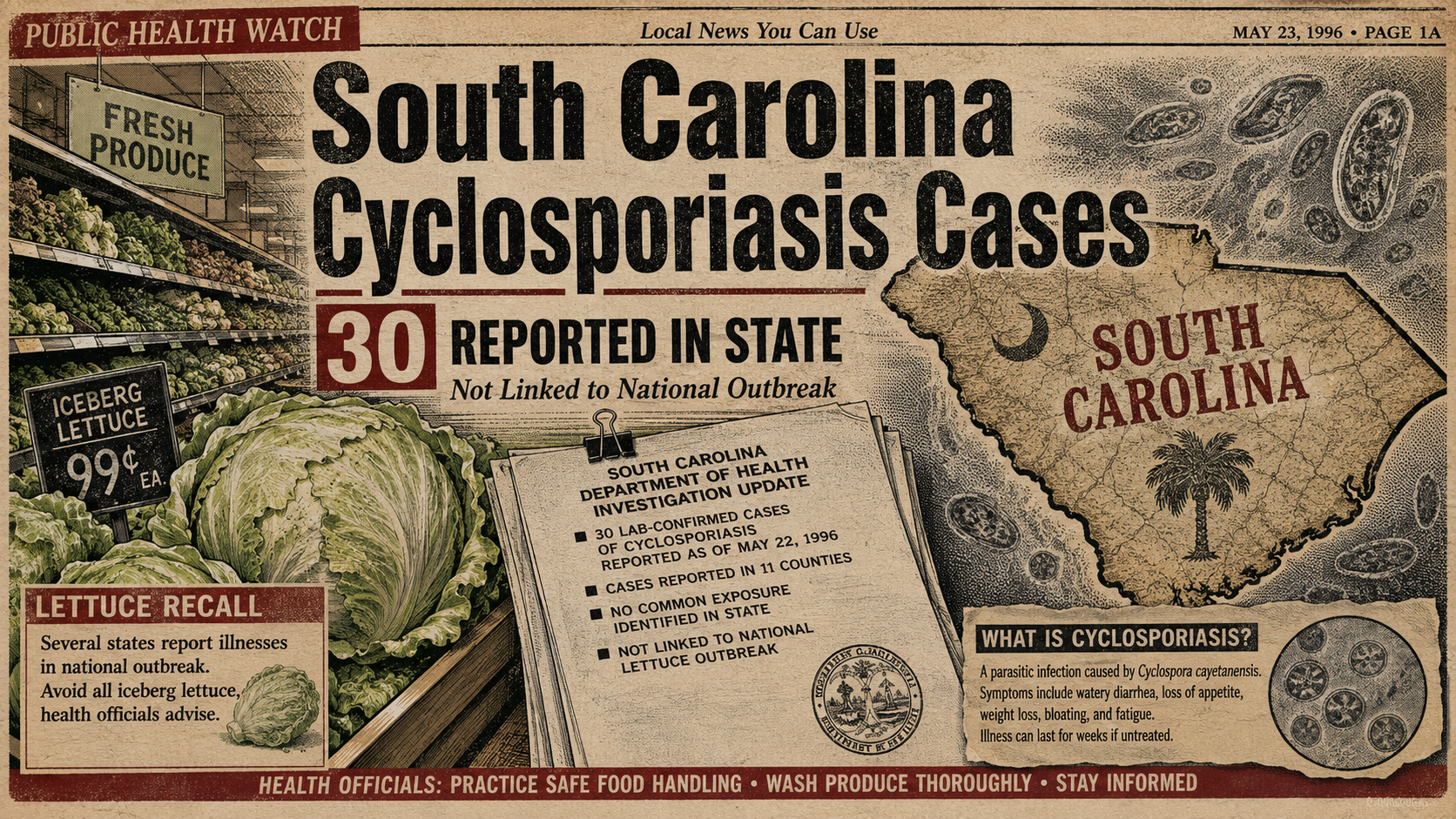
South Carolina has reported 30 confirmed cases of cyclosporiasis this year, but state health officials say those cases have not been linked to the larger national outbreak connected to recalled iceberg lettuce.
That distinction matters.
A rising national case count can make every state number look like part of the same story. But in foodborne illness investigations, the source matters as much as the total. A case in South Carolina may involve the same parasite as cases elsewhere, while still not matching the exposure pattern or laboratory evidence tied to the multistate outbreak.
According to the South Carolina Department of Public Health, the state’s cases have not matched the national outbreak “through exposure or laboratory data” as of the latest update. The department reported 30 confirmed cases as of July 21 and said it will update state counts weekly on Wednesdays for the foreseeable future.
What South Carolina Is Reporting?
The South Carolina Department of Public Health says the state has confirmed 30 cyclosporiasis cases so far this year.
That number is not far outside the state’s recent pattern. Officials told South Carolina Public Radio that the state confirmed 24 cases in 2025 and 25 cases in 2024, while averaging about 50 cases per year.
That makes the current number worth watching, but not necessarily proof of a statewide outbreak.
This is the difference between a signal and a conclusion. A signal tells public health officials to keep checking food histories, lab results, and exposure patterns. A conclusion requires stronger evidence that cases share a source.
So far, state officials say that evidence has not connected South Carolina’s cases to the national iceberg lettuce outbreak.
The National Outbreak Is a Different Question
The national investigation is moving on a separate track.
The Food and Drug Administration says it is investigating a nine-state outbreak of Cyclospora infections linked to iceberg lettuce sourced from central Mexico and recalled by Taylor Farms de Mexico. According to the FDA, Taylor Farms announced on July 17 that it was voluntarily removing all iceberg lettuce sourced from central Mexico from the U.S. market.
Earlier federal updates had described a smaller five-state outbreak linked to shredded iceberg lettuce served at Taco Bell locations in Indiana, Kentucky, Michigan, Ohio, and West Virginia. The investigation later expanded, and the FDA’s current outbreak page describes a nine-state inquiry tied to iceberg lettuce sourced from central Mexico.
That does not mean every cyclosporiasis case in the country is part of the same cluster.
It means federal and state officials are working through a large and still-developing investigation, where some cases may be linked to the recalled product and others may turn out to be unrelated seasonal infections.
For South Carolina, the key point is narrower: state officials say the 30 confirmed cases have not matched the national outbreak through the evidence reviewed so far.
How Officials Decide Whether Cases Are Connected?
Cyclosporiasis investigations are not as simple as counting symptoms.
According to South Carolina Public Radio’s reporting, state public health officials review a patient’s food history and test the patient for cyclosporiasis. If a possible connection to a broader outbreak is suspected, lab specimens can be sent to the CDC for additional review.
That process matters because two people can have the same illness without getting it from the same source.
Dr. Martha Buchanan, director of the state’s Bureau of Communicable Disease Prevention and Control, told South Carolina Public Radio that state officials cannot determine at the state level alone whether a person is connected to cases in other states. Lab specimens can be sent to CDC to determine whether the strain resembles the one making people sick elsewhere.
That is why the state’s wording is careful.
South Carolina is not saying the national outbreak is irrelevant. It is saying its known cases do not currently line up with that outbreak.
What Cyclosporiasis Is?
Cyclosporiasis is an intestinal illness caused by the microscopic parasite Cyclospora cayetanensis.
According to the CDC, people can become infected after consuming food or water contaminated with Cyclospora. Symptoms usually begin about one week after exposure, though the range can be as short as two days or as long as two weeks or more. Watery diarrhea is the most common symptom, and untreated symptoms can last from a few days to a month or longer.
Other symptoms can include stomach cramps, nausea, fatigue, low-grade fever, vomiting, muscle aches, and loss of appetite.
That symptom list overlaps with many other gastrointestinal illnesses. That is why testing matters. A person who suspects cyclosporiasis should contact a health care provider rather than assuming the cause based on recent meals or national headlines.
The CDC says most healthy people eventually recover without treatment, though illness may be prolonged. The usual treatment recognized for Cyclospora infection is trimethoprim-sulfamethoxazole, often known by brand names such as Bactrim, Septra, or Cotrim, but treatment decisions should be made by a health care provider.
Why Spring and Summer Matter?
South Carolina officials say cyclosporiasis cases usually rise in warmer months.
According to South Carolina Public Radio, Buchanan said May 1 through Aug. 31 is when the state typically sees most cases. That pattern is one reason the current 30 cases are being watched, but not automatically treated as unusual.
Seasonality can make public health communication harder.
If cases rise during the same period as a national outbreak, the public may assume the two are connected. Sometimes they are. Sometimes they are not. The job of public health investigators is to separate overlapping patterns from actual links.
That is especially important with produce-related illnesses, where foods can move through national supply chains and symptoms can appear days after exposure.
The Recall Question for Consumers
The consumer message from South Carolina officials is more measured than panic.
Buchanan told South Carolina Public Radio that consumers do not need to change their shopping patterns. She said recalled products should no longer be on grocery store shelves, but people should check any lettuce already in their refrigerators and throw it away if it is part of the recall.
The FDA recall notice says Taylor Farms de Mexico voluntarily removed all iceberg lettuce sourced from central Mexico from the U.S. market because of potential Cyclospora contamination. The company said it suspended distribution of the implicated lettuce and was working with federal and state officials.
The practical advice is not complicated:
- Check recall notices if you have iceberg lettuce at home.
- Do not eat recalled lettuce.
- When in doubt about a recalled product, throw it away.
- Wash fresh produce under running water as a routine food-safety step.
- Contact a doctor if symptoms suggest possible cyclosporiasis.
That last point matters because washing may reduce some food-safety risks, but it does not turn recalled food into safe food.
Why Can Numbers Be Confusing?

The national numbers are moving quickly.
Reuters reported this week that the CDC had identified 4,173 laboratory-confirmed domestically acquired cyclosporiasis cases since May 1 and was investigating more than 7,400 additional reported infections that had not yet been laboratory confirmed.
Other national coverage has focused on the subset of cases linked to the iceberg lettuce outbreak. That can produce different numbers in different stories, depending on whether the count refers to all reported Cyclospora illnesses, confirmed domestically acquired cases, or the specific outbreak linked to recalled lettuce.
That is not necessarily a contradiction.
It is another example of why public health numbers require careful labels. “Total cases,” “confirmed cases,” “reported infections,” and “outbreak-linked cases” are not the same thing.
For South Carolina readers, the most relevant number remains the state’s official count: 30 confirmed cases so far this year, with no current exposure or lab match to the national outbreak.
What Officials Are Watching Now?
South Carolina officials say they are continuing routine surveillance and communicating with regional and national partners.
According to South Carolina Public Radio, Buchanan said the state is following national cases and participating in calls when CDC holds nationwide briefings. The state health department says it will continue updating its cyclosporiasis page weekly.
That approach fits the current facts.
There is not yet evidence that South Carolina’s cases are part of the national lettuce outbreak. But there is also no reason for health officials to ignore a fast-moving national investigation involving a parasite that can be difficult to trace.
Food histories, lab testing, and timing will matter more than headlines.
What This Means for South Carolina Families?
For most South Carolina families, the guidance is practical rather than dramatic.
If someone has symptoms such as ongoing watery diarrhea, stomach cramps, nausea, fatigue, vomiting, muscle aches, or low-grade fever, they should contact a health care provider and ask whether testing is appropriate.
If a household has iceberg lettuce that may fall under the Taylor Farms de Mexico recall, the safer step is to discard it.
And if residents are eating out, state officials say recalled lettuce should no longer be distributed to restaurants. But consumers can still pay attention to public health updates, especially because produce-related investigations can change as more data comes in.
The broader lesson is not that every salad is dangerous.
Foodborne illness tracking depends on details: what someone ate, where the product came from, when symptoms began, and whether laboratory evidence connects one case to another.
The Bottom Line
South Carolina has confirmed 30 cyclosporiasis cases so far this year, but state public health officials say those cases are not currently linked to the national iceberg lettuce outbreak.
The national investigation remains significant. Taylor Farms de Mexico has recalled iceberg lettuce sourced from central Mexico, and federal agencies continue to investigate a multistate outbreak tied to that product.
But for South Carolina, the evidence so far points to a more limited conclusion: cases are being monitored, lab work and food histories matter, and officials have not identified a connection to the national cluster.
That could change if new evidence emerges.
For now, the responsible reading is simple: watch the numbers, check the recall, don’t eat recalled lettuce, and don’t assume every South Carolina case belongs to the same outbreak before the data supports it.
Follow us for updates on this developing public health story and more regional coverage.