Aiman Tariq – Regional News Editor
Charleston, SC –
A New York tattoo company and two South Carolina residents are challenging state restrictions that limit where tattoo shops can open and what parts of the body tattoo artists may legally ink.
The federal lawsuit, filed by Tiny Zaps and Greenville residents Joshua and Stephanie McDonald, argues that South Carolina’s tattoo laws go beyond ordinary health and safety regulation and instead place special burdens on artistic expression.
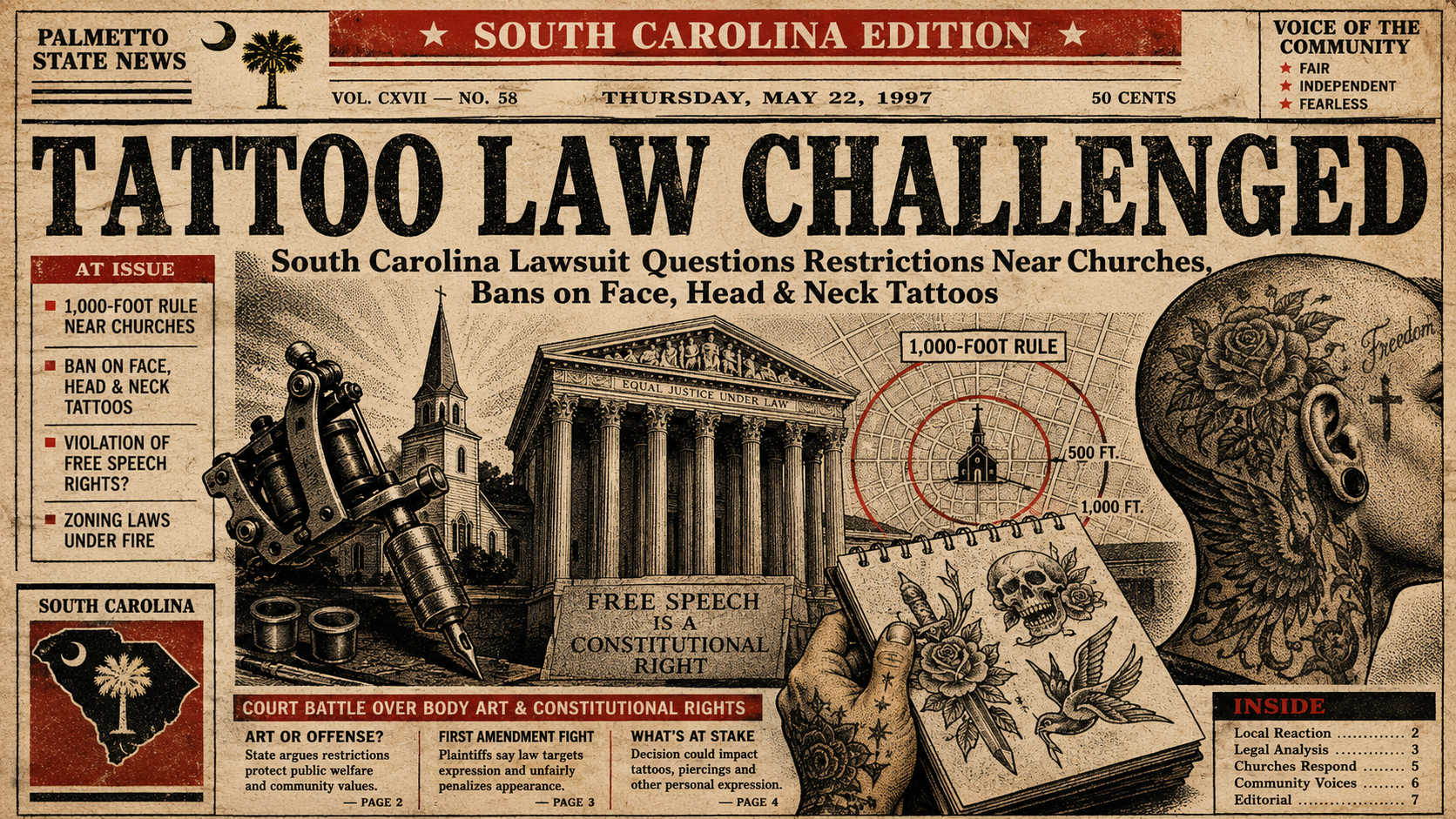
At issue are two rules. One prevents the state from issuing a tattoo facility license within 1,000 feet of a church, school or playground. The other makes it unlawful for a tattoo artist to tattoo another person’s head, face or neck. Under South Carolina law, violating provisions of the tattoo chapter is a misdemeanor punishable by a fine of up to $2,500, up to one year in jail, or both.
That is why the case is about more than one pop-up tattoo event in Charleston. It asks a broader question: when does public health regulation become a restriction on speech?
What the Lawsuit Challenges
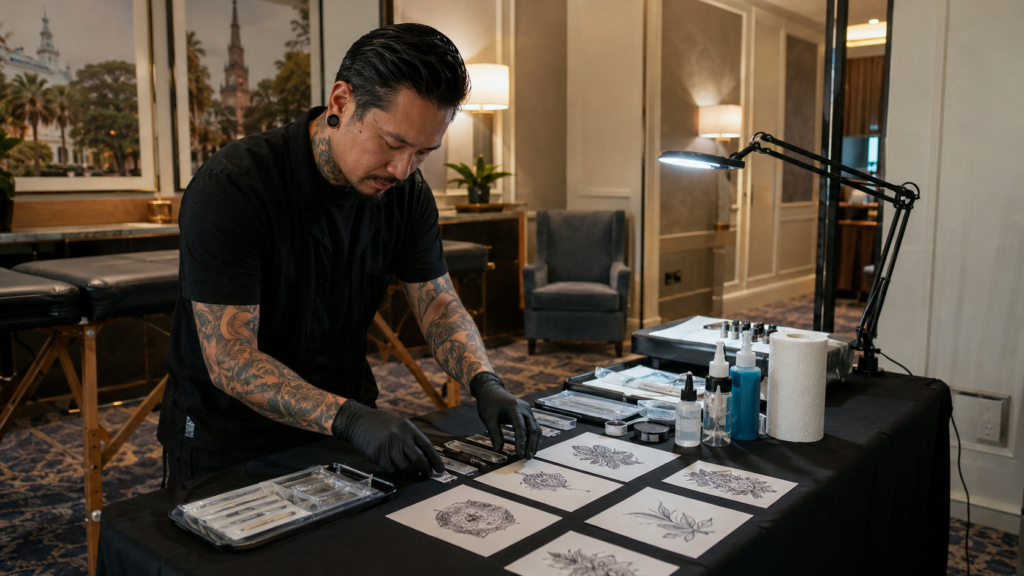
According to Pacific Legal Foundation, which is representing the plaintiffs, Tiny Zaps is a New York-based company that offers small, artist-designed tattoos through online booking, digital tools and pop-up events. The company wants to operate a pop-up at a hotel in downtown Charleston, but says South Carolina’s location restrictions make that plan effectively impossible.
The lawsuit challenges South Carolina’s rule barring tattoo facilities within 1,000 feet of a church, school or playground. State law says that distance is measured along the shortest ordinary pedestrian or vehicle route from the protected location to the proposed tattoo business.
That sounds like zoning language. But the plaintiffs argue it functions as something larger.
According to the Pacific Legal Foundation, South Carolina has more than 7,000 churches, and the 1,000-foot buffer leaves few viable locations for tattoo businesses in many communities. The group says the rule does not apply in the same way to body-piercing facilities, which raises the question of why tattooing is being treated differently.
The second challenge is to the state’s ban on tattooing the head, face or neck. South Carolina law expressly states that tattooing “may not be performed” on those areas.
The plaintiffs say that rule limits what consenting adults may choose to receive and what tattoo artists may create.
Why the First Amendment Is at the Center
The lawsuit frames tattooing as protected artistic expression.
That argument is not new, but South Carolina has a particular legal history on the issue. In 2002, the South Carolina Supreme Court rejected a First Amendment challenge to the state’s old tattooing ban, holding that the process of tattooing had not been shown to be sufficiently communicative to receive automatic First Amendment protection.
Two years later, South Carolina legalized tattooing, but kept significant restrictions in place. The First Amendment Encyclopedia notes that South Carolina became the 49th state to allow tattoos in 2004, with Oklahoma following later.
Since then, courts elsewhere have moved in a different direction. The First Amendment Encyclopedia notes that federal courts in more recent years have invalidated some restrictions on tattoo parlors, including decisions recognizing tattooing as expressive activity protected by the First Amendment.
That split in legal framing is part of what makes this lawsuit worth watching.
The state can regulate tattooing for sanitation, licensing, training and inspection. The plaintiffs do not appear to dispute that basic point. Their argument is narrower: South Carolina already has health and safety rules for tattoo facilities, so rules based on proximity to churches or the location of a tattoo on the body may need a different justification.
A Health Rule or a Speech Rule?
This is the line the lawsuit is trying to draw.
Public health regulations usually focus on how tattooing is performed: sterilization, sanitation, licensing, consent, inspections and infection control. South Carolina law includes rules dealing with cleanliness, impaired customers, unhealthy skin conditions and other safety matters.
Those rules are easier to understand as health regulation.
The 1,000-foot buffer is different. A tattoo shop does not become more or less sanitary because it is closer to a church. A tattoo artist does not become better or worse trained because a playground is nearby. And a customer’s risk of infection does not change because a studio is located inside or outside a zoning circle.
That does not automatically make the rule unconstitutional. The state may still defend it.
But it does explain why the plaintiffs are calling the restriction speech-related rather than safety-related. If the law does not regulate the safety of tattooing, then the question becomes what it is regulating instead.
The Head, Face and Neck Ban
The head, face and neck restriction raises a slightly different issue.
Some states regulate tattoos for minors, consent or safety. South Carolina goes further by banning tattoo artists from tattooing those areas even on consenting adults. The state code places that restriction alongside other safety-related rules, but the plaintiffs say it controls the content and placement of lawful expression on the customer’s own body.
That distinction matters because adults can make many personal choices that others may dislike.
Tattoos may affect employment prospects. They may carry social stigma. They may be regretted later. But those concerns do not necessarily explain why the state should criminalize the act of creating them above the shoulders.
The lawsuit argues that Tiny Zaps and willing customers should be allowed to decide what art is created and where it appears, subject to ordinary health and safety rules.
That is the cleaner way to understand the case. It is not a demand to remove sanitation standards. It is a challenge to restrictions the plaintiffs say are based on discomfort with the medium.
Why Charleston Matters
Tiny Zaps says it wants to operate in Charleston through a pop-up arrangement at a downtown hotel. That detail matters because Charleston is dense, historic and filled with churches, schools and public spaces.
A 1,000-foot rule may look modest on paper. On a city map, especially in a historic district, it can become much more sweeping.
That is why the plaintiffs say the licensing application would be futile. If almost every practical location falls within a restricted zone, then the rule can operate less like a standard siting requirement and more like a functional barrier.
South Carolina may argue that businesses can locate elsewhere. The plaintiffs will likely argue that the Constitution does not allow the state to push a protected form of expression out of ordinary commercial areas without a sufficient reason.
The court will have to decide how to treat that burden.
The McDonalds’ Role in the Case
The lawsuit also includes Joshua and Stephanie McDonald, a Greenville couple who say they value tattoos as self-expression and would get additional tattoos, including above the shoulders, if South Carolina allowed it.
Their role gives the case a customer-rights angle, not just a business-rights angle.
That matters because First Amendment cases often involve both the speaker and the listener. If tattooing is expressive activity, then the artist has an interest in creating it, and the customer has an interest in receiving it.
The state may frame the rules as licensing and health regulation. The plaintiffs frame them as restrictions on artistic exchange between consenting adults.
Those are very different ways of looking at the same law.
South Carolina’s Older Tattoo History
South Carolina’s tattoo laws have always carried unusual history.
Before legalization in 2004, the state had a broad ban on tattooing. In the Ronald White case, the South Carolina Supreme Court upheld the old ban and treated tattooing as an activity the state could regulate because of health and safety concerns.
The court also suggested that the final tattoo might carry expressive value while the process of tattooing itself did not receive the same constitutional protection.
That distinction has aged awkwardly as other courts have taken tattooing more seriously as art.
The First Amendment Encyclopedia points to later federal decisions recognizing tattoos and tattooing as expressive activity. That does not automatically control the South Carolina lawsuit, but it gives the plaintiffs a legal path that may be stronger today than it would have been two decades ago.
What the State May Argue?

South Carolina officials have not yet fully litigated their defense in public.
Still, the likely argument is not hard to see. The state may say tattooing involves needles, skin and blood exposure, and therefore falls within the government’s traditional authority to regulate health and safety. It may also argue that location restrictions are ordinary zoning rules, not speech restrictions.
That argument may work for some parts of the regulatory system.
The harder question is whether these specific rules fit the safety rationale. A court may ask why churches, schools and playgrounds create a 1,000-foot licensing barrier for tattoo facilities, but not necessarily for other businesses that involve bodily services. It may also ask why adult customers cannot receive head, face or neck tattoos if sanitation and consent rules are followed.
That is where the lawsuit is likely to focus.
The Bottom Line
A tattoo company and two South Carolina residents are challenging state rules that restrict where tattoo shops can operate and where adults may receive tattoos.
According to state law, tattoo facilities cannot be licensed within 1,000 feet of a church, school or playground, and tattoo artists cannot tattoo another person’s head, face or neck. Violations can carry misdemeanor penalties.
The plaintiffs argue those rules burden artistic expression without meaningfully advancing health or safety.
The state can regulate tattooing. That much is not seriously in dispute.
The question is whether South Carolina can use zoning buffers and criminal penalties to restrict tattoo art in ways that appear to have more to do with social discomfort than public health.
For now, the case is in its early stages. But it could become an important test of how far South Carolina can go in regulating tattoos — and whether tattooing is treated as ordinary business activity, protected expression, or both.