
by Charles Rollins, Publisher
Augusta, GA – A citizen-led reform effort has been overtaken—and the result may reshape who holds power in Augusta for decades
The effort to rewrite Augusta’s governing charter was presented to the public as a corrective to politics—not an extension of it. After years of public distrust in how the Augusta Commission governs itself, city leaders promised an independent Charter Review Committee that would deliberate in the open, gather public input, work under the guidance of the University of Georgia’s Carl Vinson Institute of Government, and deliver a finished product that would stand on its own merits. The official city description could not be clearer: the committee was created to study the charter, provide a comprehensive review, and operate as a body independent of the Augusta-Richmond County Commission. That independence was not cosmetic. It was the whole point of the exercise.
The city’s own Charter Review Committee page states that the committee “shall be a body independent of the Augusta Richmond County Commission.” See the official Charter Review Committee page and the enabling resolution posted there. The current charter itself is also publicly available through Municode, which matters because this is not a symbolic rewrite. It is a proposed redistribution of institutional power.
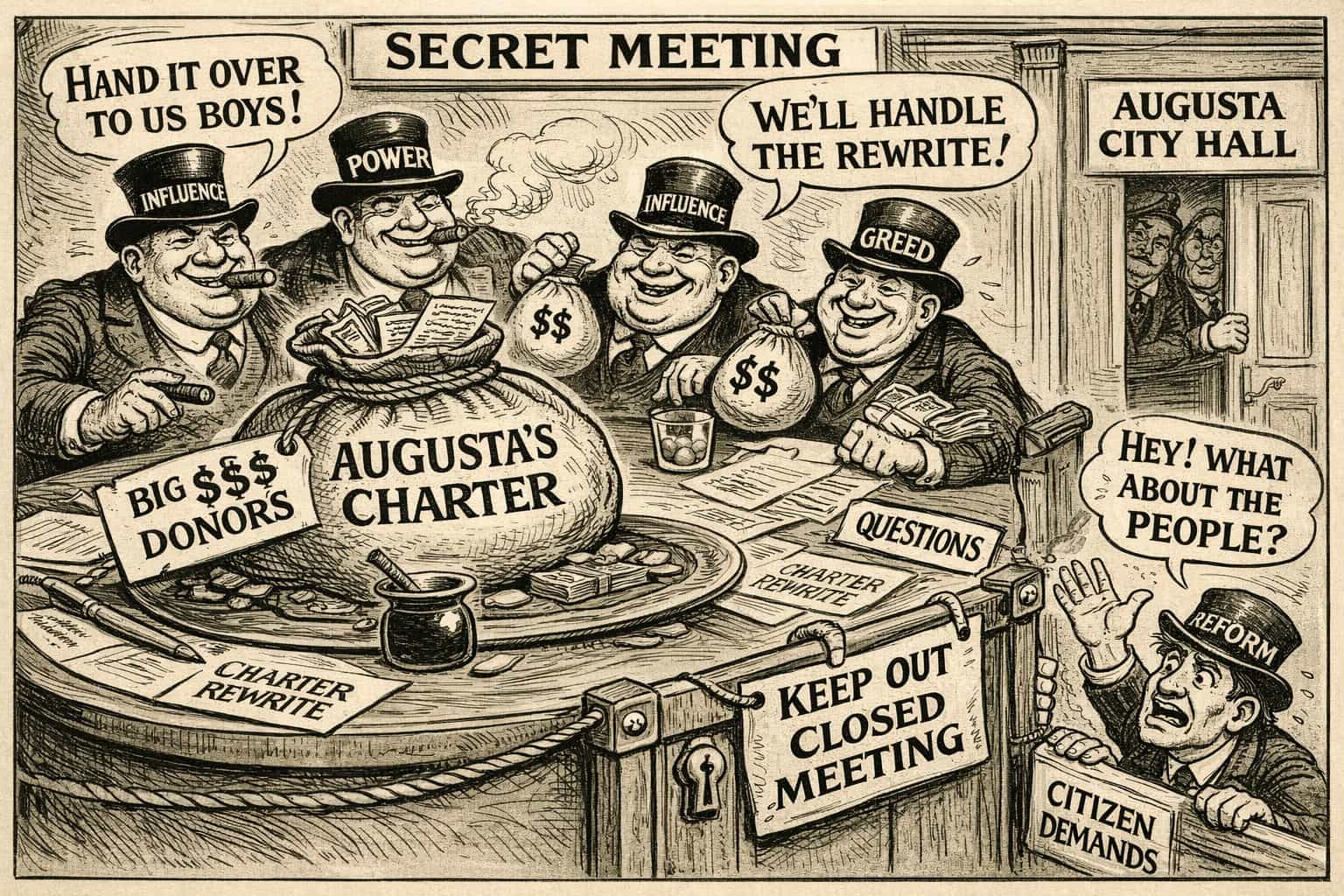
That promise of independence has now broken down. What emerged in March was not simply a dispute over timing or legislative strategy, but something much more serious: a citizen-led charter process being overtaken by the political class before it had finished its work. The commission moved to ask the Georgia General Assembly for a charter-change referendum in 2026 even as the Charter Review Committee still had unresolved motions, unfinished governance language, and active public controversy over how a future manager would actually be selected and controlled. The issue is no longer only whether Augusta should move to a manager system. It is whether the public is being asked to ratify a structure whose decisive power arrangements were never fully settled through the process they were promised.
The Timeline of Breakdown
The breakdown did not happen in a single meeting. It unfolded in stages, and the pattern matters. First came the initial promise: an independent review body, public hearings, expert input, and a finished draft that would not be micromanaged by the commission. Then came the committee’s long work cycle: subcommittees, presentations, competing language drafts, and repeated public discussion about ethics, legal structure, financial oversight, and the form of government. By early 2026, however, the process had become unstable. Key structural issues remained open, particularly within the form-of-government language. Then, rather than pause and let the committee conclude its work, the commission advanced a legislative request to the General Assembly and did so in a special-called meeting surrounded by allegations that the committee’s unfinished work was being bypassed.
The March 10 special-called meeting is the critical hinge point. As reported by WRDW, the commission passed a resolution urging state lawmakers to allow Augusta voters to consider a charter change, even though several community speakers and at least one committee member objected that the Charter Review Committee had not yet completed its job. WRDW’s reporting also confirmed that an updated resolution had been circulated before the meeting and that this revised language broadened the proposal beyond the original manager question by adding a Chief Financial Officer, an internal auditor, and mandatory charter review every seven years. Yet the commission ultimately approved the original resolution rather than the broader revised version, after the revised draft consumed much of the meeting’s controversy.
See WRDW’s March 10, 2026 report, “Augusta leaders push Ga. lawmakers to allow charter change”, and the related video segment. The city’s official committee page also posts agendas, draft language, and an archive of past meeting videos, which is the city-hosted source readers should use to watch the underlying proceedings referenced throughout this story.
What the Bills Actually Did
The original legislative request was comparatively narrow. It asked the General Assembly to authorize a charter amendment adopting a county manager form of government and to allow voters to decide the matter in November 2026. The revised request was something else. It still urged a manager system, but it also asked lawmakers to provide for a Chief Financial Officer, an internal auditor, a recurring seven-year charter review requirement, and to incorporate whatever additional revisions the Charter Review Committee might approve at its March 19 meeting. In other words, the revised language tried to convert a still-moving committee process into a state-level legislative vehicle before the committee had completed the underlying architecture.
That distinction is not academic. The original resolution could be framed as an effort to preserve a place on the 2026 ballot while deferring implementation details. The revised language moved much further by making affirmative structural asks of the General Assembly on matters the committee itself had not fully finalized. It is precisely that move—from broad direction to concrete institutional design—that transformed the controversy from a mere scheduling dispute into a legitimacy crisis. Who was actually writing Augusta’s next government at that point: the committee, the commission, outside stakeholders, or legislators? The public record does not produce a reassuring answer.
The Manager System: Approved in Principle, Unsettled in Reality
At the center of the overhaul is the transition to a county or commission-manager form of government. That model is familiar in local government reform circles: elected officials set policy, while a professionally qualified manager executes it. The argument for the structure is that it reduces administrative drift, professionalizes day-to-day operations, and clarifies the line between policymaking and execution. In the abstract, that is the case Augusta reformers have been making. But in public law, the abstract case is never enough. What matters is the actual allocation of legal authority.
Even the March 10 hearing record shows the gap between principle and structure. On one side, supporters of the legislative push argued that the Charter Review Committee had already effectively decided the matter. Commissioner Brandon Garrett defended the resolution by saying the proposal would simply put the issue in front of voters and insisting that the recommendations being discussed had been passed unanimously by the committee. On the other side, both speakers and commissioners pointed out that the committee had approved only the concept of moving toward manager government, not the critical details that make the system real. Commissioner Lonnie Wimberly stated during the hearing that the committee had “only voted to go to a manager form of government” and had not finished the language specifying what that manager would do, how the reporting mechanism would function, or how the position would be selected.
“We only voted to go to a manager form of government… All the details of that manager form of government has not been ironed out.” — Commissioner Lonnie Wimberly, March 10, 2026 hearing transcript.
That distinction is the entire story. A system can be called manager government while still preserving political choke points that make it something else. And Augusta’s unresolved questions were not peripheral. They included nomination authority, removal authority, qualifications, reporting lines, and the status of legal counsel. Each of those issues determines where power actually sits.
Who Nominates the Manager?
Of all the unresolved issues, none is more revealing than the nomination question. During the committee process, proposed language would have allowed the mayor to put forward up to three candidates for the manager position. That idea triggered one of the most direct warnings in the March 10 hearing. Angela Bakos told commissioners that Dr. Kimberly Nelson—brought in as an expert through the Carl Vinson Institute—had explicitly warned against allowing the mayor to control the final candidate list for city manager. Bakos argued that this would not create a true council-manager system at all, but a hybrid structure in which executive influence remained embedded in the hiring pipeline.
“Making those changes and allowing the mayor to put forth up to three candidates actually creates a hybrid form of government. That is a lie.” — Angela Bakos, March 10, 2026 hearing transcript.
Bakos’s point was not simply rhetorical. In a traditional council-manager government, the governing body collectively hires the manager. Once one elected official controls nominations, that official acquires a gatekeeping function that filters the universe of candidates before the body ever votes. Attorney Jim Plunkett confirmed on the record that the issue remained unresolved. He explained that one of the pending motions involved changing an earlier decision under which the mayor would present three names for the manager position. He further indicated that the committee had reached broad agreement on the concept of a manager but not on how the names would actually be presented. That is not a footnote. It is the institutional hinge between a professional manager model and a politically shaped hybrid.
The unresolved nomination issue also explains why the public pushback was so intense. If reform is being justified on the theory that a professional manager will reduce political interference, it is self-defeating to design the selection process so that the manager arrives through political gatekeeping. A manager chosen through a mayor-controlled list may be formally appointed by the commission, but substantively the office begins under an executive shadow.
Who Fires the Manager?
Hiring is only half the question. Removal is the other half, and the public record is strikingly vague on it. The revised legislative language did not spell out vote thresholds or termination mechanics with precision. At the March 10 hearing, commissioners openly acknowledged that crucial implementation details had not yet been settled. Commissioner Catherine Smith-Rice and Commissioner Stacy Pulliam both pressed for greater clarity on how the manager would be selected, what qualifications would apply, and who would have the actual power to decide. Pulliam specifically noted that the language in front of the commission described a ‘qualified professional manager’ but did not clearly define either the position or the process by which such a person would be chosen.
This matters because the vote threshold for removal determines the real power of the manager once installed. A manager removable by a simple majority may be politically accountable but also vulnerable to instability. A manager removable only by a supermajority may be insulated from caprice but could become extraordinarily difficult to check. If the mayor also controls nominations, the manager could become both politically filtered on the way in and structurally protected on the way out. The city was being asked to move legislation forward without these questions being answered in a way ordinary voters could evaluate.
“Who will decide the process of hiring our city manager?” — Commissioner Stacy Pulliam, March 10, 2026 hearing transcript.
That question, asked in open session, has never been a rhetorical flourish. It is the cleanest possible summary of the unresolved governance problem. Who decides? The full commission? The mayor as gatekeeper? A future state-drafted charter language that local actors will only partially control? Until that is answered precisely, the label ‘manager government’ conceals more than it reveals.
What the Scholarship Says—and Why It Cuts Both Ways
The strongest intellectual argument for manager government comes from scholarship, not local politics. Dr. Kimberly Nelson of the University of North Carolina, whom Augusta’s process treated as an expert resource on forms of government and corruption, is associated with a body of research indicating that council-manager cities experience substantially lower rates of corruption convictions than strong-mayor systems. The general theory is not mysterious. Professional managers are not elected, do not run campaigns, are not directly dependent on donor networks, and are typically socialized into a professional ethic that emphasizes administrative competence and procedural regularity. Politicians still set policy, but day-to-day execution is moved out of the immediate sphere of electoral bargaining.
For an accessible summary of the research tradition behind this view, see the National Civic League’s Cincinnati governance report, which discusses the comparative arguments for professional management. Augusta-specific coverage of Nelson’s appearance before the committee was published by The Augusta Press.
But the scholarship does not say that any structure carrying the manager label is inherently cleaner. Quite the opposite. The anti-corruption benefits depend on implementation. If political actors retain effective control over nomination, removal, legal interpretation, or the auditing chain, the system becomes hybridized. The form may still be sold publicly as reform, but the institutional incentives begin to resemble the political structure it was supposed to improve upon. That is why Bakos’s warning matters. So does Plunkett’s testimony that the mayoral nomination question was still pending. The research supports a true manager system. It does not bless a hybrid built around political choke points.
The Revised Add-Ons: CFO, Auditor, and Perpetual Reopening
The revised legislative request did more than push manager government. It also proposed a Chief Financial Officer, an internal auditor, and a mandatory charter review at least every seven years. On paper, each element can be defended. Augusta’s fiscal troubles have made financial oversight an especially potent argument. The push for an internal auditor was often framed as a corrective to the city’s own financial management failures. Likewise, a scheduled charter review cycle can be presented as an accountability measure—a way to ensure that the city does not leave its governing framework untouched for decades at a time.
But institutional reform is not just a checklist. The key question is who controls these offices. To whom does the CFO report—the manager, the commission, or both? Is the internal auditor structurally independent, or merely another administrator under the same executive chain? Does a seven-year review process create principled oversight, or does it institutionalize recurring political warfare over the city’s basic rules? Attorney Plunkett himself acknowledged that if state legislation imposed positions like a CFO, the commission would still be left with an implementation role because the legislation would likely not specify every operational detail. In other words, even under the revised structure, the power struggle would not end. It would simply be displaced into implementation fights that the charter language was supposed to clarify in the first place.
State Law Trumps Local Intent
One of the least understood but most important facts in this entire controversy is that Augusta does not have final authority over its own charter. Under Georgia law, Augusta-Richmond County’s governing charter exists because the General Assembly created it and can amend it through local legislation. The city can recommend changes. The committee can draft language. The commission can pass resolutions. None of those acts is self-executing. The legal sovereign in this process is the state legislature.
This cuts in two directions. Supporters of the March 10 resolution repeatedly argued that the commission had to move quickly if Augusta wanted a 2026 referendum because the legislative calendar imposed a deadline. That is true as far as it goes. But the same fact also undercuts the suggestion that the local process remained fully in local hands. Once the commission asked the delegation to move legislation before the committee had finished, the center of gravity shifted to Atlanta. Attorney Plunkett was candid about that point. In response to questioning, he agreed that the legislative delegation could modify what Augusta sent them and that, in his experience, lawmakers were unlikely to bring the finished draft back to the commission for approval before acting. His plainspoken formulation was that they were ‘gonna do it how they think it should be done.’
“They’re gonna do it how they think it should be done.” — Attorney Jim Plunkett, March 10, 2026 hearing transcript.
That single point changes how the whole episode should be understood. This is not merely a local fight over a local charter. It is a contest over whether an incomplete local process should be converted into state legislation before local actors have fully settled the architecture they claim to support. Once that conversion happens, local intent becomes advisory rather than controlling.
The Legal Fault Line: What Happens to Jim Plunkett?
The city attorney question is less dramatic on the surface than the manager question, but it may be just as consequential. During the March 10 hearing, commissioners and speakers raised an issue that had been brewing inside the committee language: whether Augusta would be required to rely on independent legal counsel or whether outside legal representation would become optional. Wimberly flagged that the charter language then under discussion used ‘shall’ for independent contractor counsel. Plunkett responded that one of the pending motions for the March 19 committee meeting would change that language from ‘shall’ to ‘may.’
In legal drafting, that is not a tweak. It is a transfer of discretion. A mandatory requirement for independent counsel creates a structural check. A permissive rule allows the political branches—or a future manager, depending on final language—to decide how much legal independence they want to tolerate. This does not mean Plunkett is automatically removed or barred from staying in office. Nothing in the revised request does that directly. But it means the role loses one of the structural protections that might otherwise anchor its independence from political control.
That is especially important in a government whose other power relationships remain unsettled. If the city attorney becomes structurally dependent on political discretion at the same moment a manager system is being created without clear hiring and firing rules, then legal interpretation itself becomes part of the power struggle. The question is no longer merely who drafts resolutions. It is who controls the lawyer who interprets the charter once it exists.
Named Actors and the Politics Around the Rewrite
The institutional questions cannot be separated from the people driving them. Angela Bakos emerged as one of the clearest public critics of the way the manager question was being reframed, especially with respect to mayoral nominations and the resulting ‘hybrid’ system. Commissioner Wimberly repeatedly stressed that the committee had approved only the concept of manager government, not the unfinished detail language the commission was being asked to rush toward Atlanta. Brandon Garrett defended the urgency by invoking the legislative calendar and by contending that the committee had already passed the relevant recommendations. Wayne Guilfoyle, by both public comments and the surrounding political argument, became associated with the position that the charter had to pass and that reform would be meaningless if it stalled out. Representative Mark Newton entered the dispute because of the allegation—politically explosive whether ultimately fair or not—that legislation was moving without full consensus of the delegation and before the committee’s work reached a stable endpoint.
None of these actors is peripheral. Their statements and roles illustrate the essential conflict: whether the public was watching a legitimate effort to preserve a ballot option or a political intervention that preempted the committee’s function. The answer matters because legitimacy in charter reform does not come from polished talking points. It comes from public confidence that the final document reflects the process they were promised.
What the Public May Actually Be Voting On
If the current trajectory continues, Augusta voters may be asked in 2026 to approve a package whose broad marketing language is cleaner than its legal architecture. They will likely hear that the issue is simply whether they want a professional manager to run day-to-day government. That framing is incomplete. What they will really be voting on is a contested distribution of authority among the commission, the mayor, the manager, and the legal and financial offices that orbit them. They may also be voting on a state-shaped version of that structure rather than one fully completed by the local committee process that was sold as independent.
This is why process and substance cannot be separated. A charter is not a talking-point memo. It is a local constitution. If the public is asked to ratify a document whose central power relationships were never fully settled before the process was pulled into legislation, then voters are not being asked to bless clarity. They are being asked to bless ambiguity.
The Larger Implication
The deeper scandal here is not just that the process became messy. Public processes often do. The scandal, if that is the right word, is that the independent mechanism created to produce legitimacy may have been overridden at exactly the moment legitimacy mattered most. Once that happened, every unresolved design choice became more politically charged, not less. The manager question stopped being a good-government reform in the abstract and became a proxy battle over who gets to shape Augusta’s next governing order.
Augusta may still end up with a manager system. It may even end up with a better one than it has now. But those two possibilities do not answer the question hanging over the process. Was the charter the product of the independent public review that residents were promised, or did political actors take control before the work was done? Until that question is answered credibly, the legitimacy problem that gave birth to the committee will not have been solved. It will merely have been reproduced in a more sophisticated form.
Source Notes and Reporting Links:
- Official Augusta Charter Review Committee page (agendas, documents, draft language, and video archive)
- Current Augusta charter on Municode
- WRDW report on March 10 commission action
- WRDW related video segment
- National Civic League report discussing council-manager governance arguments
- Augusta Press preview of Dr. Kimberly Nelson presentation
Prior Reporting by GCG:
Same Song, New Sheet Music: Augusta’s “Ethics Reform” Just Hit the Same Old Wall
The Quiet Rewrite of Power: Inside Augusta’s Charter Review as a Mayoral Election Approaches
🌺 UNDER THE AZALEAS 🌺 – New Columnist! – Alvin Mason Running Again?