by Charles Rollins, Publisher
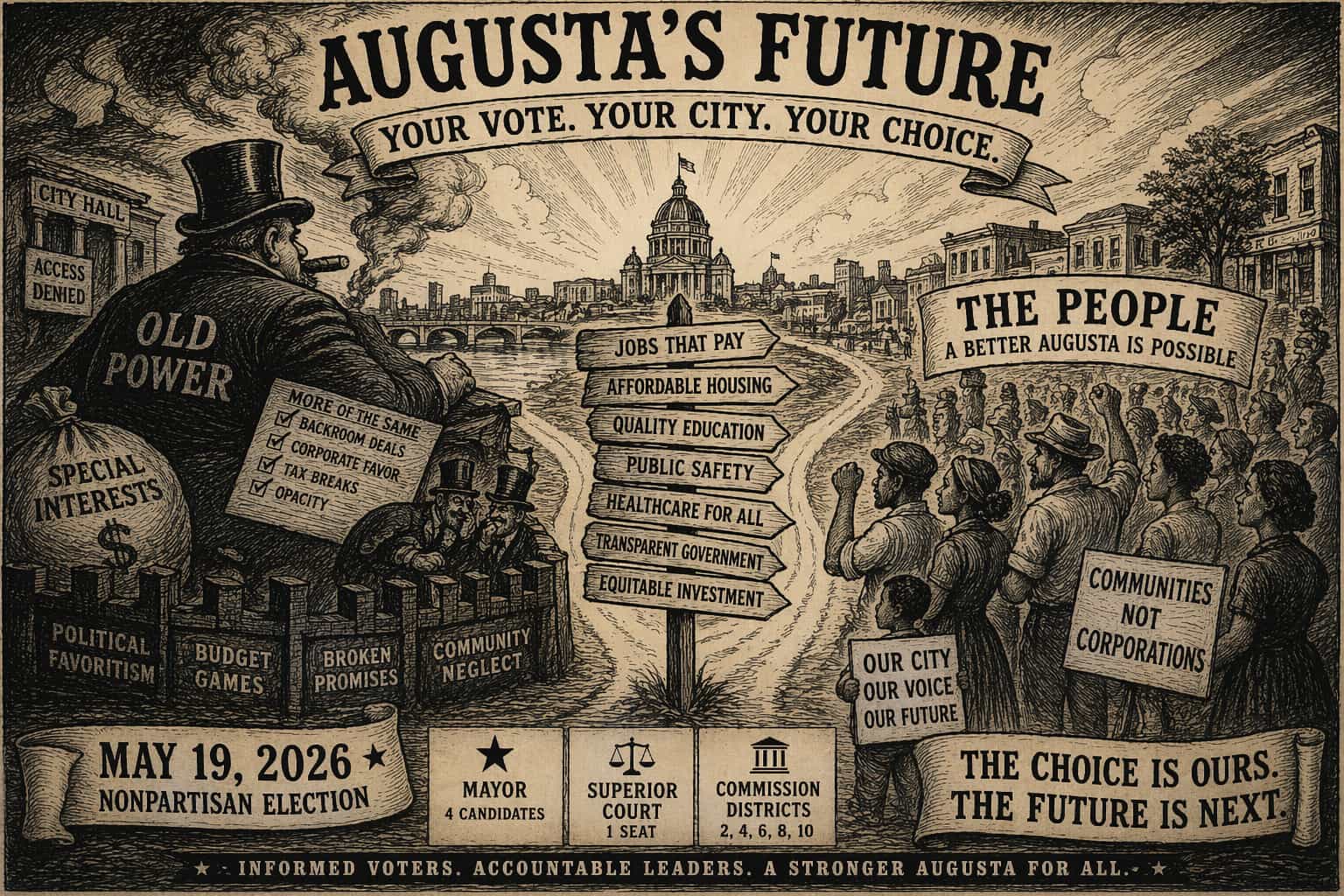
Augusta’s May 19 nonpartisan election is broader and more consequential than a simple mayoral rematch. Alongside the four-way mayor’s race, voters will decide a key Superior Court contest and several challenged commission seats that could reshape local power.
Augusta, GA – As Augusta moves toward its May 19 nonpartisan election, the local ballot is coming into sharper focus. The mayor’s race remains the most visible contest, but it is no longer the only one demanding attention. Alongside the four-way race for mayor, voters will decide a significant Superior Court contest and a series of challenged Augusta Commission races that could shape the city’s governing coalition well beyond Election Day.
The official ballot shows four candidates for mayor: incumbent Garnett Johnson and challengers Steven B. Kendrick, Eric Gaines, and Lori Myles. It also includes a contested Superior Court race between incumbent Judge Ashley Wright and attorney Alexia Davis Payne, along with Augusta Commission contests in Districts 2, 4, 6, 8, and 10. If no candidate wins a majority, a runoff is scheduled for June 16.
For months, much of the early political conversation has centered on whether Johnson can fend off a renewed challenge from Kendrick, who led the first round of the 2022 mayoral election before losing in the runoff. That remains the core frame of the race. Johnson, through his campaign website and official mayoral page, is presenting himself as a continuity candidate focused on accountability, constituent access, and finishing the work of his first term. Kendrick, on his campaign site, is again emphasizing growth, infrastructure, housing, and managerial experience, offering voters a familiar alternative rather than an outsider bid.
Gaines is running in a different lane. His campaign website frames his candidacy around transparency, city services, neighborhood protection, and investment in underserved communities, all under the banner “People Before Politics.” Myles, meanwhile, remains part of the field and part of the political math. Her campaign platform emphasizes public transit, job training, balanced budgeting, and downtown revitalization. Public candidate profiles show that she has run unsuccessfully for multiple offices in Augusta over the years, including prior races for mayor and commission seats, and in the 2022 mayoral first round she won 3.53 percent of the vote.
There does not appear to be any public independent polling in the mayor’s race. For now, the most visible evidence still points to Johnson and Kendrick as the leading figures, with Gaines attempting to consolidate a reform-minded constituency and Myles remaining a factor in a four-way field where even smaller vote shares can matter.
A Superior Court race with real stakes
But the most consequential race on the ballot may be the one that has drawn less casual attention so far: the contest for Superior Court judge.
Wright, a former district attorney who was appointed to the bench in 2017, is seeking another term and is running on experience, judicial service, and work in treatment courts and accountability programs. Her campaign site places that record front and center.
Payne offers voters a sharply different professional path to the bench. A former public defender, longtime attorney, former president of the Augusta Bar Association, and recipient of the Stephen B. Bright Public Defender Award, Payne enters the race with a résumé that stands out in local judicial politics. In earlier Garden City Gossip reporting on her campaign, Payne argued that the local bench has been shaped heavily by prosecutorial backgrounds and that her experience representing ordinary people inside the criminal legal system would bring a broader perspective to questions of fairness, sentencing, and access to justice.
In many local judicial contests, incumbency alone can make the result feel close to predetermined. That is not necessarily the case here. The electorate for this judgeship changed significantly after Columbia County left the old Augusta Judicial Circuit in 2021, leaving Richmond and Burke counties to decide these races. Wright already demonstrated that she could win decisively in the post-split circuit in 2022. But Payne enters this race with a stronger public profile than many judicial challengers, a more distinctive legal background, and visible credibility in Augusta’s civic and legal communities.
That makes the Wright-Payne contest more than a routine reelection bid. It is, at minimum, a meaningful test of what voters now want from the bench in a changed circuit. It is also one of the clearest examples on the ballot of voters being offered a real choice in judicial philosophy and lived professional experience, even if both candidates are presenting themselves in the language of public service and competence rather than ideology.
The commission races matter too
Downballot, the commission races also deserve more attention than they usually receive.
In District 2, incumbent Stacy Pulliam faces Corey Johnson, a former commissioner and former mayor pro tem. In District 4, incumbent Lonnie Wimberly faces former commissioner Alvin Mason. In District 6, incumbent Tony Lewis faces challenger Tamika Bean. District 8 is an open-seat contest among Michael Cioffi, Roger Garvin, and Evett Williams. In District 10, incumbent Wayne Guilfoyle faces Ben Hasan.
In a city where power is often exercised through district alliances, committee dynamics, and budget negotiations rather than sweeping mayoral authority alone, those races matter. Augusta’s future governing reality will not be determined only by who wins citywide office. It will also be shaped by who sits on the commission and what blocs emerge there afterward.
Money, structure and the state of play
Money is another part of the picture, though not yet a fully transparent one. Richmond County says local campaign reports are filed through its campaign reports portal, while Superior Court candidates file through the state system. The next major pre-election reporting deadline is April 30, with a grace period through May 7, meaning a clearer picture of campaign resources may emerge in the weeks ahead.
For now, the state of play in Augusta is this: the mayor’s race remains the headliner, but the ballot is broader than a simple Johnson-versus-Kendrick story. Gaines is trying to open a reform lane. Myles remains in the field. Several commission races could reshape district-level power. And the Superior Court contest between Ashley Wright and Alexia Davis Payne has become one of the most important races in the city, both because of the office itself and because Payne’s candidacy gives voters a more substantial choice than judicial incumbents often face.
The closer Augusta gets to May 19, the clearer it becomes that this is not a sleepy local ballot. It is a real contest over who governs, who gets heard, and what kind of city government and local justice system voters want next.
Official voter information and campaign links
Voters can review Augusta’s official 2026 election information page:
https://www.augustaga.gov/3345/2026-Election-Information
And the county’s qualified candidates list and nonpartisan sample ballot:
https://www.augustaga.gov/DocumentCenter/View/21088/Qualified-Candidates
https://www.augustaga.gov/DocumentCenter/View/21125/Nonpartisan-Sample
Campaign websites for the mayoral candidates include:
Garnett Johnson
https://www.garnettformayor.com/
Steven Kendrick
Eric Gaines
Lori Myles
https://keloramyles.wixsite.com/mayor2
Judge Ashley Wright’s campaign website is:
https://wrightforsuperiorcourt.com/
Alexia Davis Payne’s campaign website is:
Additional background on the local races is available through Garden City Gossip’s prior coverage:
The Quiet Rewrite of Power: Inside Augusta’s Charter Review as a Mayoral Election Approaches
Attorney Alexia Davis Payne Challenges Incumbent Judge in Local Judicial Race
The Offices That Run Augusta: GCG Expands Focus on 2026 Downballot Races