Aiman Tariq – Regional News Editor
Atlanta, GA –
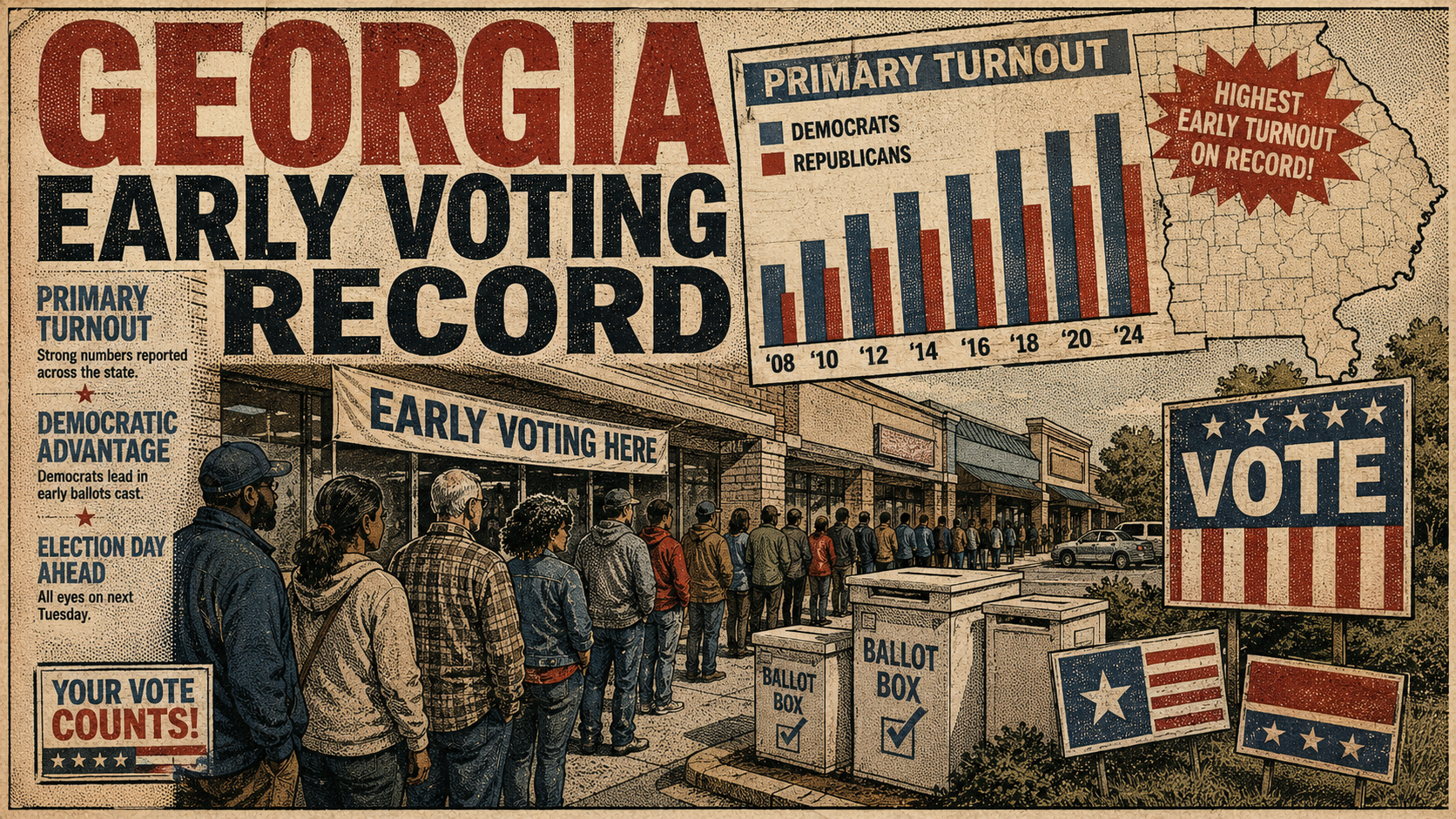
Georgia voters have already broken the state’s early-voting record for a primary election, according to turnout figures reported by WABE and the Georgia Secretary of State’s office.
The early turnout can show energy, organization and voter interest — but it does not automatically predict who will win on Election Day. It is a signal, not a verdict.
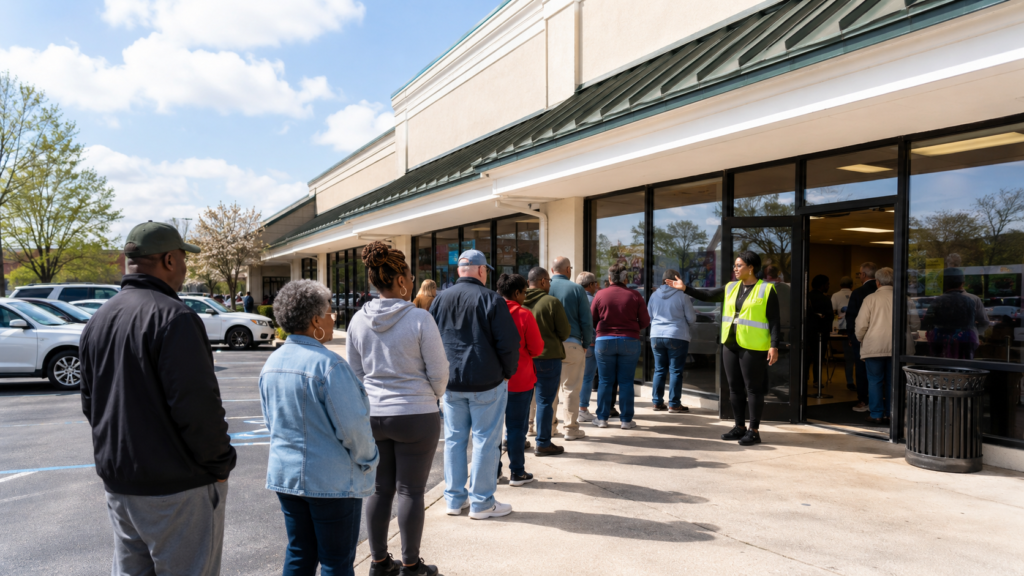
According to WABE, about 930,000 Georgians had voted early as of 3 p.m. Friday, passing the previous early-voting primary record of about 857,000 set in 2022. Early voting ended Friday, with Election Day scheduled for Tuesday.
A Record Before Election Day
The turnout number is notable because primary elections usually draw less attention than presidential contests or November general elections.
This year is different.
Georgia has major races up and down the ballot, including contests for U.S. Senate, governor, statewide offices, all 14 U.S. House seats, every seat in the state legislature and many local offices, according to WABE’s summary of the election cycle.
That makes the early turnout record more than a participation milestone. It suggests voters are engaging before Election Day in a cycle where both parties are watching for signs of strength.
But that is where the caution begins.
Early voting data tells us who has already shown up. It does not tell us who will show up Tuesday, how many voters remain undecided, or whether one party’s early advantage reflects enthusiasm, convenience, campaign strategy or simply a shift in when supporters choose to vote.
Democrats Hold an Early Ballot Advantage
According to WABE, Democrats had an early-voting advantage as of Friday afternoon, with about 515,000 voters choosing Democratic primary ballots and about 400,000 choosing Republican ballots. Roughly 14,000 voters had selected nonpartisan ballots.
That matters because it marks a reversal from the 2022 primary cycle.
In 2022, Republicans ended the early-voting period with a roughly 15-point advantage over Democrats, according to WABE’s comparison. This year, Democrats held a 12-point early advantage as of the final day of early voting.
Still, Georgia does not register voters by party in the same way some states do. In a primary, voters choose which party ballot to pull. That means these numbers show primary ballot selection, not permanent party registration.
That distinction matters.
A Democratic early-voting lead may reflect stronger Democratic participation so far. It may also reflect differences in voting habits, competitive races, mobilization efforts or campaign messaging. It does not, by itself, tell us how the final electorate will look once Election Day voters are included.
Why Kemp Is Watching the Numbers?
Gov. Brian Kemp said he was “definitely concerned” about the Democratic advantage in early voting, according to WABE. He also noted that many voters may still be undecided, including in the Senate race and other down-ballot contests.
That response is worth noting, but it should not be overstated.
Campaigns often watch early-voting data closely because it can show whether their voters are turning out. But campaigns can also use early numbers to motivate supporters, raise urgency or frame the closing days of a race.
In other words, concern can be both real and strategic.
That is especially true in a primary election, where turnout is shaped not only by party loyalty but also by the intensity of individual races. A competitive contest on one side can draw voters earlier. A confusing or crowded field can delay decisions. A familiar incumbent can reduce urgency. None of those factors are fully visible in the early-voting totals alone.
The New Data Hub Adds Detail
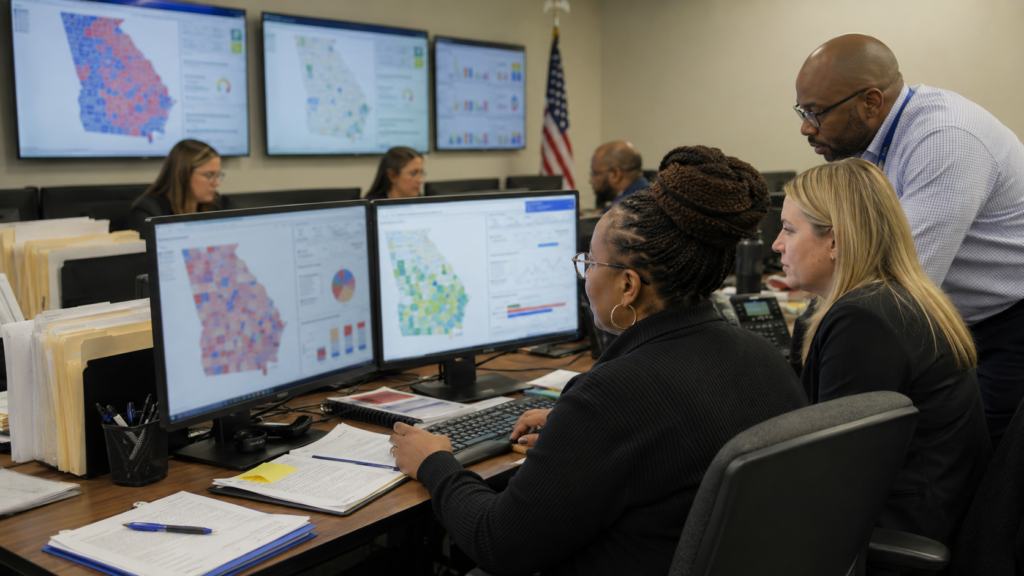
One reason this year’s early turnout is easier to analyze is that Georgia’s Secretary of State’s office has added party-affiliation filters to its Election Data Hub.
According to CBS Atlanta and WABE, the update allows voters, reporters and campaigns to track turnout by party ballot selection during the primary period.
That is useful.
It also creates a risk.
More data can make an election feel easier to read than it really is. A map can show which counties are voting. A dashboard can show which party ballot voters are choosing. But none of that explains motivation, persuasion or what late voters may do.
This is the difference between a broad signal and a precise forecast.
The broad signal is clear: Georgia voters are participating early at record levels for a primary.
The precise forecast is still unavailable.
County Numbers Tell a Mixed Story
WABE reported that the highest turnout percentage was in Bleckley County at 26.1%, followed by Taliaferro, Butts, Oconee and Towns. Four of those five counties backed Donald Trump by wide margins in 2024, while Taliaferro supported Kamala Harris.
That mix is important because it undercuts the easiest partisan reading.
High turnout is not only happening in Democratic areas. It is also showing up in heavily Republican counties. At the same time, some strongly Republican counties are near the bottom of the turnout list.
According to WABE, the lowest early-voting turnout percentage was in Whitfield County at 5.7%, with Clinch, Atkinson, Murray and Seminole counties also among the lowest. All five went heavily for Trump in 2024.
That does not mean Republican turnout is weak everywhere.
It means county-level turnout is uneven, and statewide averages can smooth over local differences.
Big Counties Still Shape the Raw Vote
Turnout percentages can also be misleading if readers do not look at raw vote totals.
A small county can post a high turnout percentage while contributing far fewer votes than a large metro county with a lower percentage. WABE noted that Bleckley County was performing far better than Fulton County by turnout percentage, but Fulton had roughly 110,000 early voters compared with about 1,700 in Bleckley.
That is why both measures matter.
Percentage turnout shows local participation intensity.
Raw turnout shows where the votes are actually piling up.
In Georgia, that distinction is especially important because large counties such as Fulton, DeKalb, Cobb, Gwinnett and Clayton can dominate statewide totals even when their turnout percentages are not the highest.
According to WABE, Fulton was at 14.7%, DeKalb at 15.7%, Clayton at 12.8%, Cobb at 13.6% and Gwinnett at 11.2% as of Friday afternoon. Statewide turnout was 12.6%.
What Early Voting Can and Cannot Tell You?
Early voting is useful, but it is not the whole election.
It can show:
- Which voters are already participating.
- Whether campaigns are successfully banking votes early.
- Where turnout is rising or lagging by county.
- Whether one party’s voters are showing up earlier than the other’s.
But it cannot fully answer:
- Who will vote on Election Day.
- Whether early voters are new voters or reliable voters voting earlier than usual.
- Whether undecided voters will break late.
- Whether one party is simply shifting more of its normal vote into early voting.
- Whether high turnout in one region offsets lower turnout elsewhere.
That is why a record early-voting number should be treated as meaningful, but not conclusive.
Trump, Early Voting and Republican Strategy
Another factor in the background is the Republican relationship with early voting.
Former President Donald Trump has repeatedly criticized mail-in voting and made unfounded claims that early and absentee voting systems lead to fraud. But he also voted early in person in 2024 and voted by mail in Florida special elections earlier this year, according to WABE.
That mixed message has mattered for Republicans in recent cycles.
Some Republican officials and strategists have urged voters to use early voting more aggressively, arguing that waiting until Election Day increases risk. Others have had to navigate years of distrust among some conservative voters toward voting methods that were once routine.
This year’s numbers suggest Republican voters are participating early in large numbers. But Democrats, at least through Friday afternoon, had pulled more early primary ballots.
Whether that remains politically meaningful depends on who is still waiting for Tuesday.
Why This Primary Is Drawing Attention?
The scale of the ballot helps explain the turnout.
Georgia voters are choosing nominees for races that will shape the rest of the year. The U.S. Senate contest, governor’s race and down-ballot statewide offices are drawing particular attention. So are legislative and congressional races that could affect control and policy direction in Atlanta and Washington.
That is why the record matters.
It suggests the primary is not being ignored.
But turnout records do not automatically mean voters are satisfied, angry, energized or aligned in one direction. High participation can come from competition, anxiety, habit, mobilization or all of those at once.
The responsible reading is narrower: Georgia voters are showing up early at levels the state has not previously seen in a primary.
Everything beyond that needs more evidence.
The Bottom Line
Georgia has broken its early-voting record for a primary election, with about 930,000 voters casting early ballots by Friday afternoon, according to WABE and the Secretary of State’s office.
Democrats held an early ballot advantage, reversing the pattern from the 2022 primary’s early-voting period. Gov. Brian Kemp has said he is concerned about that advantage, though he also noted that many voters may still be undecided.
The simplest version of the story is that Georgia turnout is high.
The more accurate version is that high early turnout is an important signal, but not a complete forecast.
Election Day still matters. So do county differences, raw vote totals, party ballot choices and late-deciding voters.
For now, the record shows that Georgia voters are engaged. What it means politically will not be clear until the full primary vote is counted.