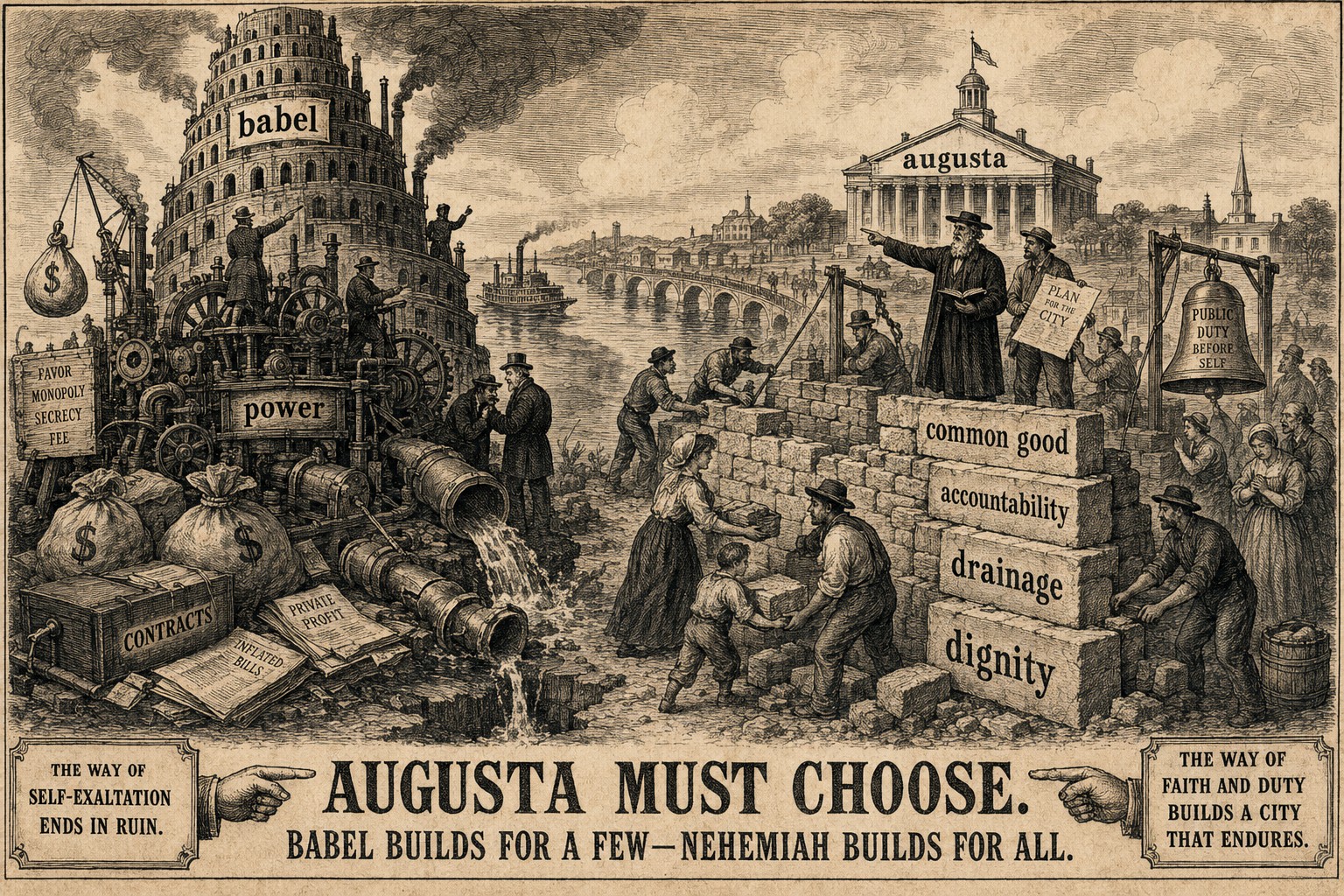
The question for Augusta is whether its public machinery serves Babel or the common good.
Milwaukee had unions. Augusta has churches. The lesson of sewer socialism is not a label. It is the discipline of organizing public power around human dignity, clean government, and the common good.
by Charles Rollins, Publisher
Milwaukee’s sewer socialists built their politics through unions. Augusta will not. Augusta can and must chart its own path, though.
Milwaukee in the early twentieth century was an industrial city where socialist organizers rooted themselves in trade unions, ward organizations, immigrant neighborhoods, party newspapers, public-service fights, and the unglamorous work of making municipal government deliver. Their enemies mocked them as “sewer socialists” because they cared so much about sewers, sanitation, clean administration, public ownership, parks, utilities, housing, and the practical machinery of city life. The insult missed the point. Sewers were never merely sewers. They were the place where dignity became material.1
Augusta is a different city, in a different century, with a different political language. Its working class is fragmented. Its labor movement is weak. Its neighborhoods are divided by race, geography, infrastructure, environmental burden, age, class, and habit. Its politics has too often been organized around personalities, factions, courthouse relationships, racial arithmetic, gerontocratic comfort, and the slow ritual of waiting for government to do what it already promised to do.
But Augusta has something Milwaukee did not have in the same way.
Augusta has churches.
It has pulpits, choirs, deacons, Sunday schools, Bible studies, prayer circles, Black church memory, white church respectability, Catholic social teaching, evangelical moral language, mainline civic conscience, and a remarkably persistent public Christianity that still shapes how many people in this city understand duty, dignity, neighbor, sin, redemption, and the common life. Barna’s city-level research found Augusta-Aiken near the top of American metros in recent prayer, and found that a majority of practicing Christians in the area fell into its low-income category. That does not make Augusta holy. It makes Augusta peculiarly accountable.2
If this city is as Christian as it says it is, then its politics should be judged by Christian standards.
Not by church attendance alone. Not by who can quote Scripture at a banquet. Not by who invokes God before protecting the same old hierarchy. Not by which candidate can wrap self-interest in religious language.
But by the harder standard: whether Augusta’s public life honors the dignity of the poor, the worker, the renter, the sick, the single mother, the elderly, the child, the polluted neighborhood, the overlooked district, and the person whose only experience of government is delay.
The Christian Case Is Older Than the Socialist Label
The Christian frame is not a decorative add-on to the sewer-socialist frame. It is older.
Long before socialism became a modern political category, Christian communities had already challenged hoarded wealth, private domination, permanent debt, enclosure, and social arrangements that left the poor dependent on the powerful. The early Church described in Acts held goods in common. The Jubilee laws of Leviticus interrupted debt, accumulation, and permanent alienation from land. The prophets condemned those who joined house to house and field to field until there was room for no one else. Jesus announced good news to the poor, release to the captives, and freedom for the oppressed. He was brutally murdered by the State and local “civic leaders” for these views.
That history matters because it prevents a cheap evasion. If one begins with Marx, half the room can pretend the argument has nothing to do with them. If one begins with Scripture, the room has to work harder.
The English Diggers, also known as the True Levellers, made that older tradition political during the upheaval of 1649. Gerrard Winstanley and his followers cultivated common land and argued that the earth was a “common treasury.” They were not modern Marxists. They were radical Christians confronting enclosure, poverty, hierarchy, and the seizure of common life by property power. Their movement was brief, vulnerable, and defeated. But its moral imagination remains useful because it shows that Christian communal politics did not begin as an imitation of later socialism. It came from Scripture, poverty, land, and the conviction that God did not create the earth for a few people to fence off from the many.3
That line runs through Catholic social teaching as well. Leo XIII’s Rerum Novarum answered the industrial age by defending the dignity of work, the right of workers to organize, the duty of a just wage, and the moral limits of capital. Pope Leo XIV’s Magnifica Humanitas returns to the same field under new conditions: artificial intelligence, platform power, private technological sovereignty, labor discipline, and systems that reduce human beings to data, productivity, and cost.4
The Black church carries its own version of this public theology. It did not learn from European socialism that Pharaoh was wrong, that captivity required liberation, that the poor deserved more than consolation, or that the Exodus was political as well as spiritual. The civil-rights movement did not become dangerous when it asked for polite inclusion. It became dangerous when King began speaking more plainly about economic democracy, militarism, labor, housing, and the Poor People’s Campaign.5
That is why the Christian frame matters in Augusta. This city does not need to be talked into caring about the poor in a language foreign to its deepest habits. It needs to be reminded that the language it already claims has consequences.
Charity gives a hungry man a meal. Justice asks why he is hungry in a city full of churches, restaurants, hospitals, universities, contractors, developers, nonprofits, public agencies, and people who say every human being bears the image of God.
Charity helps a flooded family after the storm. Justice asks why drainage, housing, infrastructure, insurance, land use, and political power left that family exposed in the first place.
Charity comforts the worker. Justice asks why the worker’s labor is visible enough to tax, schedule, discipline, and replace, but not powerful enough to secure health care, housing, leisure, and a margin of safety.
Babel, Jerusalem, and the Machine
Pope Leo XIV’s Magnifica Humanitas is formally about artificial intelligence, but its deeper warning is older than the machine. The Pope’s argument is that no technology, institution, market, platform, or political system exists in a vacuum. The systems we build carry the assumptions of the people who build them. They measure what their masters tell them to measure. They ignore what their masters can afford to ignore. They reward what their masters already value. They punish what their masters have already decided is expendable.
The machine will serve its master.
In my earlier essay on Pope Leo, AI, wealth, Babel, and Augusta, I argued that this warning cannot be confined to software. The tax machine, the governing machine, the development machine, the campaign machine, the public-comment machine, the nonprofit machine, the bureaucratic machine, and the market machine all raise the same question: who built it, who owns it, who benefits from it, who is processed by it, and who is told to wait?6
Pope Leo gives that question theological weight. In Magnifica Humanitas, he writes that the Church does not replace the State, but it also cannot ignore the suffering produced by the systems that shape human life. Catholic social doctrine, he says, is not a rigid policy manual. It is a process of discernment rooted in human dignity, the common good, solidarity, subsidiarity, social justice, and the universal destination of goods. Human dignity, he insists, does not depend on ability, wealth, position, productivity, or the choices a person has made. It precedes every system that tries to measure it.7
That is not a soft claim. It is a direct challenge to any political order that treats people as units of efficiency, cost, risk, compliance, labor, data, nuisance, vote share, or demographic management.
Pope Leo turns to two biblical images: Babel and Nehemiah’s rebuilding of Jerusalem. Babel is a public project built around power, uniformity, ascent, and control. Nehemiah begins with ruins, prayer, inspection, shared responsibility, and rebuilding. Babel centralizes. Nehemiah organizes. Babel climbs. Nehemiah repairs.
Augusta has had too much Babel.
It has had too many impressive words attached to structures that still leave ordinary people waiting. Modernization. Efficiency. Reform. Development. Consolidation. Revitalization. Innovation. Stakeholder engagement. Public-private partnership. Equity. Transparency. Accountability.
Some of those words name real goods. But words do not repair a city. Structures do.
Augusta’s Infrastructure Is a Moral Argument
That is where the Christian argument has to come down from the clouds and touch the ground.
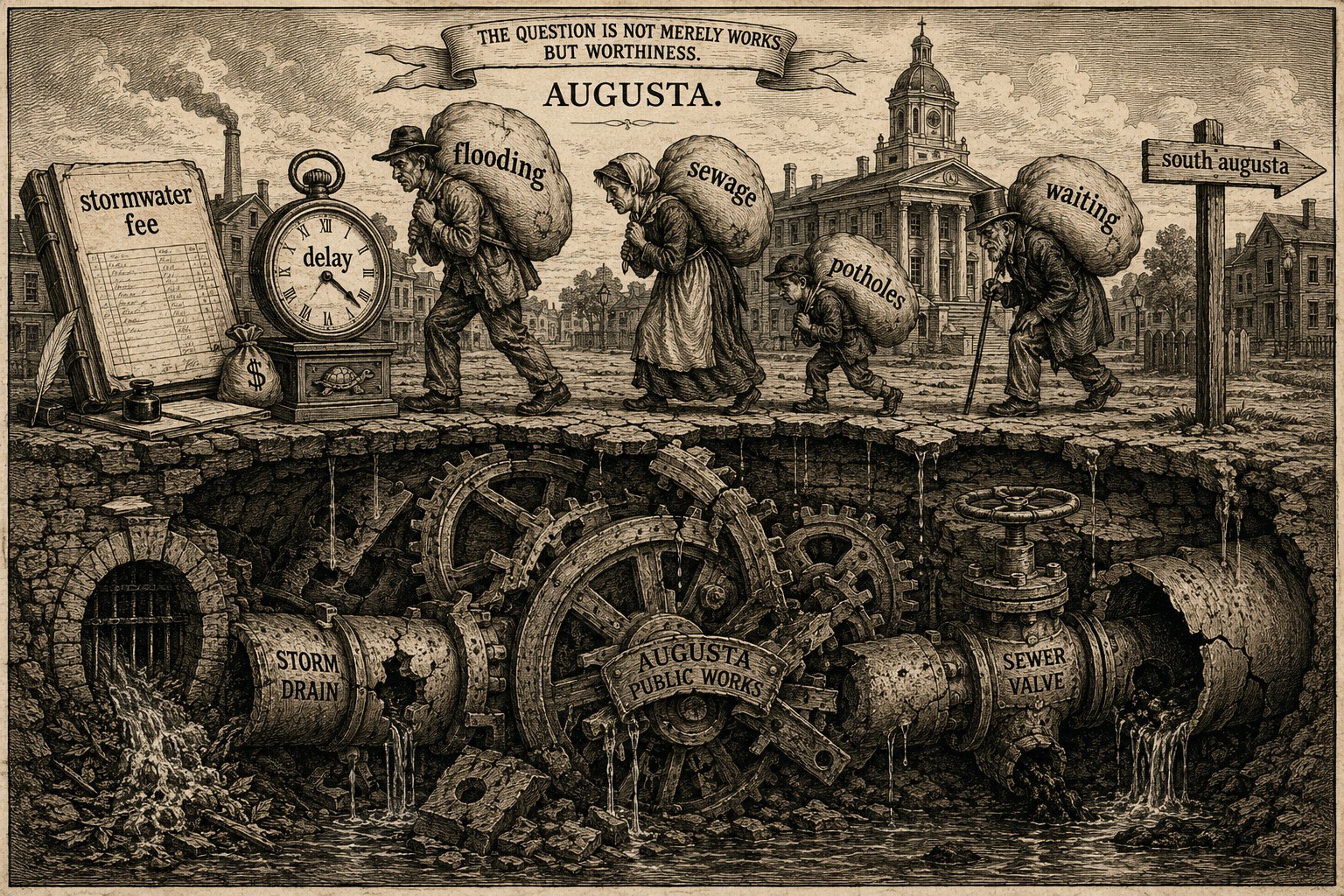
In Augusta, infrastructure is not an abstraction. It is the pipe under the road, the ditch behind the house, the storm drain that does not clear, the sewer line that cannot handle the rain, the pothole that is not really a pothole, the water pressure that disappears after disaster, the resident who pays a stormwater fee and still watches the yard flood.
The record is not subtle.
In 2014, Augusta’s own stormwater funding white paper said the city faced “real, growing, and unresolved stormwater infrastructure problems.” It described a system covering 329 square miles, with hundreds of miles of ditches and storm drains, more than 12,600 catch basins, and nearly 1,000 flood detention ponds. It identified aging and failing infrastructure, local flooding of homes, businesses, and roadways, and growing demands for maintenance. It estimated a stormwater repair backlog of more than $240 million, including $100 million in critical projects.8
That was not yesterday. That was more than a decade ago.
The city’s stormwater management plan shows the scale of the machinery: thousands of catch basins, hundreds of miles of storm drain pipes, hundreds of miles of ditches, and an inspection system that necessarily depends on prioritization, complaints, five-year cycles, and limited crews. A city can write that system down in technical language. Residents experience it as water, delay, damage, and uncertainty.9
Local reporting has repeatedly shown what that looks like on the ground. WRDW reported in 2018 that storm drains were still failing to keep up, that 89 projects were tied to the stormwater fee, and that older lines in neighborhoods were deteriorating. The story’s plainest line came from the field: aging infrastructure was “a problem that won’t be going away.”10
The Augusta Press reported in 2022 that residents complained about clogged drains, flooded roadways, Ellis Street runoff from Calhoun Expressway, and questions over how stormwater fee money was being used. The same reporting noted that the fee, enacted in 2016, was intended to support drainage infrastructure, ditch maintenance, storm drain cleaning, and flood abatement, and that the city estimated the fee brought in roughly $10 million annually.11
Then came the June 2023 storms. WRDW reported that more than 30 homes were uninhabitable in a South Augusta neighborhood after flooding, with sewage-tainted water coming through toilets, sinks, and shower drains. Residents off Argonne Drive described water coming from every direction. WRDW reported that cracked sewer pipes allow stormwater into the sewage system until it becomes overwhelmed, and that major overflows included more than 538,000 gallons at the sewage treatment plant affecting Butler Creek, along with additional overflows from manholes on Mike Padgett Highway, Doug Barnard Parkway, and Argonne Drive.12
That is not just infrastructure failure. That is public dignity backing up through the floor.
By 2024, the need had not disappeared into better management. The Augusta Press reported that the city’s Engineering and Environmental Services director brought another $178.7 million in sales-tax infrastructure requests to the Augusta Commission, including $25 million for stormwater, $30 million for road resurfacing, $8 million for multiphase road and drainage work in east Augusta, and funding for on-call repairs to address routine stormwater failures. The director put it plainly: the city has aging infrastructure and stormwater failures “all over the place.” Commissioners said potholes were among the chief complaints they heard, and the director noted that many potholes reflect larger underground failures.13
The problem is not confined to rainwater. WRDW reported in 2025 that a stretch of the Augusta Canal had to be drained for essential repair work on a sewage line near the Kroc Center after a sinkhole at a sewage lift station near the Mill Village Trailhead. Boat tours were suspended and part of the trail required caution. That is a small sentence in the daily news cycle. It is also a perfect Augusta sentence: recreation, history, sewer infrastructure, tourism, a sinkhole, and public repair all occupying the same civic body.14
And in 2026, WRDW reported that Augusta received a $2 million grant to expand sewage service in the Woodlake neighborhood, an area city officials said had experienced repeated flooding and stormwater runoff. The city described the project as a way to reduce sewer overflows, improve water-service reliability, protect public health, and strengthen resilience. That is exactly the language this argument requires. Infrastructure is public health. Infrastructure is resilience. Infrastructure is dignity.15
This is the point Milwaukee helps clarify. A pothole is not always a pothole. A sewer overflow is not only a sewer overflow. A stormwater fee is not only a fee. These are the places where a city reveals whether public goods are treated as obligations or as favors parceled out through scarcity.
Helene Showed the Fragility Under the Routine
Hurricane Helene did not create Augusta’s structural problems, but it exposed the stakes of them.
In the days after the storm, the Associated Press reported that water, gasoline, and electricity were in short supply in Augusta, the largest Georgia city directly in Helene’s path. Mayor Garnett Johnson said water pressure was low citywide and workers were struggling to reach water main breaks. Augusta later issued a boil-water advisory on September 30, 2024, and lifted it on October 4 after testing confirmed the water met regulatory standards.16
The Augusta Press later reported that the city said its water reservoirs were full and most customers capable of receiving water had service restored, but the same briefing showed the broader shape of recovery: thousands still without power, points of distribution closing or continuing, debris trucks working the hardest-hit areas, city offices reopening unevenly, and mosquito treatment complicated by the storm’s breeding conditions.17
The longer recovery kept revealing the same thing. WRDW reported that Augusta’s recovery costs from Helene were estimated at $88.4 million, including emergency response, debris removal, public facility repairs, and restoring infrastructure. The city identified 46 recovery projects, with work involving debris removal, roads and drainage, public buildings, utilities, parks, cemeteries, and emergency facilities.18
The Canal itself became a civic case study. WRDW reported that the towpath was only partially reopening in late 2025 after Helene left it covered in debris and hazards. Later reporting described additional Canal closures and cleanup work in 2026, with crews draining seven miles from the Savannah Rapids Pavilion headgates to 13th Street, removing submerged debris, and repairing storm damage that included a hydro turbine at the raw-water pumping station.19
A disaster is not the same thing as routine government. No honest person should pretend every storm impact proves administrative failure. But disaster reveals what routine politics often hides. It shows which systems have slack, which neighborhoods can absorb shock, which communications channels people trust, which public agencies can coordinate, and which residents are left improvising until the machinery reaches them.
A Christian public-goods politics would take that seriously before the next storm, not only after it.
The New Infrastructure Question: Data, Water, and Trust
The old infrastructure is not the only test. New infrastructure now raises the same moral questions.
The proposed QTS data center near Gordon Highway has already produced the familiar Augusta pattern: residents asking why they did not know sooner, what the project will mean for traffic, noise, wetlands, water, power, property values, and whether the public process was legible enough for the people most affected by it. WRDW reported that several neighbors said they did not know about the project until News 12 covered it months earlier, and that transparency became a central theme of the community meeting.20
The water question is especially revealing. QTS representatives told residents that public claims of 18 million gallons per day were wrong and that maximum daily use would be around 18,000 gallons, with a one-time cooling-system fill. Later WRDW reporting described Augusta Utilities Director Wes Byne discussing a possible use of treated wastewater for cooling, which he said could avoid drinking-water impacts and help the city with discharge-permit capacity.21
Those claims may prove accurate. The point here is not to turn uncertainty into accusation. The point is that Augusta should not have to rely on after-the-fact reassurance when projects of this scale arrive. A Christian public-goods standard would require clarity before trust is demanded: water demand, wastewater use, power upgrades, noise, generator testing, environmental impact, emergency burden, public benefit, and enforceable promises should all be plain enough for ordinary residents to understand before the machinery is already moving.
Technology is not neutral just because it is new. Development is not good merely because it is large. A data center can be a public benefit, a private extraction, or something in between. The difference depends on who controls the terms, who bears the costs, and whether the public can see the bargain clearly.
What Augusta Can Learn From Milwaukee
The sewer socialists did not win because they had clever branding. They won because they connected moral argument to organization.
Eric Blanc’s account of Milwaukee stresses that the city’s socialists paired electoral campaigns with working-class organization rooted in unions. They did not merely preach doctrine. They picked concrete fights. They emphasized bread-and-butter issues. They sought concrete political achievements, not theoretical treatises. They governed cleanly, delivered public improvements, fought corruption, supported labor, and used the city as a site where ordinary people could see that public power might serve them rather than manage them.1
Augusta’s equivalent will not look the same. The city is not going to produce an early twentieth-century socialist party anchored in dense industrial unions. That world is gone. But the principle remains: reform without organized people beneath it becomes elite rearrangement above them.
That is what much of Augusta’s charter fight exposed. One side defended the old structure because it knew how to survive inside it. Another side wanted a cleaner command apparatus. But neither side built anything close to a mass democratic movement around public goods, labor dignity, environmental repair, neighborhood power, and transparent administration.22
They argued over the machine. They did not organize the people who are processed by it.
A Christian public-goods movement would begin differently. It would not ask first which faction gets control. It would ask what a city owes its people.
It would say drainage is not a district favor. It is a moral obligation.
It would say public meetings that working people cannot attend are not meaningfully public.
It would say a service request without follow-through is not accountability. It is paperwork.
It would say environmental burdens in South Augusta are not somebody else’s neighborhood issue. They are an injury to the whole body.
It would say budget documents, SPLOST projects, procurement decisions, development incentives, and audit findings should be legible to ordinary people because opacity is one of the ways power protects itself.
It would say public workers deserve dignity, clear management, and protection from political chaos.
It would say private contractors who profit from public money should meet public standards.
It would say churches cannot preach the Good Samaritan on Sunday and then remain silent while the road to Jericho is designed into the budget.
Not Theocracy. Not Technocracy. Reconstruction.
None of this means the Church should govern Augusta.
Pope Leo is careful on that point, and he is right to be careful. The Church does not replace civil institutions. A pluralistic city cannot be governed as a sect. Augusta includes Christians, non-Christians, people of other faiths, and people with no religious affiliation. Their rights and dignity do not depend on whether they share the majority’s theology.
But that does not mean Christian citizens must pretend their faith has nothing to say about public life.
The better distinction is this: theocracy imposes religious authority from above; Christian social ethics forms conscience from below. Theocracy seeks control. Christian public responsibility seeks the common good. Theocracy baptizes power. Christian reform judges power.
So the test should be practical.
Does this charter provision make authority clearer or blurrier?
Does this district map give voters more power or protect incumbents?
Does this budget reduce exposure for the most burdened neighborhoods or simply reward the loudest constituencies?
Does this development deal create dignified work or merely subsidize private return?
Does this public-comment rule help ordinary people speak or manage them into silence?
Does this technology make government more accountable or merely automate indifference?
Does this reform serve the whole body, especially the parts that have been made to wait?
That is not socialism as a scare word. That is moral government.
And in a Christian city, moral government should not be too much to ask.
The Movement Augusta Actually Needs
The practical reform agenda almost writes itself once the moral standard is clear.
Augusta needs a public dashboard for major infrastructure projects that normal residents can understand: promised scope, funding source, timeline, delays, change orders, responsible department, district, contractor, and next action.
It needs a 311 system that does more than collect complaints. It should publicly track response times, closures, repeat issues, department handoffs, and unresolved categories by neighborhood and district.
It needs public-comment rules built around working people’s lives, not government convenience.
It needs an independent audit function with enough authority, staffing, and public reporting power to matter.
It needs procurement transparency that makes it easier to see who receives public money, how often, under what terms, and with what performance record.
It needs environmental-burden mapping tied to land use, zoning, code enforcement, health, drainage, and industrial permitting.
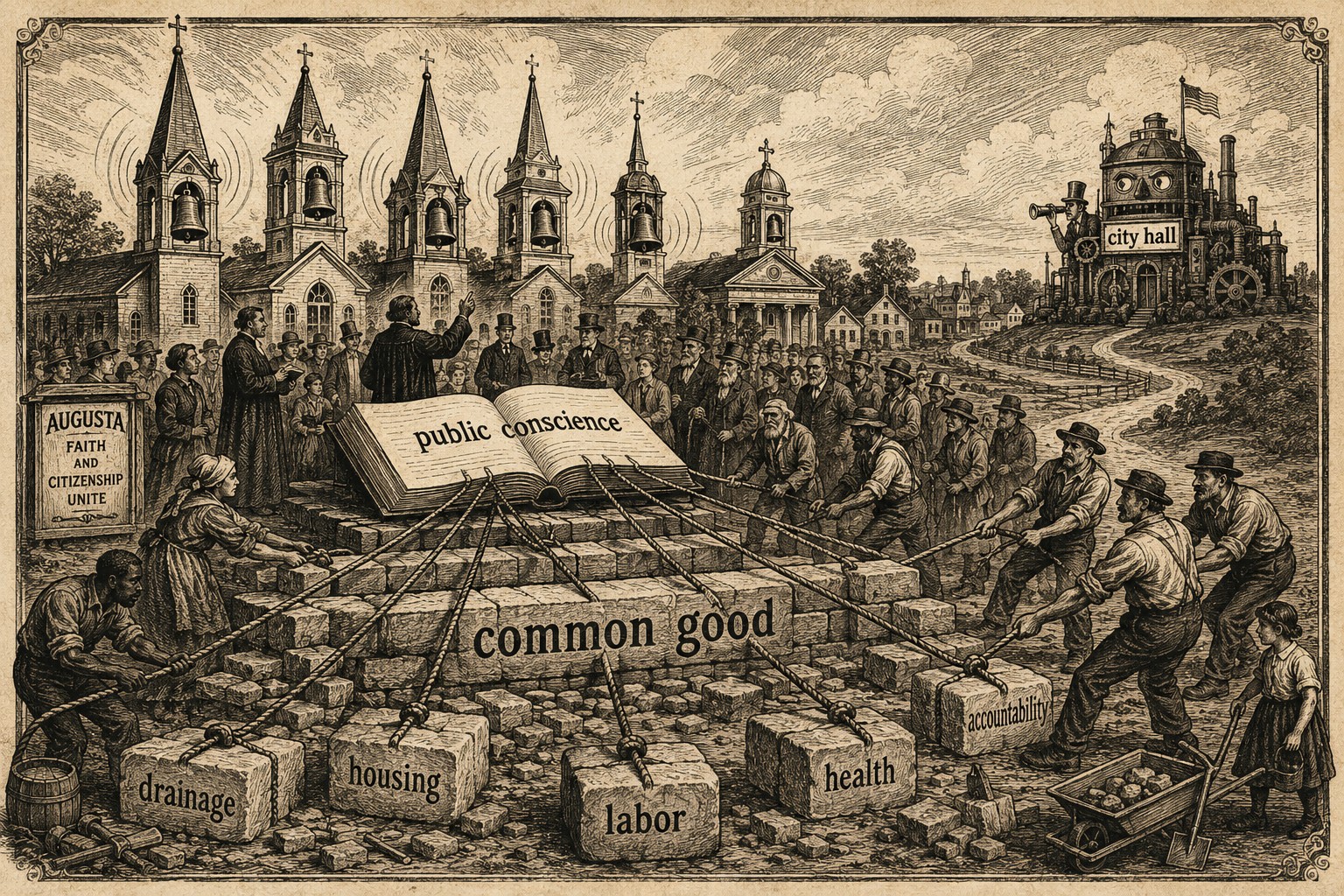
It needs churches, neighborhood associations, unions where they exist, civic groups, tenants, public workers, small businesses, and ordinary residents organized around a shared public-goods platform rather than isolated complaints.
It needs candidates who can speak about power without hiding behind either racial fear or color-blind fantasy.
It needs older leaders who know when wisdom requires making room, and younger leaders who understand that impatience is not the same thing as preparation.
It needs a politics that can say, without embarrassment, that the poor are not a constituency to be managed but neighbors to whom the city owes justice.
That is where the churches matter most.
If Augusta’s churches can organize mission trips, building campaigns, youth ministries, food drives, funerals, revivals, conferences, prayer breakfasts, and capital campaigns, they can organize public conscience. They can teach people to read a budget as a moral document. They can ask why the neighborhoods that need repair are always told to wait. They can refuse to let race be used as a fence while also refusing to pretend race does not structure the ground beneath our feet. They can insist that government be neither a patronage machine nor a consultant’s puzzle, but a servant of the common good.
They can help build the local equivalent of what Milwaukee’s unions once supplied: durable organization beneath reform.
Not partisan capture. Not clerical control. Not a baptized version of the same old machine.
Public power rooted in moral obligation.
That is the lesson worth taking from Milwaukee.
The sewer socialists understood that a city’s most basic services reveal who it serves. Pope Leo reminds us that systems must be judged by whether they honor human dignity. The Diggers remind us that Christian politics has long challenged enclosure and domination. Augusta’s own history reminds us that delay, division, and managed scarcity are not accidents. They are structures.
The work now is not to admire the argument.
The work is to build.
Not Babel, with its impressive height and hidden violence.
Jerusalem, stone by stone, neighbor by neighbor, with the ruins named honestly and the whole people called into the repair.
If Augusta is Christian, let its government prove it.
Notes
- Eric Blanc, “The Lessons of ‘Sewer Socialism,’” Catalyst, https://catalyst-journal.com/2026/04/the-lessons-of-sewer-socialism.
- Barna Group, “10 Facts About Faith in American Cities,” https://www.barna.com/research/10-facts-faith-american-cities/.
- BCW Project, “The Diggers (True Levellers),” https://bcw-project.org/church-and-state/sects-and-factions/diggers; JSTOR Daily, “What Did the Diggers Really Believe?,” https://daily.jstor.org/what-did-the-diggers-really-believe/.
- Pope Leo XIV, “Magnifica Humanitas,” Vatican, https://www.vatican.va/content/leo-xiv/en/encyclicals/documents/20260515-magnifica-humanitas.html; Vatican News, “Pope Leo’s ‘Magnifica humanitas’: AI must serve humanity not concentrate power,” https://www.vaticannews.va/en/pope/news/2026-05/pope-leo-xiv-encyclical-magnifica-humanitas-ai.html.
- Martin Luther King Jr., “The Other America,” Civil Rights Movement Archive, https://www.crmvet.org/docs/otheram.html.
- Charles Rollins, “The Machine Will Serve Its Master; the Question Is Whether Augusta Rebuilds Babel or Jerusalem,” Garden City Gossip:
- Pope Leo XIV, “Magnifica Humanitas,” Vatican; Vatican News, “Pope Leo’s ‘Magnifica humanitas’: AI must serve humanity not concentrate power.”
- Augusta-Richmond County, “White Paper: Funding Recommendations for the Augusta-Richmond County Stormwater Program,” https://www.augustaga.gov/DocumentCenter/View/6207/White-Paper-Final-111814.
- Augusta, Georgia, “Storm Water Management Program,” https://www.augustaga.gov/DocumentCenter/View/6634/Augusta-SWMPpdf.
- WRDW/WAGT, “Ongoing issues for Augusta storm drains,” https://www.wrdw.com/content/news/Ongoing-issues-for-Augusta-storm-drains-493540001.html.
- The Augusta Press, “Augusta Stormwater Fee Program to receive scrutiny,” https://theaugustapress.com/augusta-stormwater-fee-program-to-receive-scrutiny/.
- WRDW/WAGT, “After years, sewage still spews during storms in south Augusta,” https://www.wrdw.com/2023/06/27/despite-fees-neighbors-endure-years-spewing-sewage-during-storms/.
- The Augusta Press, “Augusta 1% sales tax wish list swells with stormwater, road needs,” https://theaugustapress.com/1-augusta-wish-list-swells-with-stormwater-road-needs/.
- WRDW/WAGT, “Stretch of Augusta Canal drained for repair of sewage line,” https://www.wrdw.com/2025/08/18/stretch-augusta-canal-drained-repair-sewage-line/.
- WRDW/WAGT, “Augusta gets $2M grant to address southside sewer problems,” https://www.wrdw.com/2026/04/03/augusta-gets-2m-grant-address-southside-sewer-problems/.
- Associated Press, “Tropical Weather Latest: Millions still without power from Helene as flooding continues,” https://apnews.com/article/52162181c47f400351397fe1c71e32a6; Augusta, Georgia, “Hurricane Helene Water Boil Information,” https://www.augustaga.gov/3237/Hurricane-Helene-Water-Boil-Information.
- The Augusta Press, “Water service, power and mosquitoes addressed in press conference,” https://theaugustapress.com/water-service-power-and-mosquitoes-address-in-press-conference/.
- WRDW/WAGT, “Here’s an update on Augusta’s recovery from Hurricane Helene,” https://www.wrdw.com/2026/01/15/heres-an-update-augustas-recovery-hurricane-helene/.
- WRDW/WAGT, “Augusta Canal closure comes just as it was starting to reopen after Helene,” https://www.wrdw.com/2026/01/12/augusta-canal-closure-comes-just-it-was-starting-reopen-after-helene/; WRDW/WAGT, “Another portion of Augusta Canal towpath is reopening to public,” https://www.wrdw.com/2025/12/18/another-portion-augusta-canal-towpath-is-reopening-public/.
- WRDW/WAGT, “‘It’s a lot of unknowns’: Augusta data center meeting draws concerned neighbors,” https://www.wrdw.com/2026/02/11/augusta-data-center-meeting-draws-concerned-neighbors/.
- WRDW/WAGT, “Augusta data center could use wastewater for cooling,” https://www.wrdw.com/2026/05/11/qts-data-center-project-raises-questions-about-savannah-river-water-use/.
- Charles Rollins, “Augusta’s Charter Rewrite Was Supposed to Be Independent. It Wasn’t,” Garden City Gossip,
Augusta’s Charter Rewrite Was Supposed to Be Independent. It Wasn’t.
Charles Rollins, “The Charter Died. The Structure Remains,” Garden City Gossip,
Charles Rollins, “Tax Day in Augusta: What the Affordability Debate Refuses to See,” Garden City Gossip,
Tax Day in Augusta: What the Affordability Debate Refuses to See
Charles Rollins, “Augusta Is One Body: How Division Still Shapes the City,” Garden City Gossip,
Garden City Gossip, “Under the Azaleas: Richmond County Gerontocracy,”
🌺 UNDER THE AZALEAS 🌺 – The Gerontocracy Showed Up, and Augusta Got the Government It Rewards