
Aiman Tariq – Regional News Editor
Charleston, SC –
South Carolina anglers who fish for red drum will face tighter limits beginning July 1, as state officials move to reduce harvest pressure on one of the coast’s most familiar game fish.
The new rules lower the recreational daily limit, create a smaller boat limit, adjust the legal harvest size, and add new hook requirements for anglers using larger hooks with natural bait.
According to the South Carolina Department of Natural Resources, the changes follow recent stock assessments showing that the southern Atlantic red drum population has fallen to unsustainable levels. The state’s own review produced similar findings.
That does not mean red drum are disappearing from South Carolina waters. It does mean fisheries managers believe the current rules are no longer strong enough to support the population over time.
That distinction matters. For anglers, the rules change what can be kept. For the state, the change is about trying to protect a fishery before the problem becomes harder to fix.
What Changes on July 1?
Beginning July 1, recreational anglers may harvest one red drum per person per day.
The previous limit was two fish per person per day.
The boat limit will also change. Anglers may keep no more than two red drum per boat per day. The previous boat limit was six fish per boat per day.
The legal size range is changing as well. Only red drum measuring 18 to 25 inches may be harvested. The previous slot limit was 15 to 23 inches.
That means smaller red drum that were previously legal at 15, 16, or 17 inches will no longer be available for harvest under the new rules.
The state is also changing tackle rules for certain situations. Anglers fishing for gamefish, including red drum, cobia, and tarpon, must use non-offset, non-stainless circle hooks when using natural bait and hooks size 4/0 or larger.
There are no hook-type restrictions for anglers using smaller hooks or artificial lures.
Why the State Is Tightening the Limits?
The rule changes follow a 2024 regional stock assessment from the Atlantic States Marine Fisheries Commission.
That assessment found mixed results for red drum along the Atlantic coast. The northern stock, from New Jersey through North Carolina, was not considered overfished. But the southern stock, covering South Carolina through the east coast of Florida, was found to be overfished and experiencing overfishing.
That is the central reason the new rules are being put in place.
In fisheries language, “overfished” means the population has fallen below a target level. “Overfishing” means too many fish are being removed compared with what the population can sustain.
Those terms can sound technical. But the practical meaning is fairly simple: managers believe fewer red drum should be harvested now so more fish can remain in the water and support the population later.
According to SCDNR, the state-specific assessment pointed in the same direction as the regional review.
That makes the South Carolina change less like a sudden policy shift and more like the result of several years of data collection, public discussion, and pressure from fisheries scientists.
What Anglers Need to Know?
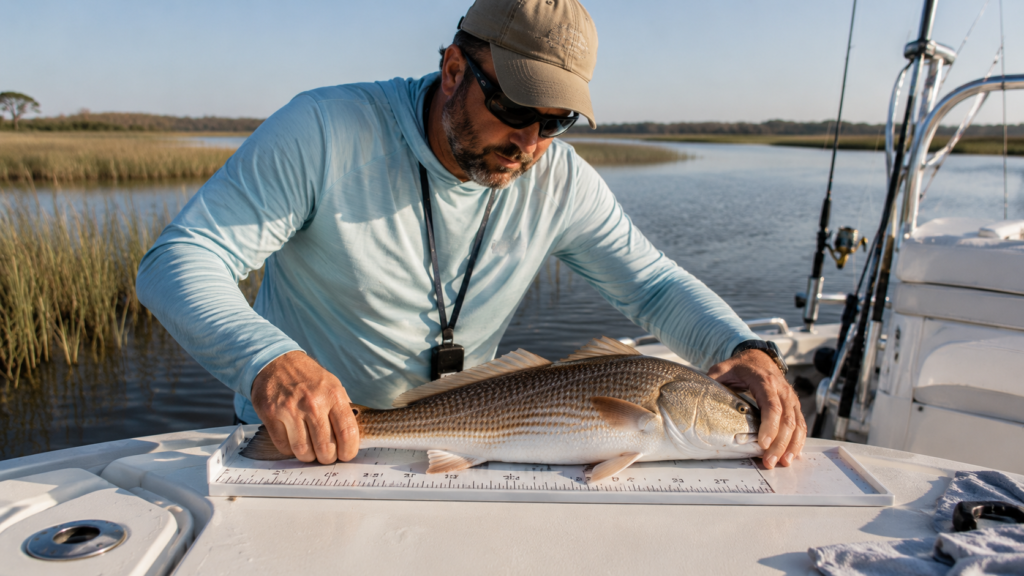
For most recreational anglers, the immediate change is straightforward.
The new rules mean:
- One red drum per person per day
- Two red drum per boat per day
- Legal harvest size of 18 to 25 inches
- Circle hooks required in certain natural-bait situations with hooks 4/0 or larger
- A valid recreational saltwater fishing license required for anglers 16 and older
Those are the rules most anglers will need to remember before keeping a red drum after July 1.
The hook requirement may take a little more explanation. The rule does not apply to every rig or every fishing method. It applies when anglers are fishing for gamefish with natural bait and using a hook size of 4/0 or larger.
Artificial lures are not affected by that requirement.
The purpose is not only to reduce harvest but also to improve survival for fish that are released. SCDNR has long encouraged catch-and-release practices that reduce injury, including the use of circle hooks.
Why Red Drum Matter on the South Carolina Coast?
Red drum, often called redfish, are a major part of South Carolina’s coastal fishing culture.
They are popular with inshore anglers, guides, families, and recreational fishermen who target creeks, flats, docks, marsh edges, and nearshore waters.
They also play an economic role. Fishing trips, guide services, bait shops, boat ramps, tackle sales, and coastal tourism all benefit from a healthy red drum fishery.
That is why rule changes like this tend to draw attention. They affect weekend anglers and charter captains, but they also reflect a broader question: how much harvest can a popular fishery support before the long-term quality of fishing starts to decline?
SCDNR framed the new law as a proactive step.
Blaik Keppler, SCDNR marine resources deputy director, said red drum are an important part of South Carolina’s coastal resources and fishing heritage. He said the rule changes are meant to rebuild a sustainable fishery and protect future fishing opportunities.
That is the state’s position. Anglers will now judge the rules by how they play out on the water.
The Harvest Debate Is Not Always Simple
Fishery restrictions often create a familiar split.
Some anglers support tighter limits because they want better fishing years from now. Others see the restrictions as another burden on people who already follow the rules and buy licenses.
Both reactions are understandable.
A one-fish daily limit is a meaningful change, especially for anglers who regularly kept red drum for the table. The boat limit may be even more noticeable for families or groups fishing together.
But the state’s argument is that red drum need more protection now because the population trend is moving in the wrong direction.
That is where the data becomes important.
A stock assessment is not a perfect window into every creek or every fishing trip. It is a model built from surveys, landings, biological sampling, and other inputs. Like all models, it has limits.
But it is also the main tool fisheries managers use to detect whether a population is being pushed too hard.
So the responsible way to read the new rules is not that every South Carolina red drum spot is suddenly empty. It is that managers see enough evidence of stress in the broader southern stock to justify lower harvest.
How This Fits Into the Broader Coastal Picture?
South Carolina is not making this decision in isolation.
The southern red drum stock covers a larger region, from South Carolina through the east coast of Florida. That means South Carolina’s rules are part of a bigger management picture, not just a local reaction to one year of poor fishing.
Georgia and Florida also factor into the regional status of the stock, though each state manages its own recreational rules.
That is part of what makes coastal fisheries difficult to manage. Fish do not follow state lines. Anglers do.
A population can be affected by harvest pressure, habitat conditions, recruitment, water quality, weather events, and changes in the number of people fishing. When those factors overlap, managers tend to respond with conservative rules.
That is also why these decisions often arrive slowly. The state has to analyze data, take input, work with regional partners, and give anglers time to understand what is changing.
For readers following our broader outdoors and coastal-resource coverage, this rule change fits into the same larger conversation about how South Carolina manages growth, recreation, and environmental pressure along the coast.
The Circle Hook Requirement

The circle hook rule may be one of the less noticeable changes for casual readers, but it matters on the water.
Circle hooks are designed to reduce deep hooking. When used properly, they are more likely to catch fish in the jaw instead of deeper in the throat or stomach.
That can improve survival for released fish.
SCDNR has previously cited studies showing that non-offset circle hooks can reduce mortality for sub-adult red drum compared with some other hook types.
That is why the new rule focuses on natural bait and larger hooks. Those are the situations where deep hooking can be a greater concern.
The requirement does not mean anglers must change every setup. It means they need to pay attention to hook size, bait type, and whether they are targeting gamefish covered by the rule.
As with any new regulation, there will likely be a learning period.
Enforcement and Angler Responsibility
Once the new rules take effect, anglers will be responsible for knowing the updated limits.
That matters because old habits can linger. A fisherman who followed the previous two-fish limit may now be over the daily limit after keeping a second red drum.
The same is true for the old 15-to-23-inch slot. A 16-inch fish that was once legal will no longer be legal to harvest under the new rules.
That does not mean every mistake will come from bad intent. But fisheries regulations are enforced by what the rule says, not by what an angler remembers from last season.
The safest approach is simple: check the current South Carolina saltwater regulations before keeping fish, especially during the first few weeks after the change.
What Happens Next?
The new red drum rules take effect July 1.
After that, the key question will be whether lower harvest limits and gear changes help rebuild the stock over time.
That answer will not come quickly. Fishery recovery is usually measured over years, not weeks.
Future assessments will likely look at spawning potential, juvenile recruitment, harvest numbers, release mortality, and other indicators.
If the population improves, managers may eventually have more room to adjust. If it does not, additional pressure could build for more restrictions.
For now, the state is asking anglers to accept tighter limits as the price of keeping the fishery viable.
The Bottom Line
South Carolina is tightening red drum rules because fisheries managers say the southern Atlantic stock has fallen below sustainable levels.
Beginning July 1, recreational anglers may keep one red drum per person per day, with no more than two per boat. The legal harvest size will shift to 18 to 25 inches, and certain natural-bait fishing will require non-offset, non-stainless circle hooks.
The changes will be frustrating for some anglers, especially those used to the previous two-fish daily limit and six-fish boat limit.
But the state’s argument is straightforward: fewer fish harvested now may help preserve the fishery later.
That does not make the policy painless. It does make it part of a larger coastal management question South Carolina cannot avoid.
Red drum remain one of the state’s signature saltwater fish. The new rules are an attempt to make sure they stay that way.