
by Charles Rollins, Publisher
After charter reform died in Atlanta, Augusta’s political class returned to the same old work: delay, opacity, managed scarcity, and a system that still teaches ordinary people to wait their turn for rights that are too often dispensed like favors.
AUGUSTA, GA — The charter died. The structure did not.
A week after Augusta’s charter reform collapsed at the Statehouse, the Augusta Commission met on April 14 and demonstrated, more clearly than any campaign speech or procedural memo ever could, what the real problem has always been. Augusta is not governed badly because this official hesitated, or that department misfired, or some paperwork sat too long on somebody’s desk. Augusta is governed badly because it is governed through a structure that converts delay into cost, access into privilege, and public need into dependence.[1][2][3][4]
That is the point the city’s political class keeps trying to evade. They want every failure understood as local, isolated, and technical. This project is late for one reason. That service request stalled for another. Public comment is messy because governing is hard. Hiring is slow because bureaucracy is bureaucracy. The water park is still theoretical because prudence requires another study. But when the same city produces the same pathologies, in the same sequence, under different agendas, different committees, and different personalities, we are no longer talking about a string of unfortunate episodes. We are talking about a governing order.
And that governing order survived the charter fight untouched.
The Charter Fight Was Never Just About the Charter
The city’s own Charter Review Committee was not supposed to be a subsidiary of the Augusta Commission’s political timetable. It was established, in the city’s own words, as a body “independent of the Augusta Richmond County Commission,” charged with studying the charter, conducting a comprehensive review, and proposing changes under the guidance of the Carl Vinson Institute of Government.[1] That independence was not decorative. It was the whole theory of legitimacy. If Augusta’s governing structure was to be reworked, it was supposed to be done through an independent public process robust enough to persuade the public that the rewrite belonged to the city rather than to whichever faction happened to be strongest at the moment.
That is not what happened. Before that independent process had concluded its work, local legislation was already moving through the Georgia General Assembly. Senate Bill 628, sponsored by Sen. Max Burns, proposed a council-manager form of government for Augusta-Richmond County. House Bill 1584, sponsored by Rep. Mark Newton, did the same. SB 628 was read and referred in the Senate, then later appeared on the Senate’s list of tabled legislation on April 2. HB 1584 was referred in the House as local legislation. The bills died, but not before making plain what had already become obvious locally: the independent process was being outrun by the political class.[2][3]
That matters because the question was never simply whether Augusta should have a manager system. The deeper question was whether the city’s ruling class was willing to submit itself to an independent democratic process at all. The answer, in practice, was no. The moment institutional power was truly on the table, independence became negotiable.
That is why the charter’s collapse did not end the argument. It clarified it. The old structure did not beat reform because it was right. It beat reform because it remains the structure through which local power is actually exercised.
What the April 14 Meeting Revealed
The April 14 meeting was not a charter meeting in the narrow sense. It was more useful than that. It was a live demonstration of the conditions that made the charter fight matter in the first place.
Take Big Oak Park. The public discussion was not some grand ideological argument about whether the park deserved investment. It was a classic Augusta story: plans completed in 2024, bids not received until late 2025, then months later a project that came in high enough to require a diminished Phase I and a deferred Phase II. In the transcript, officials explicitly described a “system problem” in how projects move through the city’s internal machinery. That phrase ought to be read literally. By the time Augusta gets around to doing many of the things it already decided to do, inflation, procurement lag, and internal drift have already taken their cut. The public is then handed a hollowed-out version of its own promise and told to call it progress.[4]
That is not neutral administrative delay. It is distributive politics by other means. A city that consistently delays public goods until they become more expensive and less ambitious is not merely inefficient. It is teaching residents to expect less and be thankful for fragments.
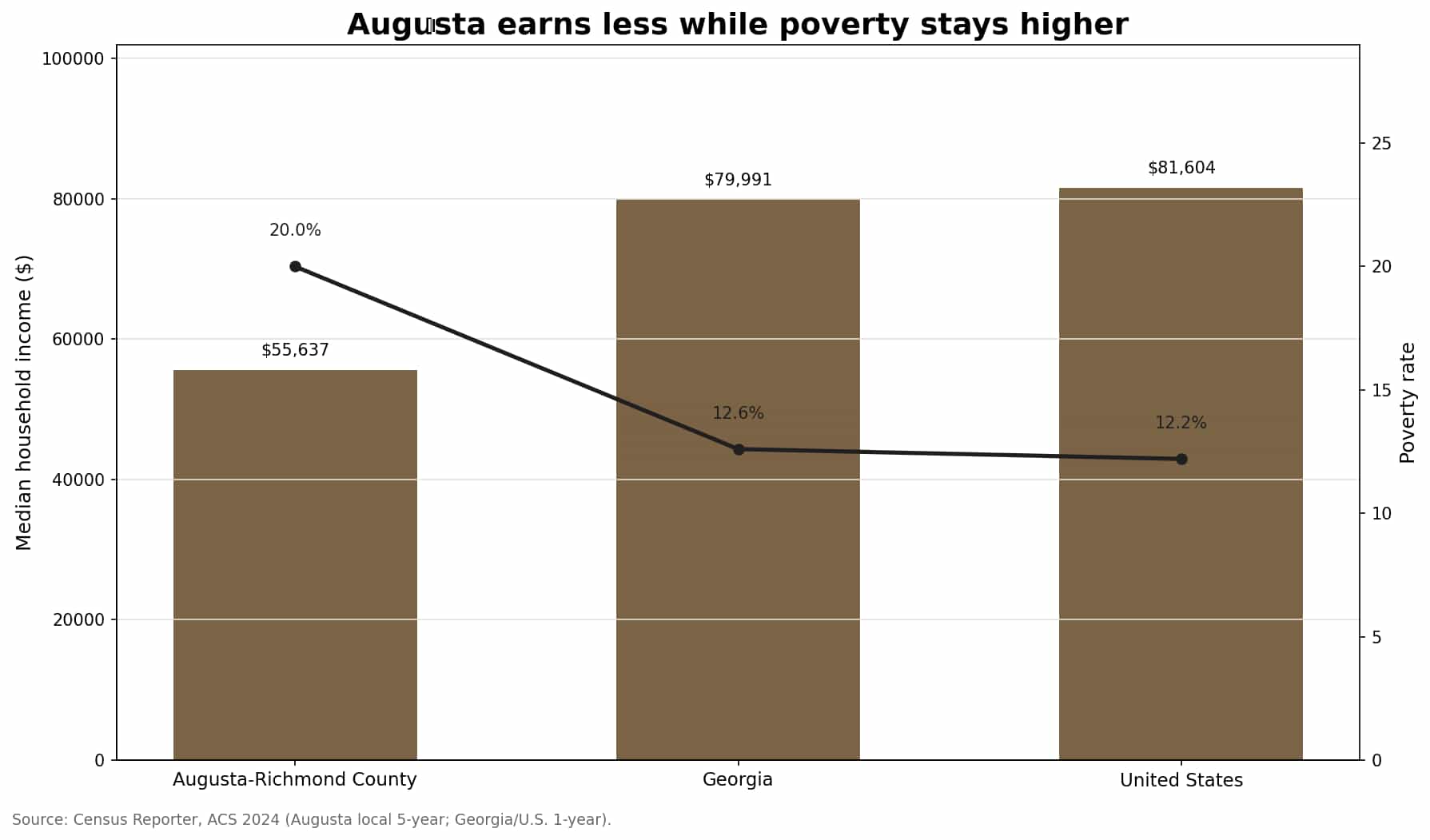
Augusta trails both Georgia and the nation on household income while posting a substantially higher poverty rate.
Augusta trails Georgia and the nation on household income while carrying a substantially higher poverty rate. Source: U.S. Census Bureau ACS 2024 via Census Reporter.
The 311 presentation exposed the same logic from the other side of government. Augusta can intake requests. Augusta can generate case numbers. Augusta can count phone calls. What it still struggles to do is guarantee that the public receives reliable, timely, intelligible updates about whether government has actually done what it said it would do. In the April 14 discussion, the 311 director plainly identified the weak points: providing updates, showing progress, and ensuring that needs are truly met. One commissioner then noted that this same problem has been raised repeatedly, only to be told that a work-order and request policy was already approved in 2023 and that the real issue is enforcement.[4]
There is something revealingly Augustan about that exchange. The policy exists. The system exists. The need exists. The enforcement does not.
And where enforcement fails, dependence thrives. The most morally admirable anecdote in the 311 discussion — a staff member going above and beyond to help an elderly resident whose service paperwork had lapsed — was institutionally devastating for exactly that reason. No decent person could object to the act. But no serious city should be comfortable with what the story reveals: that basic governmental responsiveness so often depends on the extraordinary diligence of a specific person rather than the ordinary function of the institution itself. A government that works mainly when a particularly conscientious employee intervenes is not delivering equal citizenship. It is delivering discretionary mercy.[4]
That is the kind of city Augusta still is. Too many people do not encounter government as a predictable right. They encounter it as a maze in which a good guide can save them and a bad week can bury them.
Access Is Not a Side Issue
The delegation debate made this impossible to miss. A citizen argued that public delegations should be moved to a predictable later hour so working people could know when to show up and be heard. Commissioners pushed back that they also have jobs, families, and staff constraints. The city clerk then noted that the rule preventing repeat appearances on the same topic within 90 days was inherited from pre-consolidation Richmond County practice, while a commissioner openly suggested that this limitation on public speech may itself deserve reconsideration.[4]
That exchange should not be dismissed as procedural housekeeping. It goes to the heart of who government is actually built for. A public-comment regime that assumes flexible schedules, institutional fluency, transportation, and endless patience is not neutral just because it is longstanding. It privileges the people already most capable of navigating power. Everyone else is told to work around the state. That is not participation. That is managed access.
And managed access is how systems of domination survive long after the language of exclusion has become impolite.
When the city’s political class speaks about “representation,” it usually does so in abstract and flattering terms. But the test of representation is not whether a microphone technically exists. The test is whether ordinary people can get to it, understand the rules around it, speak without ritual humiliation, and reasonably expect that what they say will matter. Augusta still fails that test too often.
Race, Poverty, and the Local State
This is where race and history enter the argument not as ornament, but as discipline. Augusta-Richmond County’s balance is 56.8 percent Black, and 20.1 percent of residents live in poverty.[5] That is not incidental background. It is the social terrain on which all of this unfolds.
In a wealthy, high-capacity city, procedural drag is often experienced as annoyance. In a poorer city, and especially in one where poverty is disproportionately embedded in Black neighborhoods with long histories of state neglect, procedural drag becomes a mechanism of social control. A delayed project is not merely delayed; it is a neighborhood left as it was. A broken service-response loop is not merely inconvenient; it is time and transportation extracted from people who have less of both. An inaccessible meeting structure is not merely clumsy; it is a quiet announcement about whose workday matters and whose does not.
That is why the phrase “structural oppression” is not too strong here. Oppression is not only the dramatic act, the slur, the vote, the openly stated exclusion. Oppression is also the settled arrangement by which one class of people is made to navigate life through scarcity, delay, uncertainty, and institutional dependence while another class experiences the same government as negotiable, penetrable, and responsive.
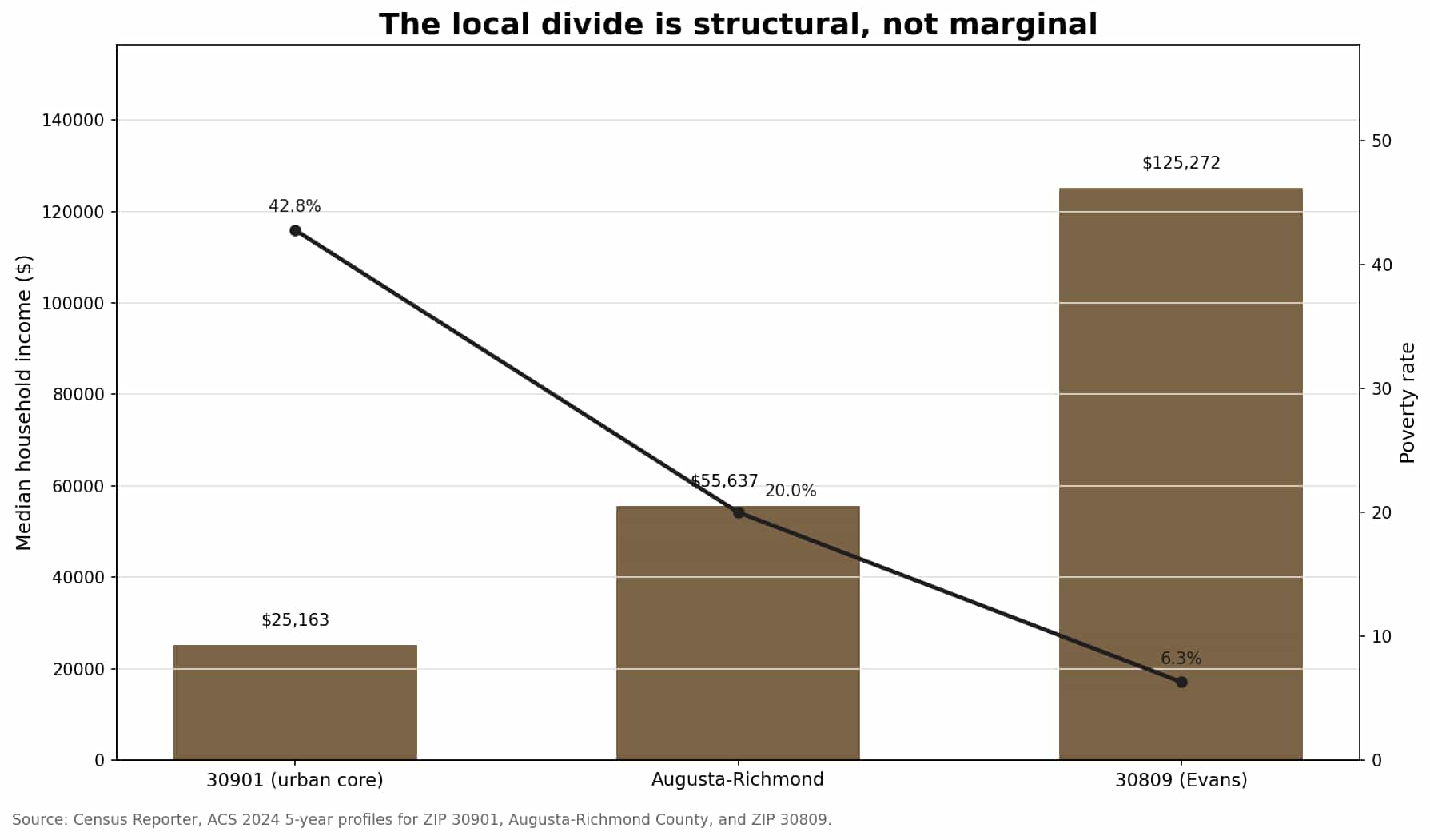
The divide is not abstract. 30901 and 30809 occupy sharply different economic realities, with Augusta overall sitting uneasily between them.
The divide is not abstract. ZIP code 30901 and ZIP code 30809 occupy sharply different economic worlds, with Augusta overall sitting uneasily between them. Source: U.S. Census Bureau ACS 2024 via Census Reporter.
And that arrangement in Augusta has history behind it. The present consolidated government dates to 1996, when Augusta and Richmond County consolidated into one governing body consisting of a mayor and ten commissioners.[6] But the institutional struggle that produced that order goes back much further; Augusta University’s archival records preserve an entire collection devoted to Augusta-Richmond County consolidation, underscoring that the system we live under was not born yesterday and was never a neutral technical redesign.[7]
Consolidation was sold, in part, as modernization. Efficiency. Streamlining. Good government. Three decades later, what we have is a government that still cannot make itself consistently legible to ordinary people without requiring procedural literacy, personal persistence, and, too often, inside help. The old promises of rational administration remain, but the everyday experience is something else: centralized authority with diffused accountability.
The Political Class Is Still Evading the Real Question
The defenders of the status quo deserve criticism, and not the courteous variety. They continue to act as though preserving the current arrangement is equivalent to defending democracy. It is not. A structure that repeatedly produces delayed projects, partial transparency, stale policy, and public frustration is not vindicated by the mere fact that it is familiar. Habit is not legitimacy. Endurance is not virtue.
But the reform faction deserves far more scrutiny than it has received as well. Much of what passed for reform in this fight was not democratic reconstruction. It was elite reconfiguration. A council-manager system may or may not improve administrative execution in some respects. That is a legitimate institutional debate. But what Augusta’s political elite offered was not a program for dismantling the deeper structure of dependence. It was, at best, a program for optimizing it. They were willing to move power around. They were not prepared to democratize it.
That is the line no one serious should let them escape. One side wanted to preserve an exhausted structure because it knows how to operate inside it. The other wanted to redesign the command apparatus without disturbing the city’s deeper political economy of waiting, rationed access, and managed scarcity. Neither side proposed anything like a local state that ordinary people could approach without supplication.
And so we arrive at the central truth of Augusta politics in 2026: the charter died, but the structure that produced the charter crisis remains entirely alive. It sat at the dais on April 14. It spoke in the language of process. It acknowledged inefficiency, asked for patience, authorized another study, promised future improvement, and carried on.
That is why euphemism is no longer acceptable. Augusta does not merely suffer from dysfunction. It reproduces dependence. It reproduces uneven access. It reproduces lowered expectations. It reproduces, in municipal form, a social order in which the people who most need a competent and democratic state are the ones most likely to encounter it as delay.
The charter died. The structure remains.
Publisher’s Note: Garden City Gossip has closely covered the Augusta Charter Review process, including reporting on the Commission’s formation, timeline pressures, internal disputes, and legislative involvement. This column is published as part of our opinion section and is written under a pseudonym. The views expressed are those of the author and do not necessarily reflect the views of Garden City Gossip, its publisher, or its editorial staff.
Endnotes
- Augusta-Richmond County’s official Charter Review Committee page states that the committee “shall be a body independent of the Augusta Richmond County Commission” and was created to study the charter and provide a comprehensive review under the guidance of the University of Georgia Carl Vinson Institute of Government. Official Charter Review Committee page.
- Georgia Senate First Readers for March 20, 2026 lists SB 628 by Sen. Max Burns as a bill to amend the Augusta-Richmond County consolidation act to provide for a council-manager form of government and a referendum. Senate First Readers, March 20, 2026.
- The Georgia Senate’s “Legislation Tabled” calendar for April 2, 2026 lists SB 628 as tabled in substitute form. House First Readers for the same legislative period lists HB 1584 by Rep. Mark Newton as a local bill to provide a council-manager form of government for Augusta-Richmond County. Senate tabled legislation, April 2, 2026; House First Readers, 2026 Day 35.
- Transcript of the Augusta Commission’s April 14, 2026 meeting cycle provided to Garden City Gossip by the author, including discussion of Big Oak Park delays and phasing, 311 service-response problems, delegation timing and rules, the stale personnel manual, and the water park feasibility study.
- U.S. Census Bureau QuickFacts for Augusta-Richmond County consolidated government (balance), Georgia lists the jurisdiction as 56.8% Black alone and 20.1% persons in poverty. U.S. Census Bureau QuickFacts.
- Augusta’s official history page states that in 1996 the City of Augusta consolidated with Richmond County to form Augusta-Richmond County, governed by a mayor and ten commissioners. City of Augusta history page.
- Augusta University’s archival finding aid for the Augusta-Richmond County consolidation records documents the longer institutional history behind consolidation and preserves the collection as “Augusta-Richmond County consolidation records (MSS 013).” Augusta University consolidation records.
- The official April 14 commission agenda materials included the Big Oak Park item, delegation timing discussion, 311 presentation, HR presentation, and the SPLOST 8 water park update, confirming that the meeting’s subjects were not incidental but central to the day’s business. Augusta Commission meeting materials, April 14, 2026.
- The interstitial charts in this article are based on U.S. Census Bureau ACS 2024 data as presented by Census Reporter for Augusta-Richmond County, ZIP code 30901, and ZIP code 30809. Augusta-Richmond County profile; 30901 profile; 30809 profile.
- Underlying chart data: augusta_structural_economic_graphs
Related GCG Coverage
Augusta’s Charter Rewrite Was Supposed to Be Independent. It Wasn’t.
🌺 UNDER THE AZALEAS 🌺 – Who Killed Augusta’s Charter? A Reform Effort Dies Under Political Pressure