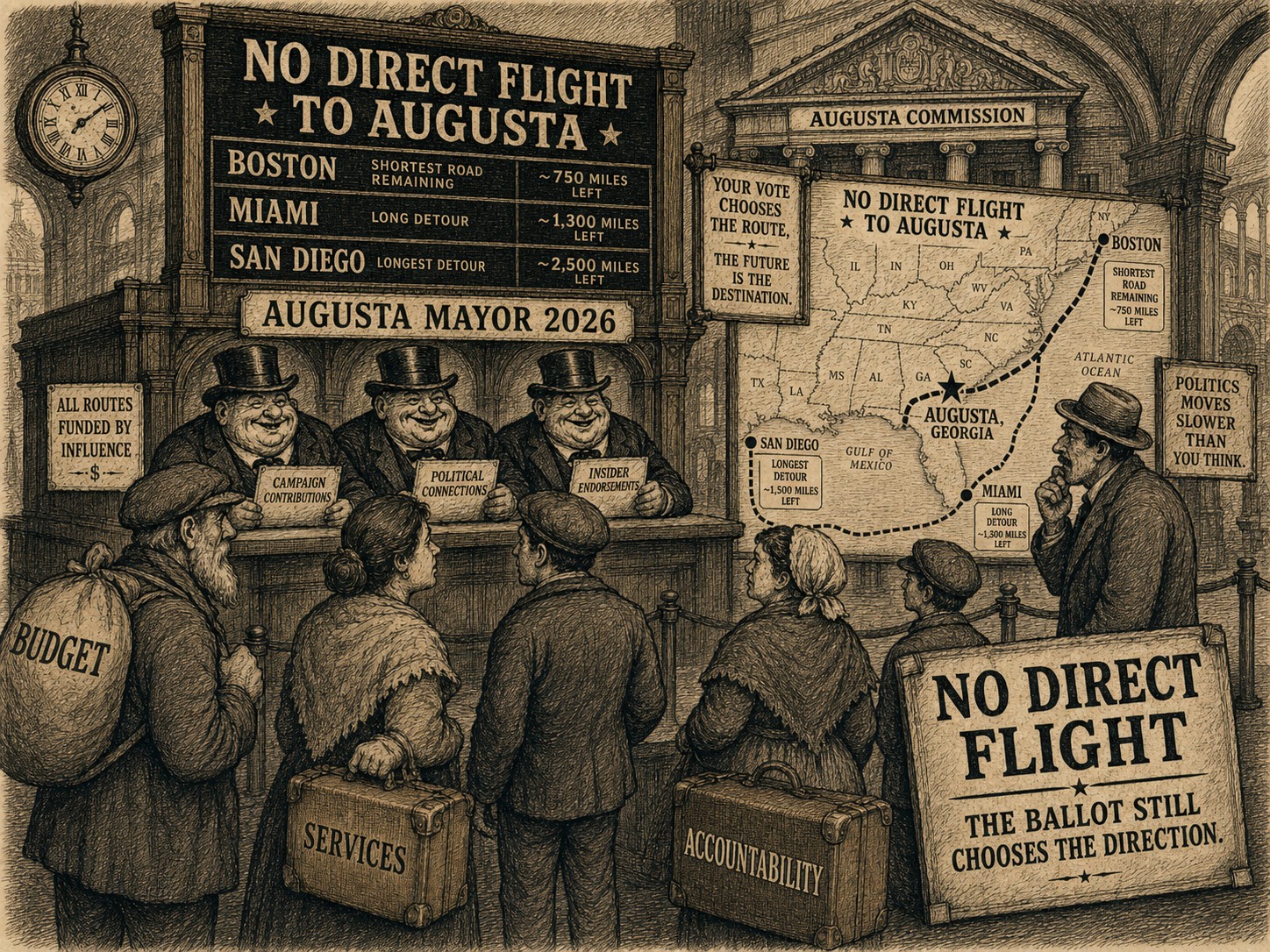
The mayoral ballot may not offer a direct route to the city voters want, but it still chooses the direction.
by Publisher.
Augusta, GA – There are four names on the ballot for mayor: incumbent Garnett Johnson, former Richmond County Tax Commissioner Steven Kendrick, educator and nonprofit leader Lori Myles, and real estate investor and Army veteran Eric Gaines. They are not the same person. They do not come from the same biography, the same professional network or the same political temperament.
But that is not the same as saying Augusta has been offered four clear governing choices.
So far, the public race has been full of words that are hard to oppose: accountability, transparency, unity, neighborhoods, fiscal management, quality of life, public safety, efficiency and better government. Every candidate says some version of those things. Every candidate says Augusta’s government needs to work better. Every candidate says the public should be heard. Every candidate says money should be managed more carefully.
That is the problem.
When every candidate is for accountability, accountability stops being a position. When every candidate is for neighborhoods, neighborhoods stop being a program. When every candidate is for better management, voters are left to guess whether that means cutting staff, replacing department heads, changing the charter, expanding public dashboards, shifting money to transit, tightening finance controls, changing development incentives or simply presiding over the same machinery with a different voice.
This is the central fact of Augusta’s mayoral race: the candidates are distinguishable as people, but not yet sufficiently distinguishable as governing programs.
That does not make voting less important. It makes voting more demanding.
A ballot is not always a direct flight. Sometimes you are standing in an airport in St. Louis, trying to get to Augusta, and the board does not show an Augusta flight. It shows Boston, Miami and San Diego. None is the destination. But a voter who believes Miami, or even Boston leaves the easiest remaining drive has not wasted their ticket by boarding one of those flights, and it certainly is better than going to San Diego. The disappointment that no one offered Augusta does not make Boston, Miami and San Diego the same. It does not make staying in the terminal (not voting at all) a plan.
Local voting is often directional rather than perfect. Even when the policy differences are not as clear as they should be, voters still have a meaningful act available: decide which candidate they most want to win, record that choice, and shape the governing field the next mayor will have to work inside.
The Mayor Has More Power Than Before. Still Not Enough To Govern Alone.
The mayor of Augusta is not a king, a city manager or a commissioner-at-large with unlimited authority. Augusta-Richmond County operates under a mayor/commission/administrator form of government. The city’s own description says the mayor is elected countywide, presides at Commission meetings, serves as the official head of the consolidated government for ceremonial and service-of-process purposes, signs contracts entered into by the Commission, and is charged with ensuring that laws, ordinances and resolutions are faithfully executed.1
Since the 2024 referendum, the mayor also has a full vote on the Augusta Commission. That is significant. It gives the office more formal power than it had when the mayor could vote only to break ties. But it does not create a strong-mayor government. It does not give the mayor a veto. It does not let the mayor personally run every department, fix every service failure or impose a budget by decree.2
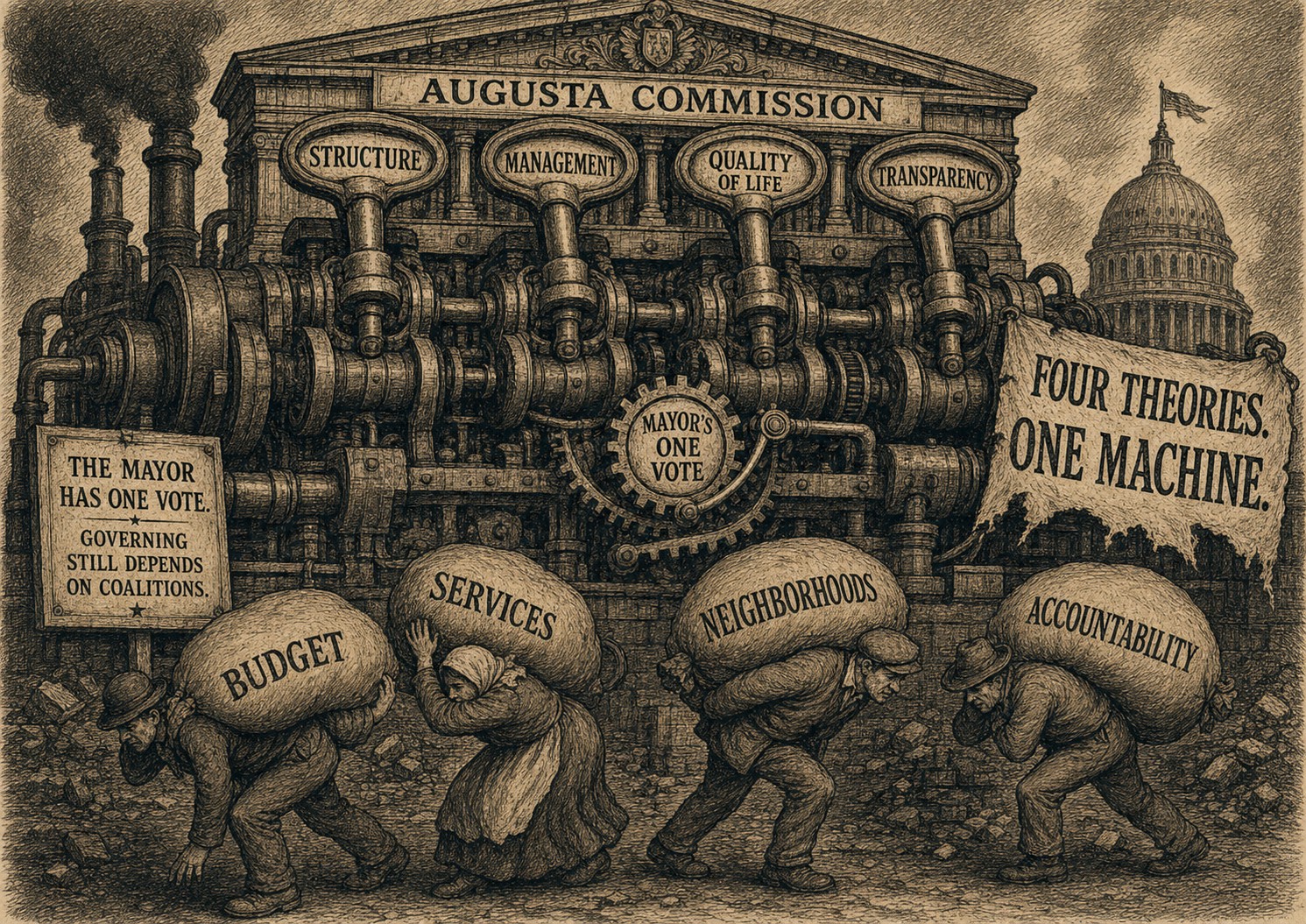
The next mayor will be one vote in an eleven-vote government. The office has a microphone, a citywide constituency, ceremonial authority, agenda influence, contract-signing duties and the ability to frame public conflict. But to govern, the mayor still has to assemble majorities, pressure administration, expose or conceal dysfunction, and decide whether to spend political capital on structural reform or day-to-day service delivery.
That is where the race has to be translated.
What The Latest Forums Added
The latest public coverage does not overturn the basic structure of the race. It sharpens it.
WRDW reported that candidates for mayor and Augusta Commission Districts 2, 4, 6, 8 and 10 appeared at an April forum at A.R. Johnson Magnet School. The forum’s stated purpose was voter education and public awareness ahead of the May election. That matters because the mayoral race is not happening by itself. The next mayor will govern with the commission voters choose at the same time.3
Later coverage of the West Augusta Alliance forum showed the same basic lanes. All four mayoral candidates were present. Myles described quality of life, bus routes and equal access to services as central priorities. Kendrick emphasized revenue generation and spending efficiency. Gaines described the need to align the commission and departments around clear priorities and a long-term vision. Johnson argued that existing leadership has put Augusta on the right track.4
A separate March debate featuring Myles, Kendrick and Gaines produced similar language. Gaines said Augusta had to become more practical. Kendrick emphasized relationships with state and federal officials and bringing dollars home. Myles described a coming paradigm shift and a need to reach the masses.5
The useful point is not that those statements are empty. It is that they still require translation. What happens after the slogan becomes a vote?
What Johnson Is Really Running On
Mayor Garnett Johnson’s argument is continuity under stress. He is asking voters to see his first term through the disruptions that surrounded it: ambulance turmoil, hurricane recovery, winter weather, finance problems, interim leadership and the long-running fight over Augusta’s governing structure.
At the West Augusta Alliance forum, according to the Augusta Press article supplied for this story, Johnson put the argument plainly: “Our government is broken.”
That sentence is the most useful way to understand his campaign, and the internal contradiction of it: if the government is broken, its a government that he has been a part of for the past 4 years. It’s not unfair to ask, what, exactly, is going to make next time different than this time? He says he wants change, and he’s been advocating for change for years, but apparently, according to his own assessment: “Our government is broken.”
Johnson is not merely saying that Augusta needs a better mayor. He is saying Augusta needs clearer lines of authority. His campaign language emphasizes results, relationships, jobs, opportunity and accountability. His public defense of the charter review process suggests that he sees Augusta’s problem as structural: too many blurred lines, too much room for delay, and not enough clear responsibility when city government fails.6
Translated into likely action, a second Johnson term would probably mean continued pressure for charter reform, clearer administrative authority and a mayor’s office that argues the current system is the reason progress is difficult. He would likely frame budget and service failures as evidence that Augusta’s structure must change, not merely that one department or commissioner made a bad decision, and most importantly, that only by consolidating more power in his office, can he make the changes that he believes will make Augusta better.
For a citizen, the practical effect depends on whether that argument becomes anything more than process. Process is great, but you need more than process to actually do anything.
If Johnson can build a working majority around clearer authority, the result could be faster decisions, less confusion over who is responsible and a government less able to hide behind its own design. If he cannot, voters may get another term in which the mayor correctly diagnoses the machine while the machine keeps producing the same delays.
The Johnson question is not whether Augusta is broken. It is whether the incumbent mayor, after one term inside that broken structure, has proved he can change it, and then, if he succeeds and gets what he wants, are you going to like the changes he makes?
What Kendrick Is Really Running On
Steven Kendrick’s argument is competence. His campaign rests on the idea that government can be modernized if it is run by someone who understands administration, finance and institutional relationships. He points to his tenure in the Richmond County Tax Commissioner’s office, where his campaign says he helped modernize services and make government work better for families and businesses.7
At the West Augusta Alliance forum, Kendrick returned to the financial question. The Augusta Press article supplied for this story reported that he distinguished the full city budget from the smaller general fund where many political decisions become visible. He criticized the habit of blaming prior administrations for current deficits. He pointed toward staffing and efficiency. He warned that if Augusta does not get control of its finances, the city could face a terrible next decade.
Translated into likely action, Kendrick would probably be a managerial mayor. He would likely use the office to press for budget discipline, administrative modernization, better finance practices and a more deliberate use of development tools. His background with the Tax Commissioner’s Office, the Development Authority and the Land Bank Authority points toward a candidate who sees government through institutions, not just speeches. But again, he talks a lot about process, and is very fuzzy on what exactly he wants to do, where he wants to do it, what would get cut to get those things done, and/or how those things would be paid for.
For a citizen, that could matter in concrete ways. A Kendrick administration might place more emphasis on whether offices are accessible, whether payments and records are modernized, whether South Augusta gets development tools rather than only campaign attention, and whether city finance is understandable enough to manage, but is any of this what people really want and need from their mayor or the commission?
Competence is not the same as politics. The question is whether Kendrick’s managerial language would produce a different distribution of power or simply a more orderly version of the current order, and then if he is able to actually execute a plan, what is it going to be? If the problem is only efficiency, Kendrick has a natural argument. If the problem is also who gets listened to, who gets protected, and which neighborhoods are allowed to wait, efficiency alone will not answer it.
The Kendrick question is whether better management would also mean different priorities, and again, specifics on what those priorities would be are scant.
What Myles Is Really Running On
Lori Myles is running most clearly as the candidate of quality of life and overlooked constituencies. Her public candidate profile identifies her as a former educator and current leadership executive who has previously run for mayor. Recent public coverage has emphasized her “Voice for the Voiceless” frame and her advocacy for equitable growth.8
At the West Augusta Alliance forum, according to the Augusta Press article supplied for this story, Myles spoke about women, families, students and disabled residents. She referred to the “pink vote,” meaning women voters. She also pointed to a concrete daily-life problem: students at Augusta Tech walking because transportation is inadequate.
That is the most practical part of her argument. It moves the mayor’s race away from abstractions and toward the lived experience of people whose city is measured not by ribbon cuttings but by whether they can get to class, work, a doctor, a grocery store or a government office.
Translated into likely action, Myles would probably use the mayor’s office to elevate transit, women, students, disabled residents, job training and the softer infrastructure of daily life. She is less likely to sound like a finance technician or charter engineer, and more likely to frame city government around access: who can move, who can participate, who is seen, and who is expected to endure inconvenience as the price of being poor, young, disabled or disconnected from power.
For a citizen, the practical impact would depend on whether that representational language becomes budget action. Transit cannot be improved by sympathy alone. Student access cannot be fixed by naming the problem. A mayor who wants to govern through quality of life still has to win votes for routes, funding, staffing, sidewalks, service standards and agency coordination.
Myles also appears more cautious about changing the charter “midstream” in a way that would silence commissioners, according to the Augusta Press article supplied for this story. That position matters. It suggests she may see Augusta’s problem less as too little executive authority and more as a failure to listen to the public through the representatives people already elected.
The Myles question is whether voice can become power. For a perennial candidate who perennially polls in the single digits, electability is a major issue for her, but votes that she pulls will have an effect on this election, particularly with the low turnout that is typical in a local May election in a non-presidential election year.
What Gaines Is Really Running On
Eric Gaines is running as the outsider and process reformer. His campaign language is built around “people before politics,” transparent budgeting, safer neighborhoods, economic opportunity, food deserts, responsive city services and neighborhood preservation. His website frames Augusta’s problem through backroom deals, forgotten promises and voices ignored.9
At the West Augusta Alliance forum, according to the Augusta Press article supplied for this story, Gaines framed Augusta’s problem as poor management. Drawing on his military background, he argued that leaders cannot simply wait for problems to climb the chain of command. He also said elected officials should not control the charter review process.
Translated into likely action, Gaines would probably try to make city government more visible from the outside. That could mean pushing for public-facing service metrics, clearer complaint tracking, more accessible meetings, tighter scrutiny of development decisions and more explicit neighborhood protections.
For a citizen, that could matter if your main experience of Augusta government is calling about a basic problem and never knowing where it went. A dashboard does not fill a pothole. But a public dashboard can make it harder for city government to pretend the pothole does not exist. A public office hour does not replace a budget vote. But it can create a record of who is being ignored. But again, to what end? Where is this all going? How will his plans actually impact real people in ways they can feel and see.
The risk for Gaines is the usual risk for outsider candidates in commission governments. The system does not reward moral distance from politics. It rewards vote-counting, alliances, persistence and procedural knowledge. An outsider mayor who cannot build a governing coalition becomes a commentator with an office, and, short of major and unlikely changes in Augusta politics, a bully-pulpit alone is unlikely to get anyone very far.
The Gaines question is whether transparency can survive the need to govern.
Where The Candidates Actually Differ
The differences are real, but they are mostly differences of emphasis.
Johnson is the structural-continuity candidate. He is most likely to keep arguing that Augusta’s form of government itself prevents accountability.
Kendrick is the administrative-competence candidate. He is most likely to talk about finance, staffing, modernization and development tools.
Myles is the quality-of-life and constituency candidate. She is most likely to center transit, students, women, families, disabled residents and daily access.
Gaines is the outsider-transparency candidate. He is most likely to push public-facing accountability tools, neighborhood protection and skepticism toward political insiders.
Those differences matter. But they are not yet the kind of differences voters can easily translate into votes on a budget, a department head, a development incentive, a bus route, an audit structure or a charter amendment.
Where The Candidates Do Not Yet Differ Enough
Based on the public campaign materials, forums and prior coverage reviewed for this story, the candidates converge on the safest available language. They all say Augusta needs accountability. They all say government should listen. They all say money should be managed better. They all say neighborhoods matter. They all say leadership matters.
But Augusta voters do not live inside slogans. They live inside consequences.
If the budget is short, what gets cut?
If the city needs more revenue, who pays?
If a department fails, who is removed?
If a development deal promises jobs but burdens a neighborhood, who gets priority?
If the charter is reopened, who gets more power and who gets less?
If transit is inadequate, which route changes first?
If the city promises transparency, what information appears online without a citizen having to beg for it?
Those are the questions that turn a campaign into a governing choice. And on those questions, the race remains underdeveloped.
Still, an underdeveloped race is not an irrelevant race. Voters do not need perfect information to make a civic judgment. They need enough information to decide which candidate is closest to the city they want, which candidate they trust with the mayor’s vote and public microphone, and which candidate they most want sitting at the center of Augusta’s next governing coalition.
How This Choice Could Actually Affect Your Life
The mayoral race matters, but not in the cartoon version of local politics where a new mayor personally fixes every problem.
It matters because the mayor can shape whether Augusta’s dysfunction remains atmospheric or becomes assigned to names, offices and votes.
On money, the next mayor will enter a city that has already adopted a difficult FY2026 budget with no millage increase, reductions for most general fund departments and one-time funding used to close the gap. That means the next term will not be a blank slate. The practical question is whether the mayor pushes honest budget choices or lets the city continue balancing political comfort against deferred pain.10
On services, your life changes if the mayor can force measurable performance. That means trash pickup, road repair, drainage, code enforcement, emergency response, transit reliability, parks, 311 tracking and the basic experience of whether city government answers. The mayor cannot do those jobs personally. But the mayor can make failure visible, organize votes around it and refuse to let departments, administrators or commissioners bury it in process.
On neighborhoods, your life changes if the mayor can define development as more than ribbon cuttings. South Augusta, East Augusta, West Augusta and downtown do not experience “growth” the same way. A grocery store, a warehouse, a subdivision, a road project, a tax allocation, a bus route and a code enforcement decision all land differently depending on where you live. The mayor’s job is not just to celebrate investment. It is to ask who absorbs the cost of that investment and who receives the benefit.
On access, your life changes if the mayor treats government as something residents can actually reach. Myles’ example of Augusta Tech students walking is not a side issue. It is a test of whether City Hall understands that “economic opportunity” is meaningless if people cannot get to school, work or services. Gaines’ interest in service tracking is another version of the same problem. Kendrick’s modernization argument points there too. Johnson’s structural argument points there if clearer authority produces faster response.
On power, your life changes if the charter debate returns. GCG has spent months reporting on the failed charter process because it is not a procedural obsession. It is the question beneath almost every other question. Who hires? Who fires? Who supervises? Who audits? Who controls legal advice? Who answers when a service collapses? Who can delay without consequence?
The mayoral candidates talk about those problems in different accents. They have not yet shown voters precisely how they would solve them.
The Voter’s Translation Test
A useful voter should stop asking whether a candidate supports accountability. Every candidate supports accountability.
Ask what the candidate would make public in the first 100 days.
Ask what budget line the candidate would protect even under pressure.
Ask what budget line the candidate would cut if the numbers require it.
Ask whether the internal auditor should be independent, and independent from whom.
Ask whether a chief financial officer should report through administration, the Commission or some other structure.
Ask what the mayor should do when commissioners protect a failing department head.
Ask which transit problem gets fixed first.
Ask what kind of development deal the candidate would reject.
Ask whether charter reform should strengthen the mayor, strengthen a professional manager, preserve commissioner authority, or do something else.
Ask how many votes the candidate already knows how to get.
That last question may be the most important. A mayor with a full Commission vote still has only one vote. The difference between a promise and a policy is the ability to count the rest.
The Race Beneath The Race
The surface race is Johnson versus Kendrick versus Myles versus Gaines.
The deeper race is between four theories of Augusta’s problem.
Johnson says the structure is broken.
Kendrick says the management is failing.
Myles says the people most affected are not being heard.
Gaines says the insiders have made government too opaque and unresponsive.
Each theory contains part of the truth. Augusta’s structure is broken. Its management has failed. Many residents are not heard. Too many decisions are opaque. The danger is that because all four theories are partly true, voters may mistake partial truth for a complete program.
A mayoral election should help citizens see the future shape of their government. This one has mostly shown them the vocabulary of dissatisfaction.
That does not make the race meaningless. It makes it more demanding. Voters should not be satisfied by the candidate who says Augusta deserves better. They should demand to know better how.
Because in Augusta, the practical difference between candidates will not be measured by who loves the city most. It will be measured by whose love becomes votes, budgets, rules, appointments, audits, routes, repairs and consequences.
Without that translation, four candidates become one murmur: better government, later.
Other Competitive Local Races On The Ballot
The countywide nonpartisan sample ballot and the Augusta Board of Elections qualified-candidates list also include several contested local races beyond the mayor’s race. Not every race on the countywide sample ballot appears on every precinct-specific ballot. Campaign links below are included where a campaign site was located during this research; otherwise the candidate is listed with the Board of Elections qualified-candidates record as the verification source.11
Superior Court Judge, Augusta Judicial Circuit
- Alexia Davis Payne
- Ashley Wright (incumbent)
Augusta Commission District 2
- Corey Johnson
- Stacy Pulliam (incumbent) — no official campaign website located in this search; see the Board of Elections qualified-candidates record.
Augusta Commission District 4
- Alvin Mason — no official campaign website located in this search; see the Board of Elections qualified-candidates record.
- Lonnie Wimberly (incumbent) — no official campaign website located in this search; see the Board of Elections qualified-candidates record.
Augusta Commission District 6
- Tamika Bean
- Tony Lewis (incumbent) — no official campaign website located in this search; see the Board of Elections qualified-candidates record.
Augusta Commission District 8
- Michael Cioffi
- Roger Garvin — no official campaign website located in this search; see the Board of Elections qualified-candidates record.
- Evett Williams
Augusta Commission District 10
- Wayne Guilfoyle (incumbent) — no official campaign website located in this search; see the Board of Elections qualified-candidates record.
- Ben Hasan — no official campaign website located in this search; see the Board of Elections qualified-candidates record.
The same local election cycle also includes two local sales-tax questions: SPLOST 9, described by Augusta as a proposed one-cent sales tax for specific capital improvement projects, and FLOST, described by Augusta as a proposed half-cent sales tax intended to reduce property taxes. Each proposal appears as a separate ballot question.12
Official Voter Resources
Election information can change. For registration status, precinct-specific ballot information, polling-place lookup, advance-voting information, absentee-voting information, sample ballots and election updates, verify directly through official election sources and nonpartisan voter-information tools.
- Augusta Board of Elections: 2026 Election Information
- Augusta-Richmond County Board of Elections
- Georgia Secretary of State My Voter Page
- League of Women Voters of Central Savannah River Area
- VOTE411
Related GCG Coverage
- Augusta’s May Election Is About More Than the Mayor’s Office
- Augusta Mayoral Race 2026 – Horserace Coverage
- The Quiet Rewrite of Power: Inside Augusta’s Charter Review as a Mayoral Election Approaches
- Augusta’s Charter Rewrite Was Supposed to Be Independent. It Wasn’t.
- Gayla S. Keesee: The Charter Review Process Deserves Better: Holding Our Consultants Accountable
- Who Killed Augusta’s Charter? A Reform Effort Dies Under Political Pressure
- The Charter Died. The Structure Remains.
- The Offices That Run Augusta: GCG Expands Focus on 2026 Downballot Races
- Augusta, GA — Mayor Johnson Launches Re-Election Campaign
Notes
1. Augusta, Georgia, “About the Office of the Mayor.” ↩︎
2. WRDW/WAGT, “Mayor now has a full vote at Augusta Commission meetings”; The Augusta Press, “Citizens give Augusta mayor vote on commission.” ↩︎
3. WRDW/WAGT, “Augusta candidate forum draws mayoral, commission hopefuls ahead of May primaries.” ↩︎
4. WRDW/WAGT, “Richmond County candidate forum draws full crowd as early voting continues”; WJBF/AOL, “West Augusta Alliance hosts candidate forum on Thursday.” ↩︎
5. WRDW/WAGT, “Augusta mayoral candidates outline priorities during debate.” ↩︎
6. Augusta Press, Susan McCord, “Our government is broken’: Mayor candidates pitch solutions,” May 3, 2026, article text supplied to GCG; Garnett Johnson campaign site, “From Augusta, For Augusta.” ↩︎
7. Kendrick for Mayor, “Why I am Running.” ↩︎
8. Branch, “Lori Myles platform & website | Augusta Mayor”; Local Matters Podcast, “Road to the Mayor’s Office with Eric Gaines, Dr. Lori Myles, and Steven Kendrick.” ↩︎
9. Eric Gaines campaign site, “People Before Politics.” ↩︎
10. Augusta, Georgia Government, “Augusta Commission Approves FY2026 Budget, Maintaining Fiscal Responsibility Amid Challenges.” ↩︎
11. Augusta Board of Elections, “Qualified Candidates for the May 19, 2026 General Primary and Nonpartisan Election.” ↩︎
12. Augusta, Georgia Government, “SPLOST 9 (Proposed)”; Augusta, Georgia Government, “Floating Local Option Sales Tax (FLOST)”; Augusta, Georgia Government, “Augusta, Georgia Government to Host SPLOST 9 and FLOST Information Sessions.” ↩︎