A NEWS RAG UNLIKE ANY OTHER

Why I’m 🏳️‍🌈 Proud 🏳️‍⚧️ of My Church | Augusta Pride

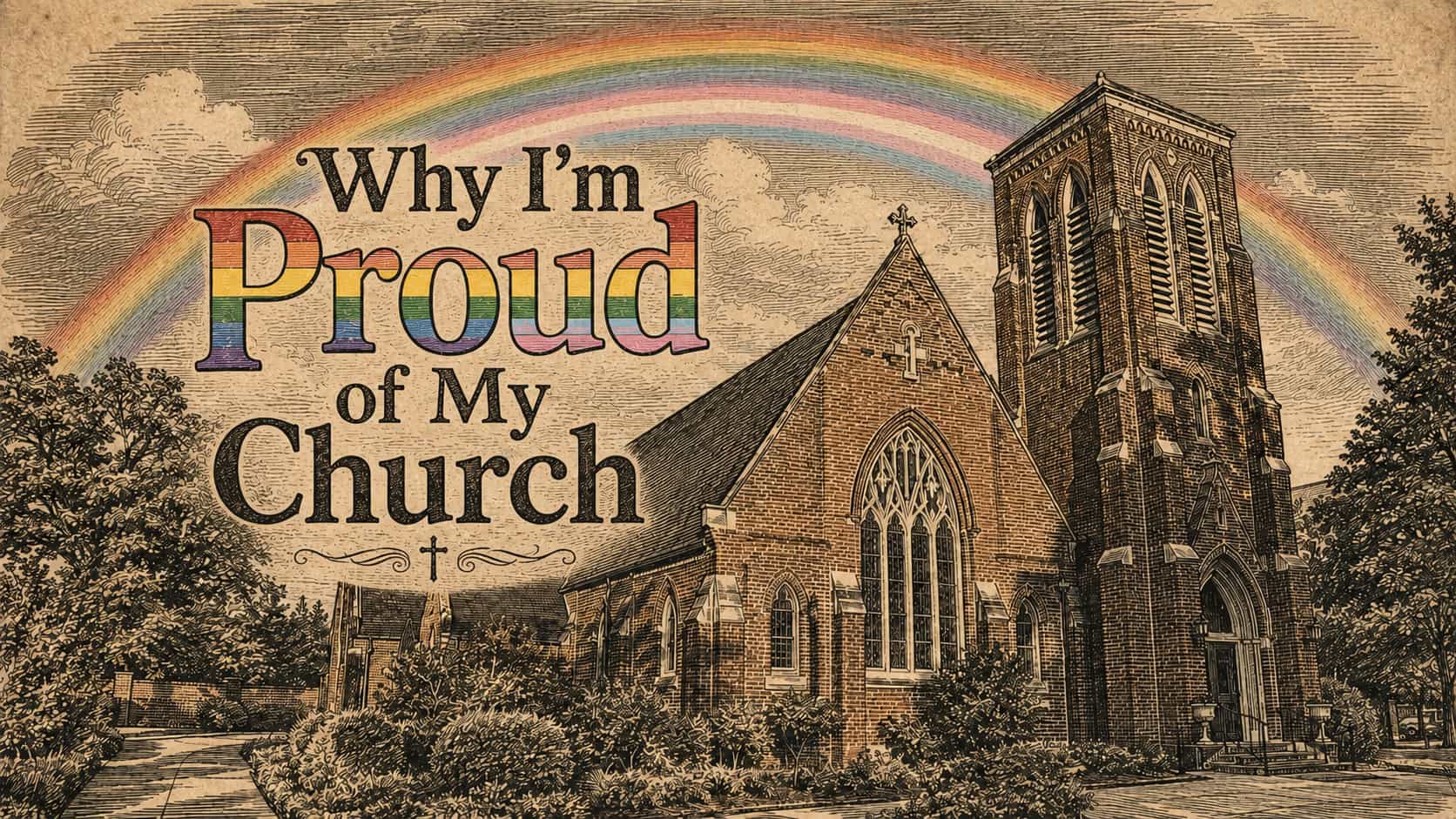
GCG-style engraved illustration of the Church of the Good Shepherd in Augusta beneath a rainbow, with the article title “Why I’m Proud of My Church” and Pride colors including trans-community colors.
A rainbow over Good Shepherd is not decoration; it is the visual argument of the piece. Image: COGS website source imagery, photo-derived and stylized by Garden City Gossip.
An Augusta Pride reflection on Good Shepherd, The Episcopal Church, and the Christian discipline of loving our neighbors. By Charles Rollins, Publisher

Pride Month is a time for joy.

Before it is a political argument, before it is a theological dispute, before it becomes another front in the endless national culture war, Pride is a public celebration of people who have too often been told to hide, apologize, explain themselves, or accept less than full belonging.
So let me start there. Garden City Gossip is proud to celebrate Augusta Pride. I am proud to celebrate Augusta Pride. I am grateful for Augusta’s LGBTQ+ community, for the people who have built public space for joy and dignity here, and for similar movements across the country and around the world that insist on something both simple and profound: every human being deserves to live openly, safely, honestly, and loved.
That should not be controversial.
But because it still is, Pride remains necessary.
It is necessary because visibility still matters.
It is necessary because young people are still listening for whether the adults around them will speak with love or contempt. It is necessary because too many families, churches, schools, workplaces, legislatures, and corporations still treat LGBTQ+ people as though their dignity were conditional, their safety negotiable, and their belonging subject to public approval.
This editorial is not an attempt to make Pride about my church. It is the opposite. It is an attempt to explain why my church, and my faith, is one of the reasons I support Pride so strongly.
The Church of the Good Shepherd in Augusta, and the Episcopal Church of which it is part, helped teach me that support for LGBTQ+ people is not a departure from Christian faith. At its best, it is an expression of it.
And the way I learned what that really meant, and how it came to change my outlook on the world in a profound way, is particularly important for not just this story, but for how we manage conflict and disagreement in all areas of our shared society.
None of this is meant to imply that does not mean The Episcopal Church has always been right. It has not.
It does not mean Episcopalians have somehow escaped the ordinary human talent for argument. We have not.
And it certainly does not mean Good Shepherd is a place where everyone agrees. Anyone who believes that has not spent much time around Episcopalians, and certainly not around Good Shepherd.
We are going through some very difficult transitions now, and this article was inspired in part on my work on a team trying to find a new youth director, and a conversation I had with my mother who is on the vestry and working with another committee to find a new rector after years of turmoil. I know that we will find our way through this time of transition and come out of it better than ever, because I know the people working on this are doing so in the absolute best traditions of both the Episcopal Church, and Good Shepherd, and putting into practice some of the things that we learned from our LGBTQ+ parishioners, neighbors, and friends through an earlier, difficult transition period, and that coinciding with the beginning of Pride Month is why I’m writing this unusually personal article today.
I am proud of my church because, when one of the most divisive moral questions of our time came directly into the life of the church, I saw my church choose love over fear. And I saw it happen not as a slogan, but as a discipline, and proof positive that when we truly open our hearts to the holy spirit, each other, and the words of Jesus Christ, not only will we find the way, but we will learn important lessons that have, and continue, to strengthen all of us.
Good Shepherd is an old Augusta church. Chartered in 1869, it has stood on Walton Way through Reconstruction, fire, rebuilding, war, suburban expansion, school founding, parish growth, decline, recovery, and all the ordinary cycles of family life in a place where some families have been around for generations and others have only recently found the door.1 That matters because churches are not abstractions. They are not policy papers. They are not General Convention resolutions. They are rooms full of people who know one another’s children, parents, divorces, illnesses, funerals, habits, sins, and casseroles.
Good Shepherd is not a political club. It is a parish. Conservatives and liberals worship there. Republicans and Democrats worship there. Lifelong Episcopalians worship beside people who are still learning when to stand, sit, and kneel (fondly known as “the pew Olympics”).
Four and sometimes five generations of the same family pass through the same doors together.
People disagree about politics, economics, public schools, zoning, presidents, bishops, taxes, sexuality, and the direction of the country. And then, Sunday after Sunday, they come to the same rail, to consume the body and blood of Jesus Christ, in communion with a billion other members of the worldwide Anglican communion, Christians, and in many ways, all of the people of the world.
When taken in the proper perspective, this is no small thing, it’s sublime.

The long road to inclusion

The Episcopal Church did not arrive at its current position on LGBTQ people in one dramatic vote. It moved through decades of argument, prayer, scholarship, pastoral care, litigation, heartbreak, and institutional conflict. In 1976, the General Convention adopted a resolution saying that homosexual persons are children of God with a “full and equal claim” on the church’s love, acceptance, pastoral concern, and care. That sentence did not settle the question. In some ways, it exposed how much was still unsettled. But it mattered. It put down a marker: gay and lesbian people were not strangers to be managed from a distance. They were members of the household of God.2
The argument continued. In 2003, at General Convention in Minneapolis, the House of Bishops consented to the election of the Rev. V. Gene Robinson as bishop coadjutor of New Hampshire. Robinson became the first openly gay priest elected bishop in The Episcopal Church. The vote was 62 in favor, 43 opposed, with two bishops not voting.3

I was there. I had no idea what I was walking into. Or the profound experience I was about to have.

After graduating from high school in Augusta, I went to the University of North Carolina at Chapel Hill. I studied religious studies there, including work under Dr. Bart Ehrman, the world-renowned New Testament scholar who was then chair of the department. I loved it. It was serious, rigorous, and small enough that undergraduates could find themselves in real conversation with people who had spent their lives studying the texts, histories, and communities that shape religion.
But it was not a divinity degree. UNC is a state school. Religious studies at a public university is not seminary training. It is an academic field, closer in spirit to anthropology, history, linguistics, gender studies, or race studies than to clerical formation. That distinction mattered to me then, and it matters to me now, because it taught me to ask a different kind of question about faith. Not simply: What have I been told this text means? But also: Who is reading it, from what position, toward what end, and with what effect on real people?
While I was at Chapel Hill, I joined the Episcopal Campus Ministry and eventually became president of the group. This was during the years when Michael Curry was Bishop of North Carolina and his leadership on this issue was profound (if you’ve never heard him preach before, do yourself a favor and look him up), before he became presiding bishop of The Episcopal Church and one of the clearest public voices for what he would later call the way of love.
Through campus ministry, I had the chance to attend the 2003 General Convention in Minneapolis as a young lay Episcopalian watching from the edges of the process.
Once I signed up, the mail started coming. I remember being contacted by groups like Anglican Fire, filled with fire and brimstone and out of context quotes from the Old Testament, which were strongly opposed to Robinson’s confirmation as an openly gay, partnered bishop. I do not remember getting anything comparable from the other side. That side was more visible at the convention itself, especially among bishops and clergy, though lay opinion felt more divided.
I was young. I was Southern. I was born in Raleigh in 1982, lived in Louisiana and South Carolina, and moved to Augusta in 1997.
My parents raised me better than overt racism. I knew there were words decent people did not use and prejudices decent people should reject.
But prejudice against gays and lesbians felt different. It was part of the cultural air. I casually used phrases like “that’s gay” to describe something lame or bad. I said and thought some very negative things not only about LGBTQ+ people, but, to my great shame, even said some of them directly to their faces.
At the time, I thought what I was doing wasn’t a big deal, did not appreciate the harm I was causing, and didn’t think I needed to learn anything more on the subject than what I picked up from my friends and culture surrounding me. It was an enormous moral blind spot, and I am not even sure I understood there were more colors in that rainbow.
I did not go to Minneapolis that year with the subject even really on my mind, I figured I was going to something that was going to be largely boring, nerdy, and procedural, but was excited about the opportunity to learn about how the national church worked. How wrong I was, and what plans God had for me!

The 2003 General Convention in Minneapolis was a shock to the system.

The convention was a zoo. Media were everywhere. Protesters were everywhere. National church politics, secular media, theological argument, and personal anguish were all jammed into the same overheated space. What I remember most vividly were the graphic anti-abortion vans, signs, and shouted accusations outside. There were also lots of street preachers, and a contingency from infamous Westboro Baptist Church and their signs with lists of who God “hates”, most prominently, gay people, though they used a much more rude term.
Abortion wasn’t even an issue seriously up for debate at the Convention, it just turned out that we’d stepped into the center of what today we would call “the culture wars”. The Episcopal Church’s position, then as now, was not absolutist on abortion. The church has long treated abortion as morally serious, opposed abortion for mere convenience, and also opposed laws that abridge a woman’s ability to make an informed decision about pregnancy.4
But the protesters outside did not feel complicated. They felt certain.
I want to be fair. Some of their arguments were not wholly without merit. Life is sacred. Pregnancy is morally serious. We are absolutely taught to avoid committing sins, but the devil, as they say, is in the details.
Christians should not treat any of it lightly. But the way those arguments were made told me something.
The graphic images. The shouted condemnation.
The flattening of women and entire groups of human beings into a single known fact about their bodies or sexual preferences.
The willingness to turn private anguish into public accusation.
It all felt cruel. It felt controlling.
It felt like religion had stopped pleading with conscience and started organizing power.
That is where the argument began to turn inside me, and the Holy Spirit moved me to a greater understanding of what it meant to be a true follower of Christ.
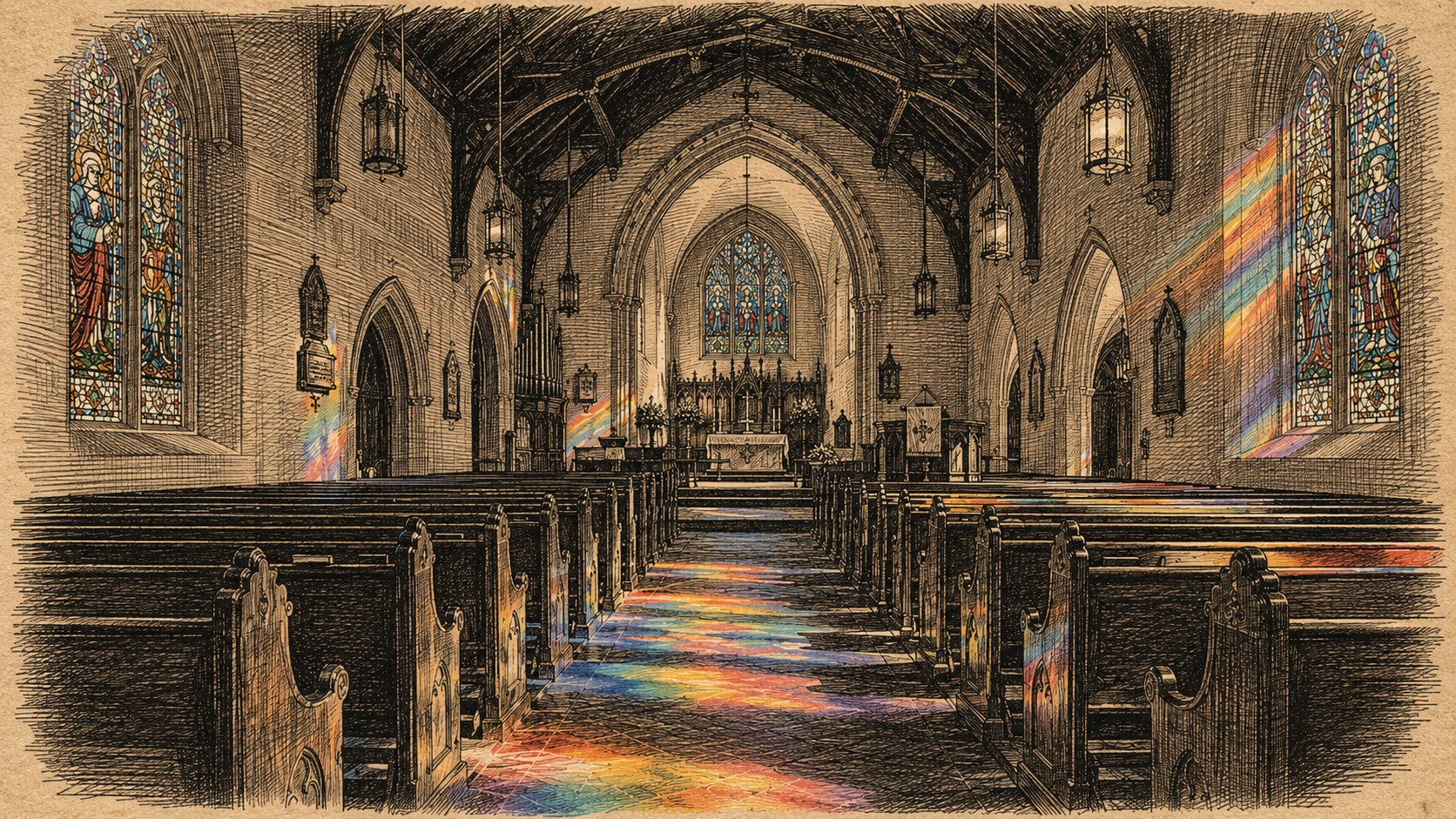
GCG-style engraved image of a Gothic church nave with stained glass windows casting rainbow light across the aisle and pews.
The argument over inclusion becomes real inside a parish, where people still kneel beside one another. Image: COGS website source imagery, photo-derived and stylized by Garden City Gossip.
I would listen to those claims. I would read the selective use of Scripture. Then I would turn back to the Gospels, and I could not make the pieces fit.
I could not square that cruelty with the words in red. Thou shalt love thy neighbour as thyself. There is none other commandment greater than these. (Mark 12:31, KJV.)5
I could not square it with the story of the Good Samaritan, which ends not with a doctrinal loophole, but with a command: Go, and do thou likewise. (Luke 10:37, KJV.)6
I could not square it with the Jesus who touched lepers, ate with tax collectors, refused to reduce women to their sexual histories, welcomed the people respectable religion wanted kept at a distance, and called the broken, despised, difficult, and outcast his brothers and sisters. Nor could I square it with the warning at the center of Matthew 25: Inasmuch as ye have done it unto one of the least of these my brethren, ye have done it unto me. (Matthew 25:40, KJV.)7
The same moral test applied to the arguments against fully integrating LGBTQ+ people into the church. I could understand that people were afraid. I could understand that people had inherited a certain way of reading Scripture. I could understand that, for some Episcopalians, Robinson’s election felt like the church had crossed a line they were not ready to cross.
But I could not understand how the church could follow Jesus by condemning people’s deepest loves, refusing to marry them, barring them from priesthood or episcopal leadership, or treating their presence as a problem to be managed rather than a gift to be received.
The Man who told us, whosoever shall smite thee on thy right cheek, turn to him the other also (Matthew 5:39, KJV), is not a man I can imagine cheering while someone calls a gay person the F-word and throws them out of church.8
The One who said, Judge not, that ye be not judged (Matthew 7:1, KJV), is not a license for moral indifference. But it is a warning against mistaking our own disgust for God’s holiness.9
And the One who told his disciples, By this shall all men know that ye are my disciples, if ye have love one to another (John 13:35, KJV), did not add an exception for the people our politics tells us to fear.10

What would happen back home?

That was Minneapolis. But Minneapolis raised a more personal question. What would happen back in Augusta?
I felt strongly that The Episcopal Church had done the right thing. I had undergone a personal change of understanding and heart that has never left me.
But I also knew enough about Augusta, the Deep South, and Good Shepherd to worry.
I did not expect this to go over well.
It was rough for The Episcopal Church across the country. Some parishes split. Some left. Conservative groups were pushing for more departures. The dispute over Gene Robinson and LGBTQ+ inclusion became one of the great fracture points in American Anglican life.
I was afraid Good Shepherd, the parish I loved, would fall into that trap. By the loving Grace of God, it did not.
Some people left angry. Some left righteously indignant. Some, as I remember it, eventually came back.
But what happened at Good Shepherd was not panic. It was pastoral leadership. The rector at the time held group listening sessions — not one performative meeting, but several. Five, maybe ten. He also met one-on-one with people who wanted to talk more. I went. My parents went. My sister went. It felt as though almost everyone went to at least one of those discussions.
What I will never forget is the tone. His emphasis was relentlessly focused on positivity, love, and inclusion. He never came right out and told people that one side was right and the other was wrong. He listened to people’s concerns. He took them seriously. He spoke from knowledge and authority about what the Bible said, and what it did not say, about the subject. He put the few passages that even obliquely reference same-sex conduct into context. He explained that the ancient world understood sex, gender, power, marriage, household structure, and human sexuality very differently than we do.
He did not pretend the Bible was irrelevant. He also did not pretend that a handful of Old Testament passages could be responsibly ripped out of history and used as weapons against people sitting in the same pews. More than anything, he kept returning to the example of Christ:
Be kind.
Be accepting.
Act as though the people you disagree about are not abstractions, but neighbors.
By the time those conversations were over, I do not believe we had a congregation full of people who were all perfectly comfortable with full LGBTQ+ inclusion. We did not suddenly become a Pride parade in seersucker and choir robes. But something important had happened.
There was no real room left to argue that LGBTQ+ people should be treated as anything less than neighbors, friends, fellow Christians, and full members of the parish family. We already had members of the LGBTQ+ community working and serving in our church. They were trusted. They were beloved. They were part of us. How could we reasonably justify treating them poorly?
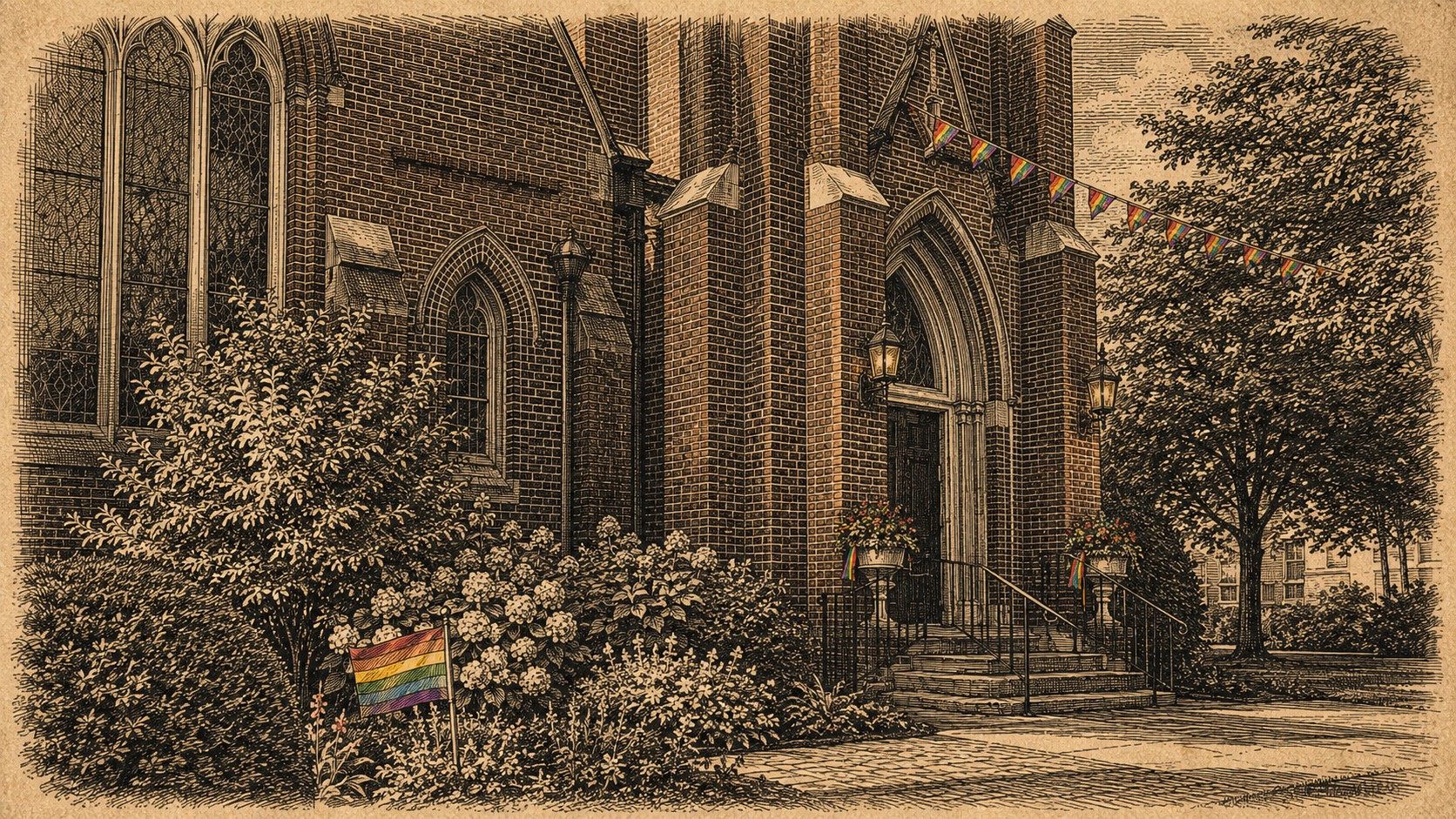
GCG-style engraved view of the Church of the Good Shepherd sanctuary with rainbow light across the aisle and stained-glass windows.
The argument over inclusion becomes real inside a parish, where people still kneel beside one another. Image: COGS website source imagery, photo-derived and stylized by Garden City Gossip.
That is what I mean when I say I am proud of my church.
Not that everyone agreed. They did not.
Not that everyone moved at the same speed. They did not.
Not that no one was hurt. They were.
I am proud because I saw a parish model something our politics has almost entirely forgotten how to do: bridge a real moral divide without humiliating people, abandoning truth, or surrendering the central commandment to love.
That is not weakness.
That is true Christian strength.

Reasonableness is not cowardice

It is also, in a very Anglican way, reasonable. Reasonableness is an underrated virtue. It is also one of the great English inheritances, embedded deeply in the common law tradition, (which in my day job as a lawyer, I learned to love and respect), and, at its best, in Anglican moral reasoning.
It does not seek perfection, nor ideological purity.
It does not pretend that Scripture, tradition, reason, and experience never come into tension.
Reasonableness.
Is this reasonable?
Is it reasonable to profess faith in Jesus Christ, read his words, and then justify being mean, exclusive, cruel, or judgmental toward the people he told us to love?
Is it reasonable to reduce a whole person to one characteristic?
Is it reasonable to build a church by deciding which neighbors are too embarrassing, too complicated, or too politically inconvenient to welcome?
I do not think it is. And I do not think the best of Anglican Christianity thinks so either.
The current Archbishop of Canterbury, Sarah Mullally — the first woman to hold that office, put the point plainly in an interview I’ve not been able to get out of my mind. The interview came after she was right after she was installed as Archbishop, and it wasn’t a softball interview 11
Mullally’s answer matters because it treats disagreement not as permission for cruelty, but as another reason the church must practice love. Source: Sky News interview with Sarah Mullally after her appointment as Archbishop of Canterbury.
Asked about women’s leadership, Mullally did not answer as though the object was to humiliate those who disagreed with her. She acknowledged theological difference within the church and spoke instead about respect, diversity, and the need for people to find a spiritual home.
Asked about LGBT people, she did not turn immediately to culture-war abstractions. She turned back to people.
That is the part worth hearing again. Not strategy. Not branding. Not institutional damage control.
Love.
That is the Anglican answer at its best: not indifference, not surrender, and not the absence of conviction. It is not evasive. It is the conviction that Christian truth cannot be separated from Christian charity, and that the world was not frozen in time during the reign of Emperor Tiberius.
The Episcopal Church’s path has been more direct than that of the Church of England. In 2012, General Convention authorized provisional rites for blessing same-sex relationships. In 2015, shortly after the Supreme Court recognized marriage equality nationwide, The Episcopal Church approved canonical and liturgical changes providing marriage equality for Episcopalians. The church eliminated language defining marriage as only between a man and a woman and authorized rites that could be used by same-sex and opposite-sex couples.12
That placed The Episcopal Church among the more progressive Christian denominations in America on LGBTQ inclusion. It also distinguished it from many of the largest U.S. religious institutions, including the Roman Catholic Church, Southern Baptists, many evangelical denominations, and others that remained opposed to same-sex marriage. Some mainline denominations have moved more recently, and some have paid a heavy institutional cost for doing so.13
So no, this has not been easy. But the fact that a thing is hard does not mean it is wrong.
The fact that love costs something does not make it optional.

Nehemiah, not Babel

That is where Pope Leo XIV’s recent framing in Magnifica Humanitas becomes useful far beyond its immediate subject of technology and artificial intelligence. Leo contrasts two ways of building: Babel and Nehemiah’s reconstruction of Jerusalem. Babel is the project of pride, uniformity, self-glorification, and power. Nehemiah’s project is the slower work of prayer, listening, shared responsibility, and rebuilding a common life one section of the wall at a time.14
That is what those Good Shepherd conversations were. Not constructing our own idols, and our tower of Babel. But building our own little Jerusalem, following in the example of Nehemiah.
The rector did not build unity by crushing dissent. He did not pretend the disagreement was imaginary. He did not humiliate people who were struggling. He did not hand the microphone to cruelty and call it courage. He convened the parish. He listened. He taught. He prayed. He kept pointing people back to Jesus.
He rebuilt relationships before rebuilding consensus.
That is the method Augusta needs far beyond church walls. It is the method we need in public life. It is the method we need across race, class, geography, party, and generation. It is the method we need when discussing poverty, housing, schools, drainage, public safety, development, and all the civic failures we inherit from people who preferred division to repair.
This has been a recurring theme in GCG’s coverage of Augusta: systems teach people how to see one another. Bad systems teach neighbors to treat each other as competitors for scraps. They turn poor white people and poor Black people, old neighborhoods and new developments, city residents and suburban commuters, into suspicious camps. They make ordinary people believe that other ordinary people are the problem.
That is the politics of Babel. Christianity is supposed to offer something different.

Pride is joy, and joy still needs defenders

That is where this Pride Month feels especially urgent.
Pride is joy, but it is not only joy.
Pride is also memory. It remembers the people who were shamed, fired, beaten, criminalized, abandoned, preached against, legislated against, and told that their deepest loves made them unworthy of family, church, or country.
That is why the public celebration matters. And that is why the retreat from Pride matters too. Across the country, some corporations that once wanted credit for supporting Pride have become quieter, more cautious, or more absent as the political climate has shifted. The Associated Press reported this month that some large corporations stopped contributing to Pride events last year and that investment firms and other companies have continued pulling back this year. The Guardian reported last year that San Francisco Pride lost major sponsorships from Comcast, Diageo, Anheuser-Busch and others. Axios reported that Pittsburgh Pride faced a $100,000 corporate sponsorship shortfall this year.15
There is something revealing about that. It is easy to support your neighbors when there is no cost. It is easy to print a rainbow logo when the market rewards it.
The test comes when support becomes inconvenient.
When even companies that sell beer appear too nervous to be publicly associated with loving their neighbors, the church had better be less afraid. That does not mean the church should become a corporation with a rainbow logo.
It means the church should remember what it is for.
The question is not whether LGBTQ people are marketable. The question is whether they are beloved.
That question cannot be outsourced to public relations departments.

It belongs to the God, and he has spoken to us through the words of his Son, Jesus Christ, and moved our hearts through the Holy Spirit.

And it belongs to Augusta.
I am proud of The Episcopal Church because it has moved, imperfectly but unmistakably, toward fuller inclusion of LGBTQ people. It has done so through votes, canons, liturgies, pastoral care, public controversy, and real institutional cost. I am proud of Good Shepherd because it showed me what that movement looks like when it is not merely a resolution in a convention hall, but a parish family deciding how to live together.
There are churches where disagreement becomes an excuse for cruelty. There are churches where unity depends on silence. There are churches where love is preached until someone asks who it includes.
Good Shepherd is not one of those churches. It has been a place where people with vastly different opinions still volunteer together, teach children, serve on committees, organize parish life, visit the sick, attend funerals, and kneel beside one another. Where every week we take a moment to shake hands with the people near us, and wish them peace. It has been a place where disagreement is disciplined by worship. It has been a place where, as far as I can imagine, someone could not stand up and make a persuasive Christian argument for being cruel to LGBTQ+ people, or anyone else.
That matters.
It matters during Pride Month because LGBTQ+ people have too often been told that faith and dignity are enemies.
They are not.
It matters because many Christians still speak as though kindness were a concession rather than a commandment.
It is not.
It matters because churches are judged not only by what they say about love, but by what kind of people they form around the altar. I am proud of my church not because it is perfect. I am proud because, when the argument came home, it did not teach me to fear my neighbors.
It taught me to love them.

Notes

1. Church of the Good Shepherd, “Our History,” https://cogsaugusta.org/about/our-history/. ↩︎

2. The Episcopal Church Archives, “Recognize the Equal Claims of Homosexuals,” Resolution 1976-A069, https://digitalarchives.episcopalarchives.org/cgi-bin/acts/acts_resolution.pl?resolution=1976-A069. ↩︎

3. Episcopal News Service, “Robinson Approved as Bishop,” Aug. 5, 2003, https://digitalarchives.episcopalarchives.org/cgi-bin/ENS/ENSpress_release.pl?pr_number=2003-208-A. ↩︎

4. The Episcopal Church Archives, “Reaffirm General Convention Statement on Childbirth and Abortion,” Resolution 1994-A054, https://digitalarchives.episcopalarchives.org/cgi-bin/acts/acts_resolution.pl?resolution=1994-A054. ↩︎

5. The Holy Bible, King James Version, Mark 12:28–31, Bible Gateway, https://www.biblegateway.com/passage/?search=Mark%2012%3A28-31&version=KJV. ↩︎

6. The Holy Bible, King James Version, Luke 10:25–37, Bible Gateway, https://www.biblegateway.com/passage/?search=Luke%2010%3A25-37&version=KJV. ↩︎

7. The Holy Bible, King James Version, Matthew 25:31–46, Bible Gateway, https://www.biblegateway.com/passage/?search=Matthew%2025%3A31-46&version=KJV. ↩︎

8. The Holy Bible, King James Version, Matthew 5:38–48, Bible Gateway, https://www.biblegateway.com/passage/?search=Matthew%205%3A38-48&version=KJV. ↩︎

9. The Holy Bible, King James Version, Matthew 7:1–5, Bible Gateway, https://www.biblegateway.com/passage/?search=Matthew%207%3A1-5&version=KJV. ↩︎

10. The Holy Bible, King James Version, John 13:34–35, Bible Gateway, https://www.biblegateway.com/passage/?search=John%2013%3A34-35&version=KJV. ↩︎

11. BBC News, “Sarah Mullally interview after appointment as Bishop of London,” YouTube, https://www.youtube.com/watch?v=dVKmd4xulDc&t=12s; Harriet Sherwood, “Sarah Mullally appointed bishop of London,” The Guardian, Dec. 18, 2017, https://www.theguardian.com/world/2017/dec/18/sarah-mullally-appointed-bishop-of-london-church-of-england; Anglican Communion Office, “The Archbishop of Canterbury,” https://www.anglicancommunion.org/the-archbishop-of-canterbury/. ↩︎

12. Sharon Sheridan, “Liturgy for blessing same-sex relationships begins provisional use,” Episcopal News Service, Dec. 3, 2012, https://episcopalnewsservice.org/2012/12/03/liturgy-for-blessing-same-gender-relationships-begins-provisional-use/; Sharon Sheridan, “General Convention approves marriage equality,” Episcopal News Service, July 1, 2015, https://episcopalnewsservice.org/2015/07/01/general-convention-approves-marriage-equality/. ↩︎

13. David Masci and Michael Lipka, “Where Christian churches, other religions stand on gay marriage,” Pew Research Center, Dec. 21, 2015, https://www.pewresearch.org/short-reads/2015/12/21/where-christian-churches-stand-on-gay-marriage/. ↩︎

14. Pope Leo XIV, Magnifica Humanitas, May 15, 2026, https://www.vatican.va/content/leo-xiv/en/encyclicals/documents/20260515-magnifica-humanitas.html. ↩︎

15. Geoff Mulvihill, “Pride Month 2026 has begun. Here’s what to expect for the LGBTQ+ celebrations,” Associated Press, June 2026, https://apnews.com/article/when-pride-month-june-2026-lgbtq-2f30b424c65704e14d3518b373ddf3f7; Dani Anguiano, “Sponsors drop San Francisco Pride as festival decries ‘rights backtracking,’” The Guardian, Mar. 18, 2025, https://www.theguardian.com/us-news/2025/mar/18/anheuser-busch-coors-pull-sponsorship-san-francisco-pride; Chrissy Suttles, “Pittsburgh Pride adapts as corporate sponsors shrink,” Axios Pittsburgh, June 3, 2026, https://www.axios.com/local/pittsburgh/2026/06/03/pittsburgh-pride-sponsorship-shortfall-weekend-events. ↩︎